


Your golden retriever starts pacing before sunrise. You hear the familiar scratch of a hind leg, then the licking begins. By breakfast, the paws are damp with saliva, one ear is red, and you're wondering whether the problem is the food, the shampoo, the grass, or something else entirely.
That uncertainty is understandable. Golden retriever allergy isn't one condition with one universal fix. Environmental allergens, food reactions, flea allergy, skin infections, and overlapping triggers can produce similar signs, but they need different strategies. The most useful first question isn't “Which product should I try?” It's “What type of allergy is driving this dog's itch?”
Table of Contents
- Why Golden Retrievers Itch More Than Most Dogs
- How Atopic Dermatitis Works in Golden Retrievers
- Three Allergy Types Owners Confuse the Most
- Reading the Signs From Face to Tail
- The Veterinary Workup From Exam to Allergy Test
- Treatment Options Worth Discussing With Your Vet
- Home Care That Actually Reduces Flare-Ups
- When to Call the Vet and What Good Management Looks Like
Why Golden Retrievers Itch More Than Most Dogs
A golden retriever's beautiful coat can hide the early stages of a skin problem. Underneath the feathering and dense fur, the dog may have a weakened skin barrier, mild redness, or small areas of irritation that become obvious only after persistent scratching. The breed is predisposed to atopic dermatitis, a chronic allergic skin disease, rather than being “sensitive” in a vague sense.
One veterinary dataset covering 4,111 dogs reported atopic dermatitis in 19% of all studied dogs, with golden retrievers accounting for 218 atopic dermatitis diagnoses within the breed-specific cases. The same dataset reported food allergies in 9% of all dogs, including 103 golden retrievers. These figures don't mean every itchy golden has a food allergy. They do show that allergic skin disease is a well-documented breed concern, not an unusual explanation, as described in this overview of golden retriever food and skin allergies.
Genetics sets the stage
Research had already identified an inherited component in golden and Labrador retrievers by the early 2000s. A 2004 study examined the heritability of atopic dermatitis in these breeds, while veterinary guidance has commonly described atopic dermatitis as affecting around 10% of dogs overall. Golden retrievers are repeatedly recognized as a predisposed breed in that broader context, according to this background on golden retriever skin and coat problems.
A litter-based study estimated heritability at 0.47 ± 0.17 under its study conditions. In practical terms, inherited biology may account for a substantial part of risk, but it doesn't identify the trigger affecting your individual dog.
Coat and lifestyle add exposure
Golden retrievers spend plenty of time outdoors, often running through grass, swimming, rolling on surfaces, and carrying pollen or dust into the home. Their dense double coat can hold environmental material close to the skin, while damp fur and floppy ears create conditions in which irritation and microbial overgrowth can become harder to control.
Their immune response may also lean toward an IgE-mediated reaction. Serology research found golden retrievers were more likely than Labrador retrievers to exceed thresholds for total and allergen-specific IgE, with a total IgE odds ratio of 1.87, and a 95% confidence interval of 1.26 to 2.87. The findings support an immune tendency toward stronger allergic responses, as reported in the published serology study.
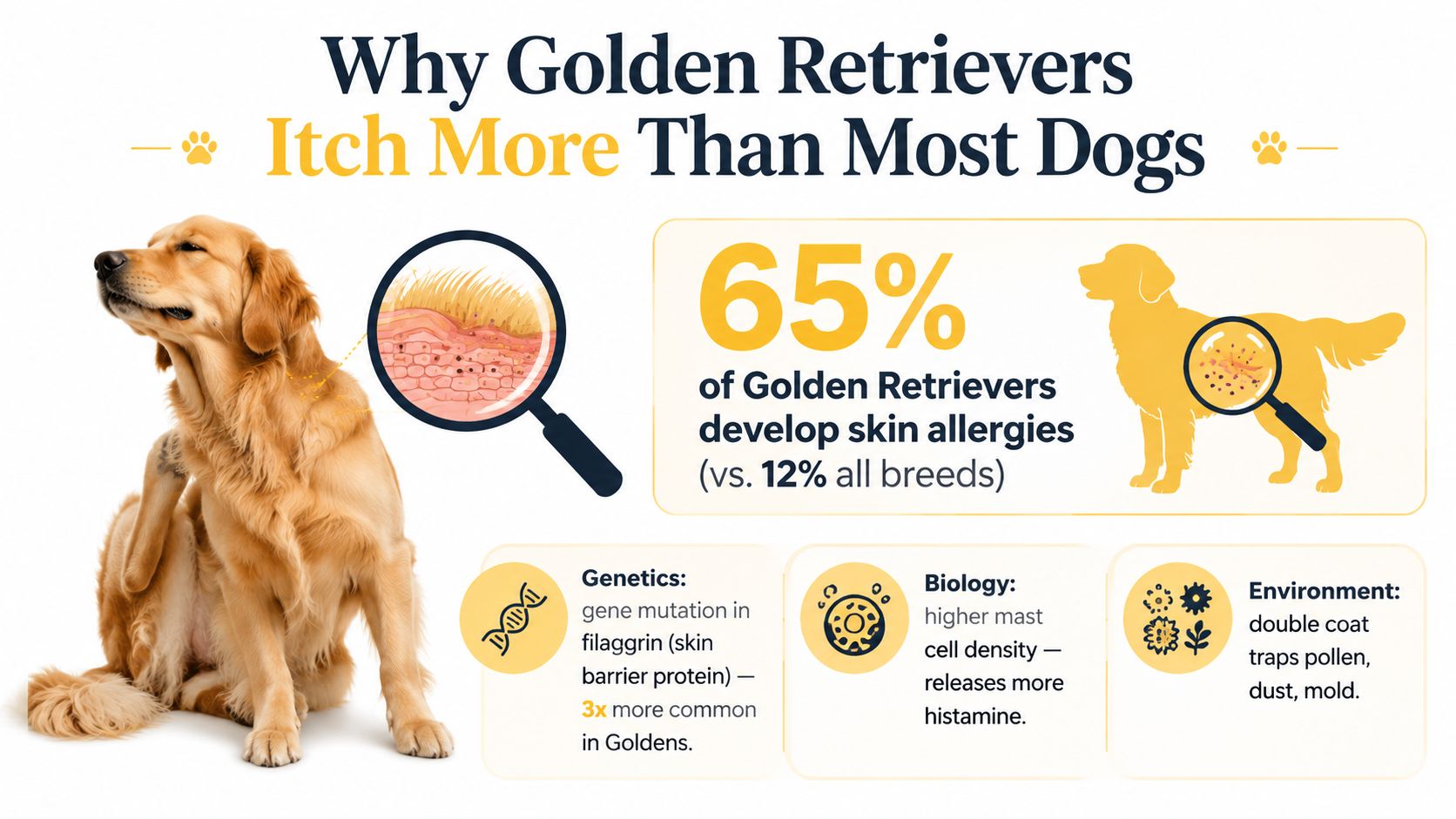
Practical rule: Breed predisposition explains why your dog may be vulnerable. It doesn't prove whether pollen, food, fleas, or infection is causing today's flare.
If you're still unsure whether the scratching is ordinary grooming or a medical sign, use this practical guide to why your dog may be scratching so much. The next step is understanding what happens inside the skin when an allergic response begins.
How Atopic Dermatitis Works in Golden Retrievers
Atopic dermatitis is a chronic inflammatory skin disease linked to hypersensitivity to environmental allergens. Common triggers include pollen, dust mites, and mold spores. A dog doesn't need to swallow these substances to react. Contact with the environment can be enough when the skin barrier and immune response make the dog unusually reactive.
The itch cycle in four steps
- An allergen meets the skin. Pollen, dust-mite material, or mold spores land on the coat and skin.
- The barrier lets more material through. A compromised outer layer offers less protection, so irritants can interact with deeper immune structures.
- Immune cells activate. Cells involved in allergic inflammation respond to the perceived threat.
- Itch signals intensify. The dog scratches, licks, rubs, or chews, causing further barrier damage.
That cycle explains why a small area can turn into a large sore. Scratching creates microscopic breaks, licking keeps the area wet, and bacteria or yeast can multiply in the damaged tissue. The resulting infection adds more redness, odor, discharge, and discomfort, so treating itch alone may not resolve the problem.
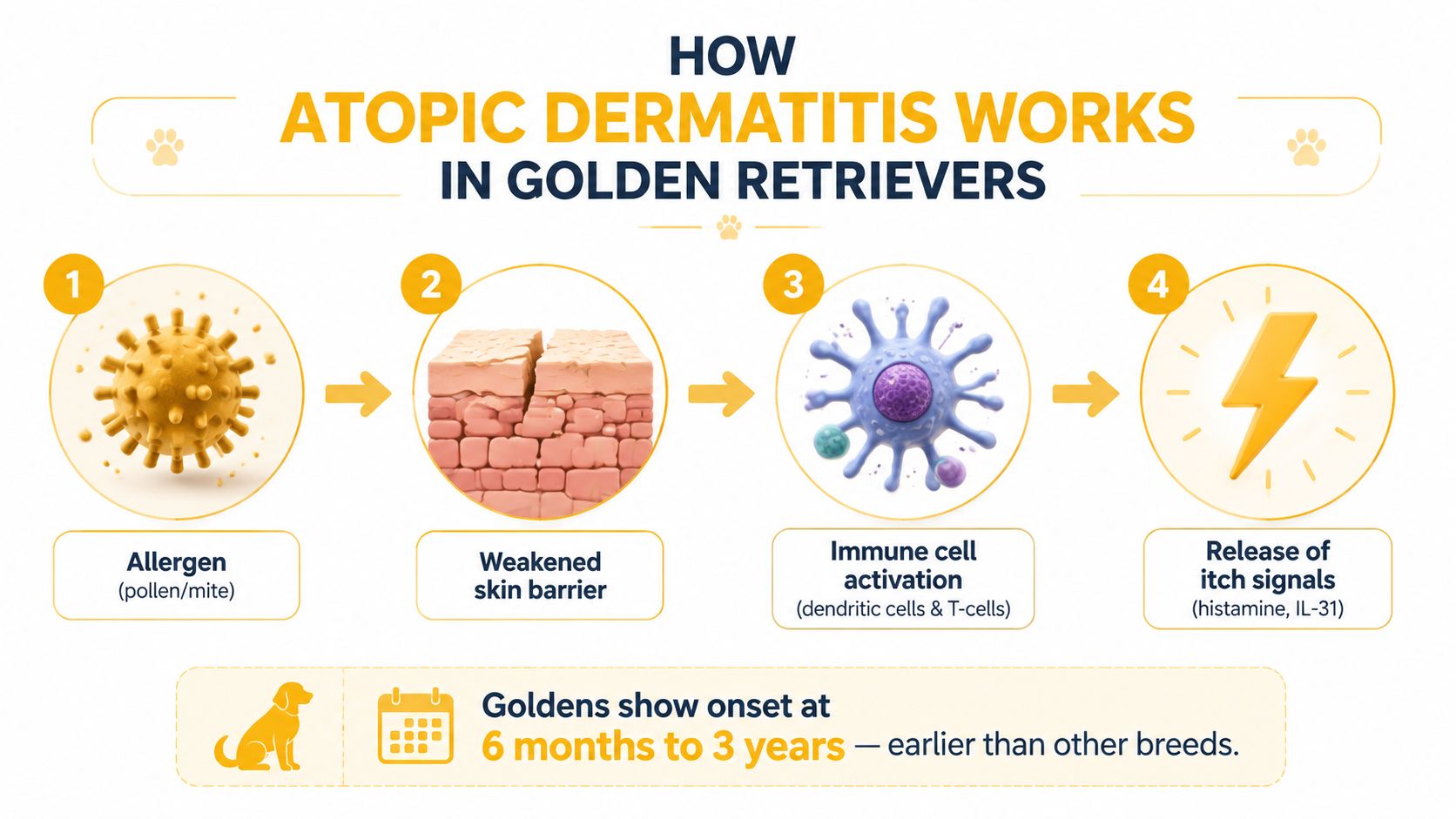
Breed-level studies have placed golden retriever atopic dermatitis prevalence between 10% and 30%, depending on the study and region. Another study reported an odds ratio of 2.1 compared with mixed-breed dogs. The important meaning isn't that a golden retriever is destined to develop disease. It's that recurring itch deserves a structured workup instead of repeated product changes, as explained in this guide to environmental allergies and atopic dermatitis in golden retrievers.
Why symptoms keep returning
Environmental exposure can change with weather, location, indoor conditions, and outdoor activity. A dog may look comfortable for a period, then develop paw chewing, ear irritation, or hot spots after exposure rises. Some dogs show signs throughout the year because indoor allergens, skin-barrier problems, parasites, or secondary infections remain present.
Supportive nutrition can have a place in a broader plan, but it isn't a substitute for identifying the cause. For example, DA-1™ Daily All-in-One - Senior Dog Support, Joints, Skin/Coat & More is described as a powdered formula with 18 human-grade ingredients intended to support aging dogs across cells, gut, and joints. Discuss any supplement with your veterinarian, especially if your dog is receiving prescription treatment or undergoing a diet trial.
This short video provides another visual explanation of the allergy process:
Three Allergy Types Owners Confuse the Most
The same dog may chew its paws because of pollen, react to an ingredient in food, or respond to a flea bite. Appearance alone rarely identifies the cause. Use the comparison below as a starting point, not a diagnosis.
Comparing the Three Allergy Types in Golden Retrievers
| Trigger Source | Common Itch Locations | Seasonality | Age of Onset | Distinguishing Clue |
|---|---|---|---|---|
| Environmental allergy, such as pollen, dust mites, or mold | Paws, face, ears, belly, and skin folds | May worsen during particular exposure periods, or continue year-round | Can appear early in life, though timing varies | Paw chewing, recurrent ear problems, and a pattern linked to outdoor or indoor exposure |
| Food allergy | Ears, paws, face, belly, and sometimes generalized skin | Usually year-round because the food is fed repeatedly | May begin at different ages | Persistent itch or ear disease that doesn't follow a clear seasonal pattern and requires a controlled elimination trial for confirmation |
| Flea allergy | Tail base, hindquarters, rump, and back legs | Depends on flea exposure and local conditions | Can occur whenever exposure happens | Intense irritation around the rear of the body, sometimes with very little visible flea evidence |
Why the clues overlap
A golden retriever with environmental atopy may also develop a bacterial or yeast infection in the ears. That infection can make the dog shake its head even after the original trigger becomes less active. Similarly, a flea allergy can complicate a food trial because one bite may keep the dog itchy while the owner is evaluating a new diet.
Food deserves careful handling. A food change made for a few days doesn't confirm or exclude food allergy, and repeated casual switching can make the history harder to interpret. A veterinarian may recommend a strict elimination trial with a novel or hydrolyzed protein diet, while ensuring that treats, flavored medications, table scraps, and supplements don't undermine the trial.
The useful question isn't “Which allergy does this breed have?” It's “Which trigger pattern fits this dog, and what must be ruled out first?”
Steroids or other anti-itch treatments may reduce signs from several allergy types, which can make the cause seem obvious when it isn't. Relief tells you the itch pathway was interrupted. It doesn't necessarily tell you what started the pathway.
Reading the Signs From Face to Tail
Start with a nose-to-tail check once or twice a week, using the same order each time. Consistent observation helps you notice small changes before scratching becomes constant.
Face and ears
Mild signs include occasional muzzle rubbing, mildly red eyes, or brief ear scratching. Moderate signs include repeated head shaking, ear odor, discharge, chin irritation, or rubbing the face on furniture. These patterns matter because allergic inflammation commonly affects the ears and face, and infection can develop secondarily.
Urgent facial changes are different. Facial swelling, widespread hives, vomiting, breathing difficulty, sudden weakness, or collapse require emergency care, not a routine appointment. Those signs can indicate a serious systemic allergic reaction.
Neck, chest, and belly
Look for small red bumps, hair thinning, damp patches, scabs, or hot spots. A dog that keeps returning to one location may have created a self-trauma cycle, even if the original irritation was minor. Moderate signs include repeated licking that interrupts rest, open skin, spreading redness, or a noticeable odor.
Paws and limbs
Paw chewing between the toes, licking the tops of the feet, nail biting, and rust-colored saliva staining suggest repeated contact or inflammation. Mild staining alone isn't an emergency, but persistent chewing can damage the skin and invite infection. Check between the toes and around the nail beds without forcing the paw open if it's painful.
Tail base and hindquarters
Flea allergy often produces marked irritation around the tail base and rear limbs, though other allergies can affect the same region. Scooting, licking under the tail, or perianal redness may also point to anal-gland or gastrointestinal concerns rather than allergy alone.
Arrange a veterinary examination if itch continues for more than a few weeks, keeps returning, or changes your dog's sleep and behavior. Early evaluation can prevent a manageable irritation from becoming a painful skin and ear problem.
The Veterinary Workup From Exam to Allergy Test
A good allergy workup usually proceeds in stages. The veterinarian starts with the pattern, not the test result.
History and physical examination
Expect questions about when the itch began, whether it changes with seasons, where your dog spends time, what it eats, which treats it receives, and how consistently parasite prevention is used. The examination maps redness, hair loss, odor, ear changes, paw lesions, and hot spots across the body.
This history helps the clinician distinguish exposure patterns from reactions that remain constant. Bring food labels, medication details, grooming products, and a short log of scratching, licking, ear shaking, and flare dates.
Rule out infection and parasites first
Skin scrapings can help investigate mites. Cytology examines material from the skin or ears for bacterial or yeast overgrowth. A flea comb and a review of flea control remain important even when you haven't seen a flea, because allergic dogs may react strongly to limited exposure.
| Diagnostic Step | What It Rules Out | Typical Duration | Outcome Meaning |
|---|---|---|---|
| Physical exam and detailed history | Pattern mismatches, obvious skin and ear disease, gaps in parasite control | One appointment, with monitoring afterward | Establishes the working problem list |
| Skin scraping and cytology | Mites and microbial overgrowth | Usually completed as part of the clinic visit | Identifies conditions that need direct treatment |
| Controlled elimination diet | Food allergy as a contributing trigger | A strict veterinary-directed trial lasting several weeks | Improvement supports a food-related component, followed by careful confirmation |
| Intradermal or serum IgE testing | Helps identify relevant environmental sensitivities | Scheduled testing and interpretation | May guide avoidance and allergen-specific immunotherapy |
Diet trials and allergy testing
A diet trial must be strict. The selected novel or hydrolyzed diet needs to replace the regular food, treats, chews, and flavored extras for the full period advised by the veterinarian. If signs improve, the clinician may recommend reintroducing the original diet to assess whether symptoms return.
Allergy tests are not standalone cures. Intradermal testing by a veterinary dermatologist is commonly treated as the reference method for identifying environmental sensitivities, while serum IgE testing may serve as an alternative. Results are most useful when they support an avoidance plan or immunotherapy, not when they replace the clinical history and examination.
Treatment Options Worth Discussing With Your Vet
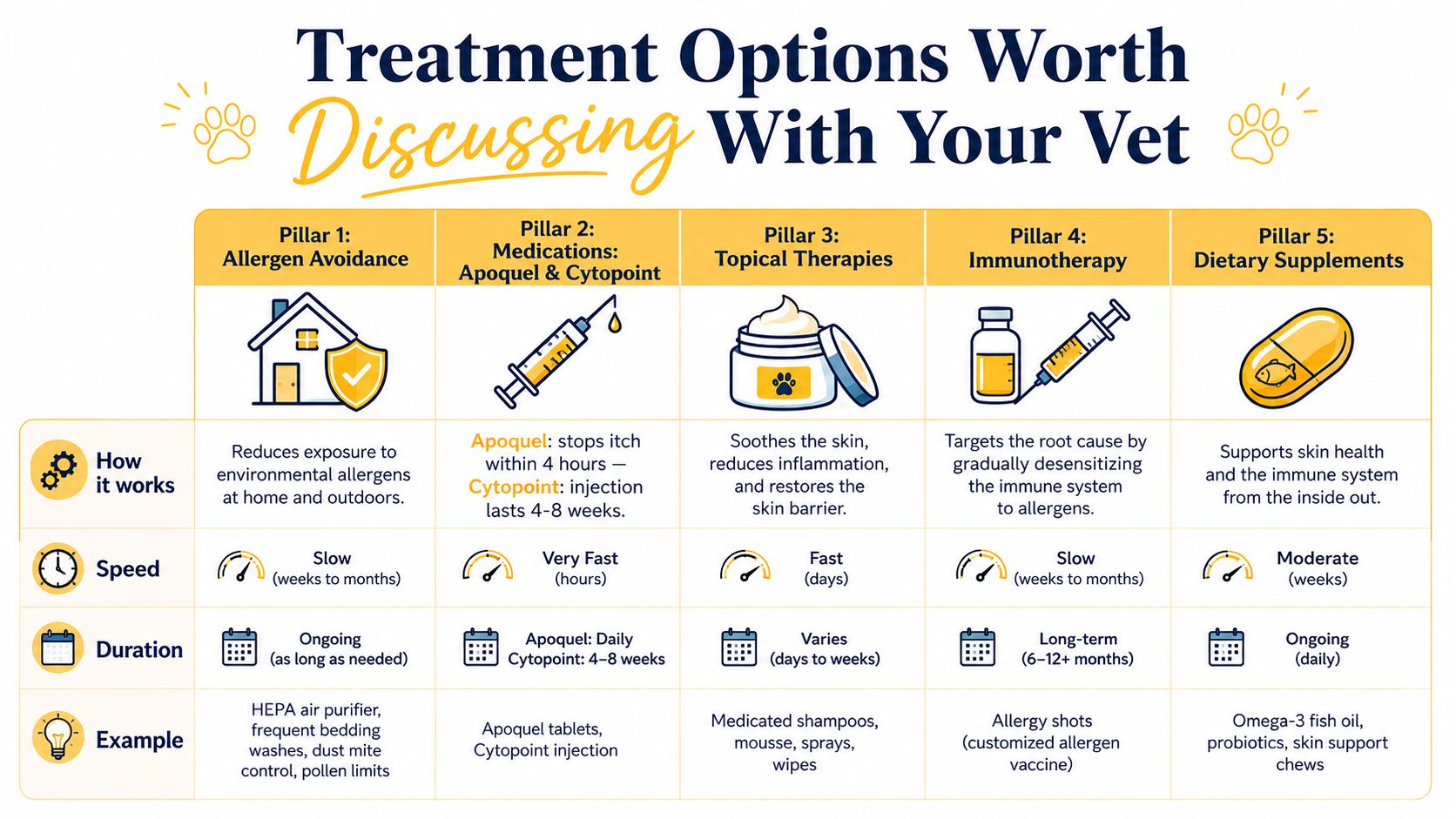
Treatment works best as a layered plan. The right combination depends on the trigger, the presence of infection, the dog's comfort, and whether flares are occasional or persistent.
Medication for itch and inflammation
For significant itch, veterinarians may discuss prescription options such as Apoquel or Cytopoint. These target itch through different mechanisms and may be useful when environmental exposure cannot be eliminated completely. Traditional antihistamines may suit some mild cases, but they don't control every allergic dog effectively.
Short steroid courses can help during selected acute flares, but the veterinarian must weigh them against the dog's health history and the need for repeated use. Never reuse an old prescription without checking first, because a current flare may involve infection or a different trigger.
Reduce exposure where possible
Paw wiping, coat rinsing, bedding care, indoor air management, and consistent flea control can lower the allergen burden. Avoidance won't remove every trigger, but it can reduce the amount of work required from medication and the immune system.
Use diet strategically
Diet changes are most useful when food allergy is suspected and evaluated through a controlled elimination trial. A random switch may add confusion rather than clarity. Omega-3 fatty acids may support skin-barrier care as part of a veterinarian-approved plan, but supplements don't replace parasite control, infection treatment, or a confirmed diagnosis.
Treat the skin directly
Medicated shampoos, mousses, wipes, and leave-in conditioners can help remove allergens, reduce microbial overgrowth, and soothe irritated skin. The product and schedule should match the skin findings. Over-bathing with harsh or heavily fragranced products can worsen dryness.
Consider immunotherapy for environmental allergy
When testing and history point to environmental atopy, allergen-specific immunotherapy may help the immune system respond less intensely over time. It requires patience and veterinary supervision, but it addresses the underlying sensitivity rather than only suppressing individual itch episodes.
For a plain-language review of supportive options, see this guide to dog allergy supplements. Treat supplements as one part of care, and ask your veterinarian about interactions, dosing, and whether they fit your dog's diet.
Home Care That Actually Reduces Flare-Ups
Home care should remove residue without stripping the skin. After walks, rinse or wipe the paws and belly, especially when your dog has walked through grass or dusty areas. Dry the coat thoroughly, paying attention to the feet and under the chest.
Use a regular brushing routine with a soft brush suited to a double coat. Brushing lifts loose hair and surface debris before it settles close to the skin, while also giving you a chance to spot redness, damp patches, scabs, or new hair loss.
Build a low-irritant routine
- Wash bedding regularly: Use fragrance-free detergent and rinse thoroughly so residue doesn't remain against the skin.
- Improve indoor air: A HEPA filter in the main sleeping or living area may help reduce airborne particles.
- Control damp rooms: A dehumidifier can make humid spaces less favorable for mold and dust mites.
- Keep grooming gentle: Ask your veterinarian whether colloidal oatmeal, chlorhexidine, ceramide, or omega-fatty-acid products are suitable.
- Protect the paws: A veterinary-approved paw balm may help after outdoor exposure, but don't apply it over infected or open skin without advice.
Omega-3 supplementation may support skin and coat quality, but the dose should come from your veterinarian because products differ in concentration and purity. Coat changes take time, so judge the plan by comfort, redness, lesion healing, and fewer flare-ups rather than expecting an immediate visual transformation.
Common mistakes include bathing too often, changing foods repeatedly without a genuine elimination trial, and applying human cortisone creams without veterinary guidance. Human products can be unsafe when licked, and they may mask an infection that needs different treatment.
If pests may be contributing, use a veterinarian-approved control plan for every pet in the household. Owners in South Florida can also review these Miami eco pest tips from Pestless Inc. for ways to think about household pest management around pets.
For additional practical ideas, read these dog itchy skin remedies, then choose only the steps that fit your veterinarian's diagnosis.
When to Call the Vet and What Good Management Looks Like
Use a simple escalation plan:
- Within 24 hours: Seek emergency care for facial swelling, hives, vomiting, breathing trouble, sudden weakness, or collapse.
- Within a few days: Arrange an appointment for hot spots, open sores, persistent ear shaking, strong odor, or itching that interrupts sleep.
- Within one to two weeks: Contact your veterinarian if scratching hasn't improved after sensible grooming and exposure changes.
Good long-term control means your dog can rest comfortably, keep the skin intact, avoid recurring ear infections, and follow a stable diet and maintenance plan. The lowest effective medication approach may be combined with seasonal strategies, topical care, parasite prevention, or immunotherapy when appropriate.
A confirmed diagnosis turns golden retriever allergy care from guesswork into a routine. Most dogs with allergic skin disease can remain comfortable when owners track patterns, treat infections promptly, and adjust the plan with veterinary guidance.
Pure Paw Labs offers daily dietary supplements designed to support areas such as skin and coat, gut health, immunity, joints, and stress-related needs in dogs. Visit Pure Paw Labs to review the available formula information and decide, with your veterinarian, whether this type of nutritional support fits your golden retriever's overall allergy-care plan.