


Your dog's paw licking has turned into full-on scratching, the ears look red again, and the shampoo only helped for a day or two. You've probably already changed food, wiped paws after walks, and wondered whether a dog allergy supplement could finally make the difference. That's a common place to be, because itching usually isn't a simple one-step problem, it's a sign that several systems are under stress at once.
The smartest way to think about allergy support is to separate quick comfort from longer-term support. A supplement can't erase allergens from the environment, but it can help support the skin barrier, gut balance, and immune regulation that influence how strongly a dog reacts. That's why the label matters, the dose matters, and the timeline matters even more.
Table of Contents
- Why Your Dog Keeps Scratching and What Supplements Can Do
- The Gut-Skin-Immune Connection Behind Dog Allergies
- Key Ingredients to Look for in a Dog Allergy Supplement
- Single-Ingredient Supplements Versus All-in-One Formulas
- How Long Until You See Results and How to Track Progress
- How to Choose a High-Quality Dog Allergy Supplement
- Putting It All Together and When to Consult Your Vet
Why Your Dog Keeps Scratching and What Supplements Can Do
A lot of owners notice the same pattern. The dog starts licking paws, then scratching the ears, then the coat looks dull or flaky, and suddenly every bath, wipe-down, and diet tweak feels like a temporary fix. That's because allergy signs usually show up on the skin, but the problem behind them can involve more than the skin alone.

A dog allergy supplement fits into the picture when you want to support the systems that keep the skin resilient. That usually means helping the body maintain a stronger barrier, calmer inflammatory signaling, and steadier digestive support. It's not the same as “treating the allergy” itself, and that distinction matters.
What a supplement can realistically do
A supplement can be useful when your dog's symptoms are mild to moderate, recurring, and tied to everyday triggers like pollen, grass, or dusty indoor environments. It can also make sense if your dog is already receiving veterinary care and you want to add support without creating a complicated routine. In that sense, the supplement is a support tool, not a standalone fix.
Practical rule: if your dog is uncomfortable enough that the skin is raw, infected, or rapidly worsening, a supplement shouldn't be your only next step.
The other reason supplements get used is simple, owners want something they can give consistently. Real-life use data show that dogs often receive supplements before or alongside veterinary treatment for itchy-dog problems, which tells you demand is already there. The challenge is choosing something that's formulated with the right ingredients and doses, not just a label that sounds reassuring.
The Gut-Skin-Immune Connection Behind Dog Allergies
Think of your dog's allergy response like a fortress with three walls. One wall is the gut barrier, another is the skin barrier, and the third is immune regulation. When one wall weakens, the others usually have to work harder, and that's when itching, redness, and recurring flare-ups become harder to ignore.
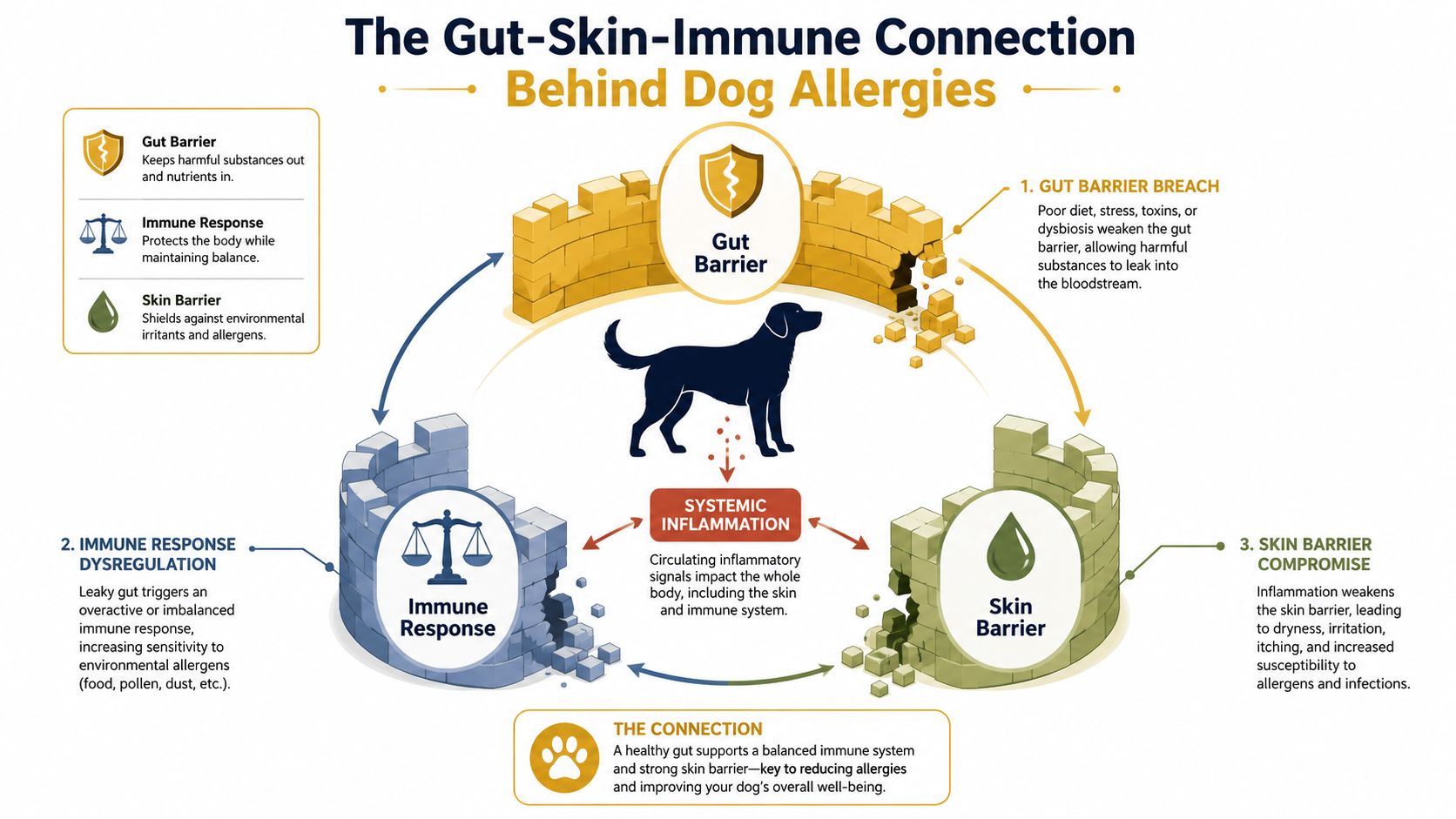
The gut-skin-immune idea is useful because it explains why allergy care often needs more than one ingredient. If the gut environment is unsettled, inflammatory signals can become less balanced. If the skin barrier is dry or fragile, outside irritants can get in more easily. If immune regulation is off, the body may overreact to things that shouldn't trigger such a strong response.
How the three systems work together
The gut contains microbes that help shape how the body responds to the world. When that internal balance is steadier, the dog often has a better chance of maintaining normal inflammatory signaling. That doesn't mean probiotics are magic, it means the gut is one of the places where support can matter.
The skin barrier is the visible one, so owners usually notice it first. Dryness, itch, and flaky coat often show up before anyone thinks about digestion. But the skin is only part of the story, because the immune system decides how aggressively the body reacts to allergens in the first place.
Why multi-system support makes sense
A product that supports more than one system can be more practical than a narrow approach, especially when a dog has several small problems at once. That's why some formulas combine ingredients aimed at the gut, immune system, and skin in a single scoop. Pure Paw Labs' DA-1™ Daily All-in-One - Senior Dog Support, Joints, Skin/Coat & More is described as a multi-system formula with 18 human-grade ingredients targeting cells, gut, and joints, plus a 60-day money-back guarantee.
If you want a deeper primer on digestive support, the brand's dog gut health guide is a useful companion read. The main takeaway is simple, a dog with allergy signs often needs support that reaches beyond the skin alone.
Key Ingredients to Look for in a Dog Allergy Supplement
A dog allergy label is easier to judge when you slow it down and read it in two passes. First, ask what each ingredient is meant to do. Then ask whether the label gives enough detail to show that the amount is meaningful, because a long ingredient list can still hide a weak formula.
Commercial formulas often combine immune-modulating lipids with probiotics/postbiotics instead of depending on one ingredient alone. One sensitive-care formula lists 511 mg yeast culture, 119 mg gamma-linolenic acid (GLA), and marine omega-3s, including 12 mg EPA and 8 mg DHA per chew, which shows how mixed the category can be. Another dog allergy chew provides 100 million CFU of a proprietary probiotic blend with colostrum 125 mg, salmon oil 100 mg, zinc 5 mg, and selenium 200 mcg per serving, which is why exact counts and per-ingredient masses matter. For readers who want more context on fish-based omega-3s, see a guide to fish oil for dogs.
Dog Allergy Supplement Ingredient Benchmarks
| Ingredient Category | Primary Mechanism | Effective Dose Range | What to Look For on Labels |
|---|---|---|---|
| Omega-3 fatty acids | Support inflammatory balance and skin comfort | No precise universal dose can be given from the verified data, so check the actual EPA and DHA amounts | Clear EPA and DHA milligram amounts, not just “fish oil” |
| Gamma-linolenic acid | Supports skin barrier function | No precise universal dose can be given from the verified data | The exact GLA amount per chew or scoop |
| Probiotics | Support gut microbiome balance | No precise universal dose can be given from the verified data | CFU count, strain names, and whether the count is guaranteed |
| Colostrum | Immune support | No precise universal dose can be given from the verified data | The per-serving milligram amount |
| Yeast-derived fractions | Immune support | No precise universal dose can be given from the verified data | The exact yeast culture or yeast fraction amount |
| Minerals like zinc and selenium | Support skin, coat, and immune function | No precise universal dose can be given from the verified data | Exact milligrams or micrograms per serving |
A label can sound reassuring without telling you much about the formula itself. A chew may mention probiotic support, omega-3s, or immune health, but if the dose is buried inside a proprietary blend, you cannot tell whether the product is doing real work or just using attractive wording.
Read the milligrams, not the mood words. “Immune support” sounds nice, but the actual amount of each ingredient is what tells you whether a product is built for biology or branding.
The most useful ingredients are usually the ones with a visible dose and a clear job. Omega-3s support inflammatory balance, GLA supports skin barrier function, probiotics support the gut, and colostrum or yeast fractions can add immune support. The label should let you verify those pieces in plain numbers, because that is how you judge whether a supplement is likely to support the gut-skin-immune axis over time.
Single-Ingredient Supplements Versus All-in-One Formulas
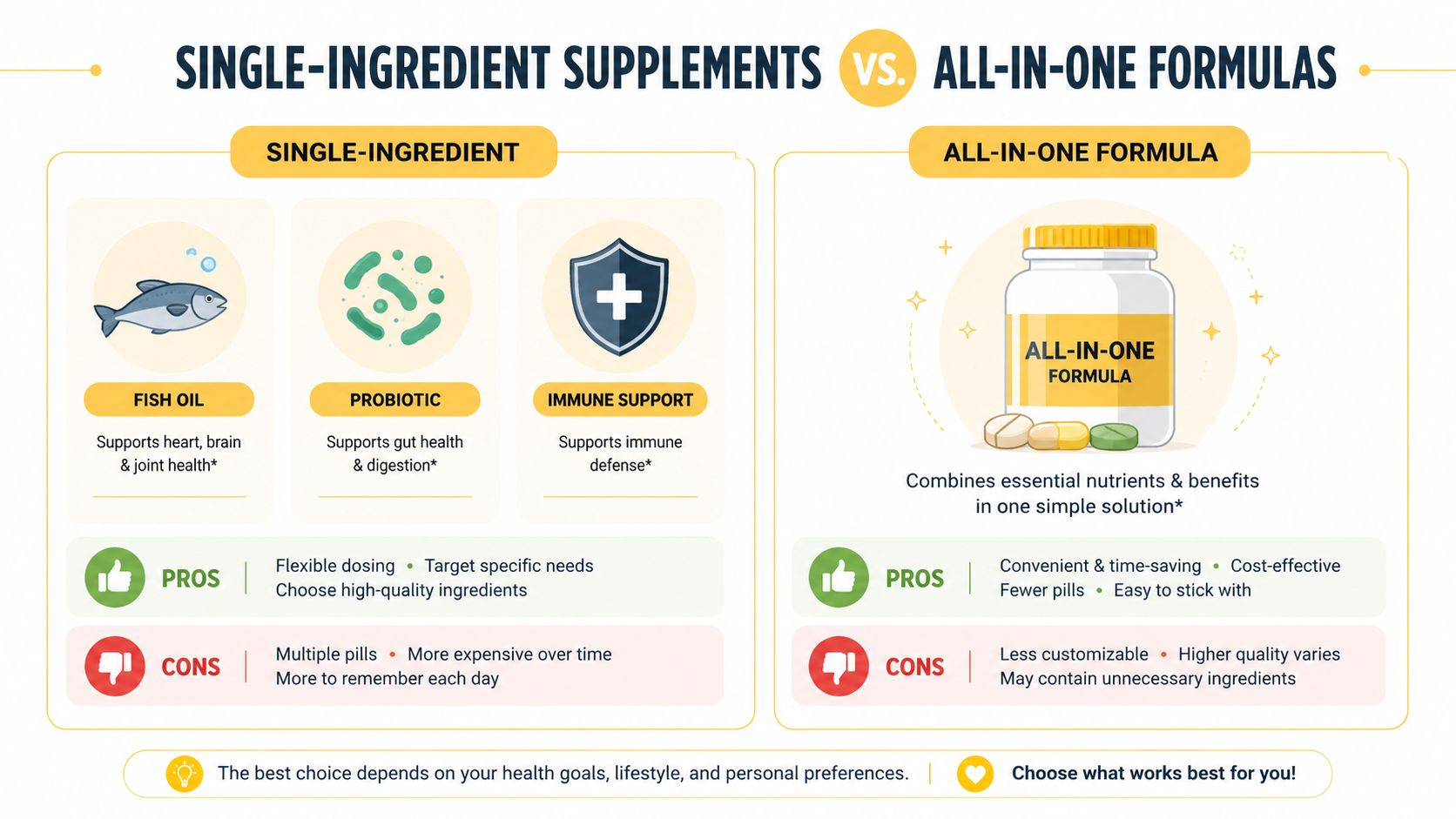
A single-ingredient product can be the right answer when you know exactly what you're targeting. If a veterinarian wants a high-dose omega-3 intervention, for example, a dedicated fish oil makes it easier to see what your dog is really getting. It also gives you tighter control if your dog reacts to a specific component or has a very narrow need.
But most families don't live in a label-reading lab. They're trying to remember a probiotic in the morning, oil at dinner, and a separate immune chew on days that already feel busy. That's where multi-product routines break down, because missed doses and inconsistent timing make it hard to judge whether anything is helping.
The trade-off is control versus simplicity
Single-ingredient products give you flexibility. You can increase or reduce one piece without changing the rest of the routine. That's useful when a vet has already identified a very specific gap, or when you're testing what changes the itch pattern.
All-in-one formulas reduce the mental load. One scoop at mealtime is easier to remember than three separate products, and that can improve consistency. For many owners, consistency matters more than theoretical customization, because the best formula in the world doesn't help if it sits untouched in the cupboard.
When each approach makes sense
- Choose single-ingredient support if your vet wants a targeted intervention, especially when one system clearly needs extra help.
- Choose an all-in-one formula if your goal is to support multiple pathways at once and keep the routine simple.
- Choose neither until you get a vet exam if the itching is severe, the skin looks infected, or the symptoms changed suddenly.
The best choice depends on the dog and the household. A family that can track several products carefully may do fine with a layered routine. A busy household usually does better with a clean, repeatable daily scoop that covers more than one system at once.
How Long Until You See Results and How to Track Progress
The biggest mistake owners make is judging a supplement too early, or waiting too long without tracking anything at all. A useful frame is to treat the first few weeks like an observation period, not a verdict. Probiotic effects may take about 4 to 8 weeks, omega-3s about 6 to 12 weeks, and allergy-related immune changes often need 6 to 12 weeks to assess properly, according to the neutral guidance in the brief.
What to measure before you start
Begin with a short baseline note. Write down how often your dog scratches, how often they lick paws, what the stool looks like, whether the coat seems dull or shiny, and whether they seem stiff or restless after sleep. Keep those notes simple enough that you'll repeat them.
A practical way to do it is with a quick score from 1 to 5 for each area. You don't need a perfect system, you need a repeatable one. If your dog scratches less often but the stool gets looser, that's useful information too, because it tells you the formula is affecting more than one pathway.
Use checkpoints instead of guessing
Track again every 2 to 4 weeks. That rhythm is slow enough to catch real change and fast enough to stop wasting time on something that clearly isn't helping. This is the point where owners usually decide whether to continue, adjust, or call the vet.
Simple rule: if you haven't measured the starting point, you can't tell whether the supplement is helping or the flare-up just happened to calm down on its own.
The other piece people forget is that supplements don't cure allergies. They're part of a broader plan that still includes allergen avoidance, good nutrition, and veterinary care when the signs are more than mild. If you want a companion resource on skin support and comfort measures, the brand's dog itchy skin remedies guide can help you think through the day-to-day side of care without treating every flare as an emergency.
How to Choose a High-Quality Dog Allergy Supplement
A good label should make your decision easier, not harder. If you can't tell what's inside, how much is inside, or whether the product was tested, you're being asked to trust a promise instead of a formula. That's a bad trade for a dog that already has itchy skin and a sensitive gut.
Start with transparency
Look for exact ingredient amounts, not vague blends. The verified data show why this matters, because veterinary probiotic products have been found to miss label claims, and many labels contained spelling errors. If a brand can't present clear numbers and clean labeling, it's fair to question the rest of its quality control.
Also check whether the probiotic portion gives a CFU count and strain identification. Without those details, you can't tell whether the product is just wearing the language of gut support. The same logic applies to omega-3s, because “fish oil” doesn't tell you how much EPA or DHA is in the chew.
Then look at manufacturing and testing
Human-grade ingredients, third-party testing, and manufacturing in a registered facility all signal a more serious quality process. Those details don't guarantee success, but they reduce the odds that you're buying something inconsistent from batch to batch. For dogs with ongoing skin issues, that consistency matters as much as the ingredient list.
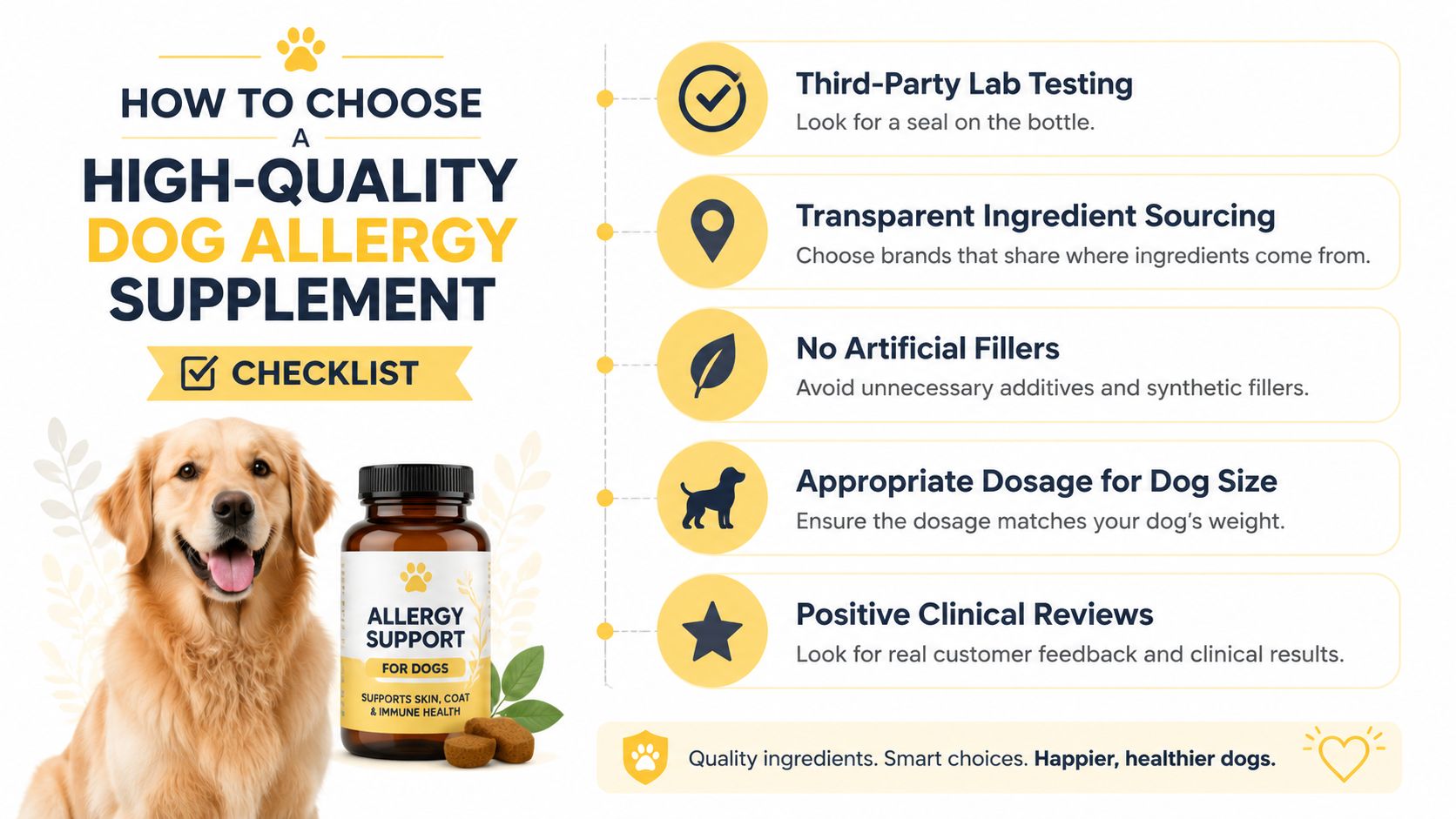
- Third-Party Lab Testing: Look for evidence that each batch is checked for purity and potency.
- Transparent Ingredient Sourcing: Make sure the label tells you what the ingredient is, not just a marketing category.
- No Artificial Fillers: A short, direct formula is easier to trust than a crowded one.
- Appropriate Dosage for Dog Size: Small dogs and large dogs need different delivery, so the product should make that clear.
- Positive Clinical Reviews: Favor products that explain the reasoning behind their ingredients, not just the feel-good story.
You'll also want to watch for a simple red flag, spelling mistakes on the label. That sounds small until you realize label errors often travel with broader quality problems. A supplement for sensitive dogs should look precise, because precision is part of the product.
Putting It All Together and When to Consult Your Vet
A dog allergy supplement works best when it fits into a bigger plan. The best routines are usually boring in the right way, one daily dose, consistent tracking, and no guessing about whether the formula contains enough of the ingredients that matter. That's also why a multi-system product can be easier to maintain than a stack of separate chews and oils.
If your dog has severe skin infection, open sores, sudden symptom changes, or no meaningful improvement after 12 weeks of consistent use, it's time to call the vet. Supplements are support tools, not substitutes for diagnosis or treatment when the problem is bigger than a mild flare. A good exam can rule out issues that look like allergies but aren't.
Pure Paw Labs offers a simple way to think about daily support, with a human-grade, once-daily powder approach built around skin, gut, immune, joint, and stress support. If you want to see whether that kind of structure fits your dog's routine, visit Pure Paw Labs and read the product details with the same checklist you'd use for any supplement.