


You're sitting on the sofa when your dog walks past. A few seconds later, the room fills with a sharp sulfur smell, and everyone starts looking for the source. If your dog's gas smells like rotten eggs, you're not imagining the resemblance. That odor comes from a specific chemical compound, and understanding it can help you decide whether your dog needs a simple feeding adjustment or a veterinary examination.
Occasional flatulence is common, but the rotten-egg variety deserves a closer look because smell and gas volume aren't the same problem. The useful question isn't only, “How do I stop the farting?” It's, “Why is my dog producing this particular odor, and are there any other symptoms?”
Table of Contents
- The Rotten Egg Smell No One Wants to Talk About
- Why Dog Gas Smells Like Rotten Eggs in the First Place
- Common Dietary and Microbial Triggers Owners Overlook
- Interventions That Actually Cut Hydrogen Sulfide Production
- A Practical Feeding Plan to Reduce Sulfurous Flatulence
- When Smelly Gas Signals Something More Serious
- Building a Long-Term Gut Health Routine for Your Dog
- Frequently Asked Questions About Sulfurous Dog Gas
The Rotten Egg Smell No One Wants to Talk About
Your dog may seem perfectly content, curled up beside you with a look of complete innocence. Then one silent release changes the atmosphere. You open a window, check the food bowl, and wonder whether a single treat could really create something that smells this intense.
That reaction is understandable. Dog gas is often treated as a punchline, but a sudden change in odor can tell you something about digestion. Rotten-egg gas isn't “bad bacteria” in a vague sense. It points toward sulfur-containing compounds being processed in the intestinal tract, especially hydrogen sulfide.
A single foul-smelling episode after an unusual treat may pass without consequence. A recurring pattern, particularly when it appears alongside changes in stool, appetite, energy, or comfort, deserves more attention. The odor alone doesn't diagnose a disease, but it gives you a useful starting clue.
Why the smell matters
Think of ordinary gas as a byproduct of digestion that may be noticeable but not especially pungent. Sulfurous gas is different. Even a relatively small amount of a sulfur compound can dominate the smell, just as a tiny amount of spoiled food can overpower an entire refrigerator.
That distinction matters because a dog can have the same amount of gas but a much stronger odor. Reducing the number of bowel movements or trying to eliminate every burp and fart may miss the actual target. The more sensible approach is to identify what your dog is eating, how quickly the diet changed, and whether illness signs are present.
Practical rule: Treat the smell as a clue, not a diagnosis.
This guide moves from chemistry to feeding habits, then to a practical decision process. By the end, you'll know which ingredients and routines to review, what targeted approaches have been studied, and when foul gas should prompt a call to your veterinarian.
Why Dog Gas Smells Like Rotten Eggs in the First Place
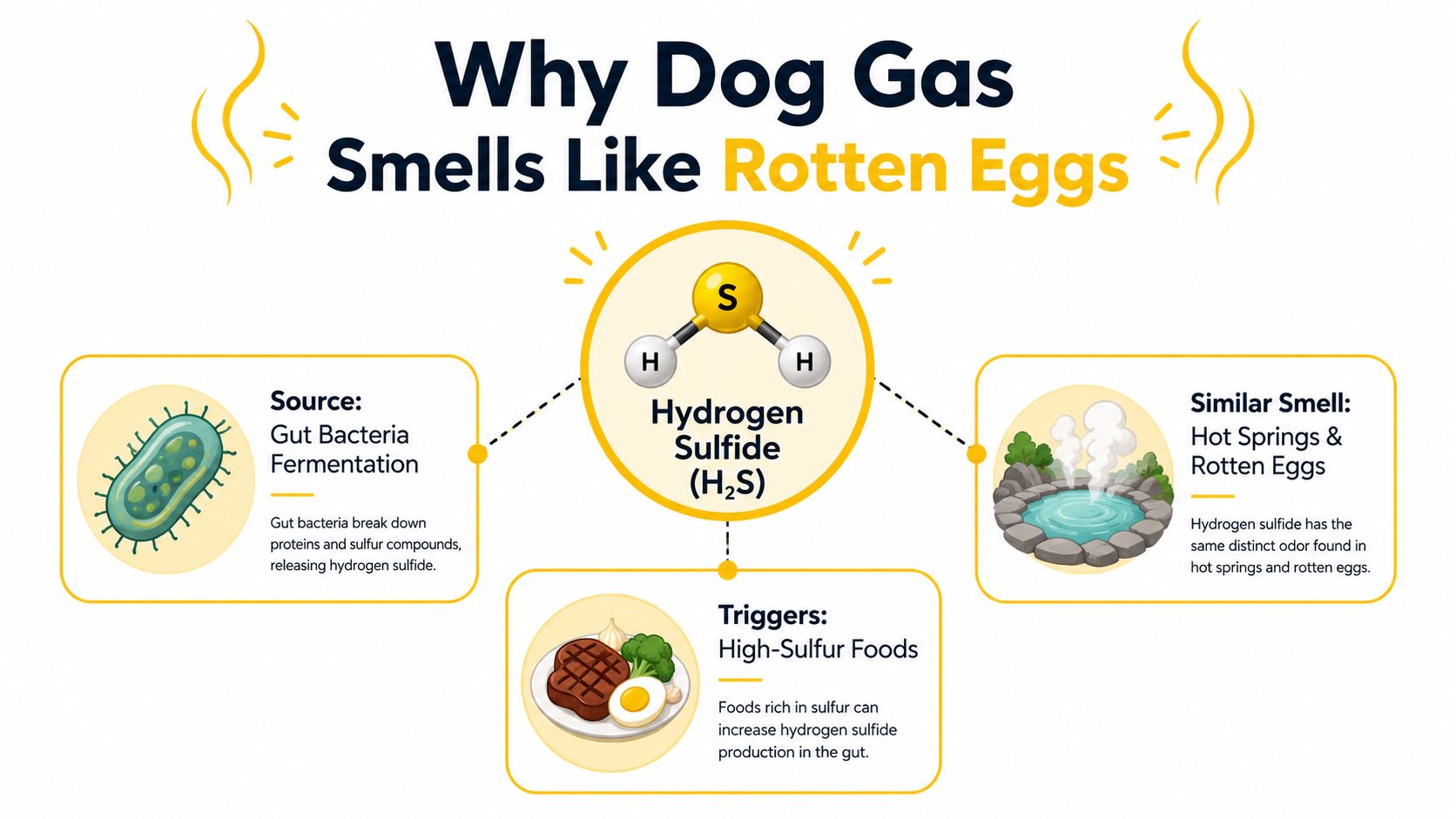
The main odor driver is hydrogen sulfide, commonly abbreviated as H₂S. It's the compound associated with the smell of rotten eggs, and it can also occur in naturally sulfurous environments such as hot springs. In your dog's large intestine, microbes act like workers in a small chemistry laboratory. They break down material that wasn't fully absorbed earlier in digestion, including sulfur-containing compounds from food and intestinal secretions.
The process can be understood in four steps:
- Sulfur-containing material enters the gut.
- Intestinal bacteria ferment and transform it.
- Hydrogen sulfide forms among the resulting gases.
- The compound reaches the air and creates the characteristic odor.
That doesn't mean every sulfur-containing food will cause a problem. The outcome depends on the whole digestive picture, including the food's digestibility, the amount offered, the dog's individual tolerance, and the way the intestinal microbes process the material.
A 2001 veterinary study measured canine flatus directly and found that odor judges could detect gas when hydrogen sulfide concentrations were greater than 1 part per million. The researchers also found that odor severity strongly correlated with hydrogen sulfide concentration, creating a measurable explanation for why some dog gas smells dramatically worse than ordinary flatulence. Read the veterinary research on hydrogen sulfide and canine flatulence.
The simple mental model
A useful shorthand is:
More sulfur available, more microbial processing, more hydrogen sulfide, stronger odor.
That's a guide, not a perfect formula. A sudden food change can alter fermentation even when the new food doesn't seem unusual. Likewise, a food that suits one dog may produce unpleasant gas in another because individual digestive tolerance varies.
If you're considering a broader daily wellness routine for an aging dog, DA-1™ Daily All-in-One - Senior Dog Support, Joints, Skin/Coat & More is described by its manufacturer as a single-scoop formula containing 18 human-grade ingredients aimed at cells, gut, and joints. It should complement, not replace, veterinary advice or a diet investigation when gas is persistent.
The key takeaway is straightforward: the rotten-egg smell has a chemical signature. That gives you a more useful path forward than blaming an undefined imbalance.
Common Dietary and Microbial Triggers Owners Overlook
The bowl may look unchanged while small additions alter what reaches the colon. An egg from breakfast, a spoonful of leftovers, a new chew, or a sudden protein switch can change both the sulfur available to microbes and the fermentation pattern that produces hydrogen sulfide. One ingredient may be responsible, or several minor changes may combine.
Start with the food audit
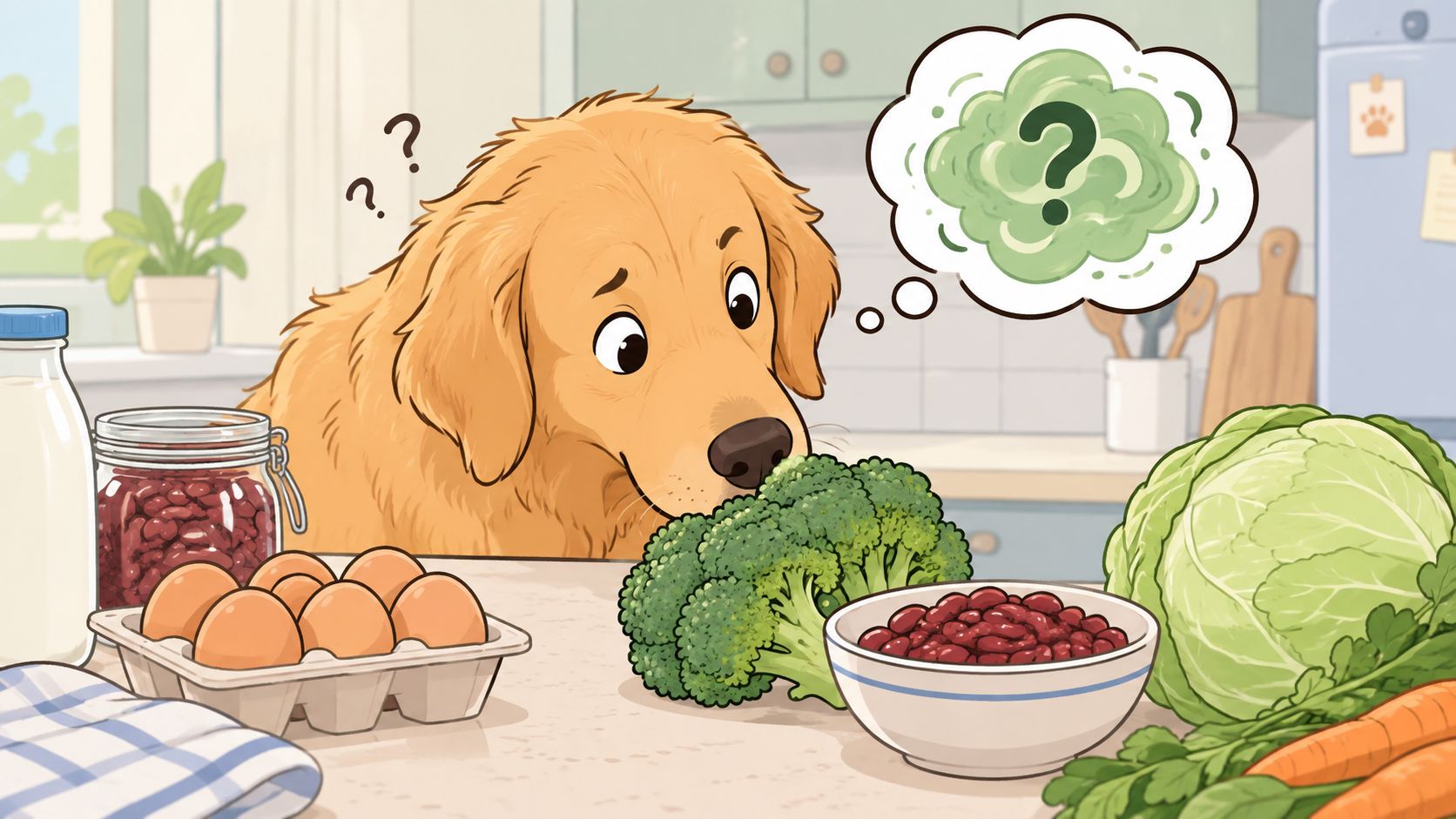
Record everything your dog eats, not only the main diet. Foods often linked with sulfurous odors include eggs, some protein sources, beans, broccoli, and cabbage. Dairy, fatty table scraps, and ingredients your dog does not tolerate can also disturb digestion, allowing odor to become more noticeable.
Look for a repeatable pattern instead of blaming the last meal. List the main food, treats, chews, supplements, table scraps, and the time the odor appears. If the smell follows a new treat and fades after the treat is removed, that clue is more useful than a broad list of possible foods your dog has not eaten.
A sudden diet change can create the same problem. Intestinal microbes adjust to the material available to them, much like a kitchen culture changes when its ingredients change. Replacing familiar food abruptly may alter fermentation before digestion settles into the new routine. Change one variable at a time and transition gradually when possible. That makes the result easier to interpret and is usually gentler on the gut.
Why gut-health products keep appearing
More diets and formulas now highlight prebiotics, fiber, and digestive-health support. One industry analysis of new pet-food launches reported that digestive claims frequently appeared alongside prebiotics, and that high-fiber positioning was also common. Review the industry report on digestive-health positioning.
That pattern does not show that a particular formula will stop your dog's gas. It does suggest a broader question: does the daily diet provide a steady, tolerable source of nutrients and fiber? Repeated scraps, poorly tolerated ingredients, and abrupt changes can keep feeding an unpredictable fermentation cycle.
Use the smell as a clue, not a diagnosis. A food audit helps separate a manageable dietary trigger from gas that continues despite a stable, well-tolerated routine.
A better audit asks: What changed, how quickly did it change, and what symptoms appeared with the smell?
Interventions That Actually Cut Hydrogen Sulfide Production
The most useful historical evidence focuses on odor chemistry, not just the number of gas episodes. In a 2001 AVMA study, researchers tested activated charcoal, Yucca schidigera, and zinc acetate in dogs. The interventions didn't change total gas production or the number of flatulence episodes, but they did reduce hydrogen sulfide production in vitro.
The reported reductions were specific:
- Activated charcoal reduced hydrogen sulfide production by 71%.
- Yucca schidigera reduced it by 38%.
- Zinc acetate reduced it by 58%.
- The combination reduced it by 86%.
The same combined approach was associated with an 86% decrease in episodes rated as bad or unbearable in odor. Read the AVMA study on charcoal, Yucca schidigera, and zinc acetate.
Why less smell doesn't mean less gas
This finding is easy to misunderstand. If your dog still passes gas, you might assume the intervention failed. But the study's distinction is important: gas volume and gas chemistry are separate targets.
Activated charcoal can bind certain compounds. Yucca schidigera and zinc acetate address sulfur-related odor through different mechanisms. The study tested these substances in a controlled research setting, so you shouldn't assume that a commercial product containing one of them will produce the same result in your dog.
Talk with your veterinarian before adding a supplement, especially if your dog takes medication, has a chronic condition, is pregnant, or has unexplained digestive symptoms. A product that targets odor can mask a recurring problem if you use it without investigating the cause.
For a broader overview of ingredients and considerations, see this guide to dog digestive supplements. Use it as background for a veterinary conversation, not as a substitute for an examination.
The practical lesson is narrow but valuable: if rotten-egg odor is the problem, sulfur reduction is more logical than attempting to suppress all intestinal gas.
A Practical Feeding Plan to Reduce Sulfurous Flatulence
Start with consistency. If your dog receives a stable main diet but several rotating treats, scraps, chews, and toppers, you won't know which item is driving the smell. Simplify meals temporarily, keep fresh water available, and record stool quality, appetite, energy, and gas odor.
Use a controlled transition
A gradual change helps you separate the effect of the new food from the stress of an abrupt switch. The provided seven-day plan uses increasing proportions of the new diet:
- Days 1 and 2: Mix 25% new food with 75% old food.
- Days 3 and 4: Move to an even mixture.
- Days 5 and 6: Use 75% new food and 25% old food.
- Day 7: Complete the transition, if your dog remains comfortable.
- Afterward: Monitor the odor, stool, appetite, and energy rather than judging the food by smell alone.
Choose a diet your dog digests comfortably, and ask your veterinarian whether a lower-residue or highly digestible option makes sense. Don't remove major food groups or create a homemade diet without professional nutritional guidance. A restrictive plan can create nutritional gaps even if it temporarily reduces gas.
Add fiber thoughtfully
Fiber can support stool regularity, but more isn't automatically better. Some dogs become gassier when fiber rises quickly, so introduce any fiber-forward change carefully and watch the stool. A practical overview of fiber sources for dogs can help you prepare questions for your veterinarian.
Prebiotics may also be included in microbiome-focused formulas. They provide fermentable material for intestinal microbes, which means they can be useful for some dogs but can also increase gas during adjustment. If your dog develops diarrhea, vomiting, pain, or marked lethargy, stop experimenting and seek veterinary guidance.
A single daily topper may make a routine easier to follow, but simplicity doesn't make an unsuitable ingredient suitable. The foundation remains a digestible diet, slow transitions, controlled treats, and careful observation.
When Smelly Gas Signals Something More Serious
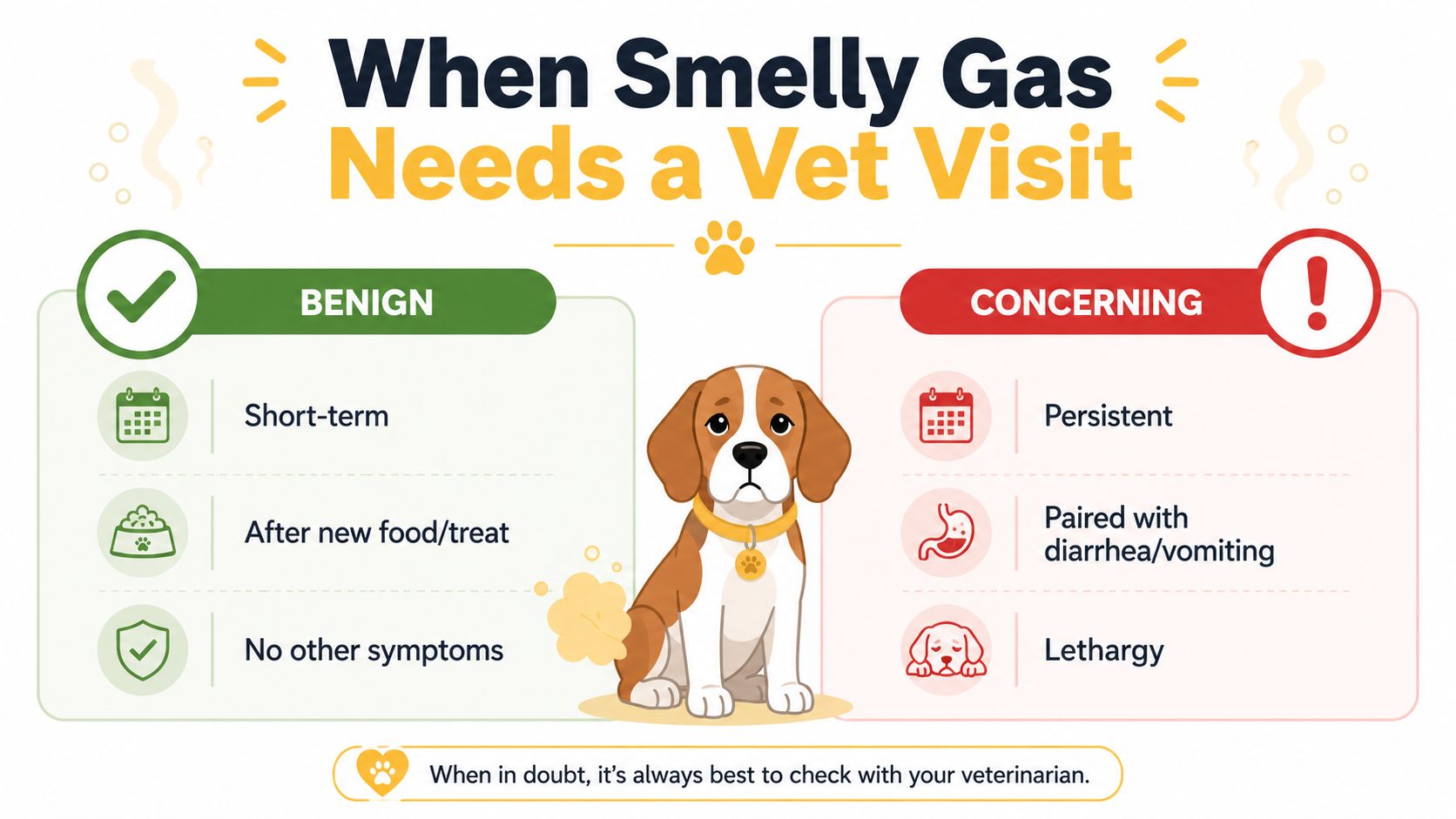
A short-lived odor after a new food or treat is often less concerning when your dog is otherwise acting normally. The situation changes when the gas persists or arrives with signs of digestive illness. Veterinary guidance identifies diarrhea, vomiting, lethargy, and suspected spoiled-food or foreign-body ingestion as reasons to take the context seriously. Review veterinary guidance on when dog gas needs more attention.
Use the pattern, not the smell alone, to choose your next step.
| Signs to Watch | Likely Cause | Recommended Action |
|---|---|---|
| Short-lived odor after a new food or treat, with normal appetite and energy | Dietary fermentation or individual food intolerance | Remove the suspected extra, keep meals consistent, and monitor closely |
| Repeated foul gas with loose stool or diarrhea | Ongoing dietary intolerance, disrupted digestion, or another intestinal problem | Contact your veterinarian for advice and possible testing |
| Gas with vomiting, weakness, or marked lethargy | Potential illness requiring prompt assessment | Seek veterinary care promptly |
| Gas after suspected spoiled food or foreign-object ingestion | Possible toxin exposure or gastrointestinal obstruction | Contact a veterinarian or emergency service immediately |
| Persistent odor with appetite change, weight loss, pain, or bloating | Possible chronic digestive disorder | Arrange a veterinary examination rather than continuing trial-and-error feeding |
The emergency distinction
A dog that steals a small amount of an unfamiliar food and passes foul gas, but remains bright, hydrated, and comfortable, may only need observation and a careful diet review. A dog that repeatedly vomits, appears painful, becomes unusually quiet, or may have swallowed an object needs a different response.
Don't wait for the smell to become unbearable before acting. Foreign objects and spoiled foods can create urgent problems, and masking the odor won't address them.
Bring a written food history to the appointment. Include recent diet changes, treats, supplements, stool changes, vomiting, appetite, energy, and anything your dog might have eaten outdoors or from the trash. That information can help the veterinarian decide whether the next step is dietary management, stool testing, blood work, imaging, or another evaluation.
Building a Long-Term Gut Health Routine for Your Dog
A lasting routine starts with consistency, not a new supplement after every smelly episode. Keep a digestible base diet, introduce changes gradually, limit unplanned table food, and record when the rotten-egg odor appears. Hydrogen sulfide is the measurable sulfur compound behind that smell, so tracking food, stool, appetite, and energy can show whether a change is helping.
If the pattern continues, ask your veterinarian to review the record before adding more products. A formula marketed for digestive health may contain prebiotics, fiber, or other microbiome-focused ingredients, but those ingredients can affect individual dogs differently. Evaluate the complete label, introduce one change at a time, and stop a home trial if other symptoms develop.
A daily supplement may complement a stable feeding routine when the goal is digestive support alongside broader wellness. It does not replace a complete diet, veterinary treatment, or a targeted elimination plan when disease is possible. For practical background on maintaining digestive balance, explore this guide to dog gut health. Pure Paw Labs also offers daily supplement options, including the single-scoop DA-1™ formula.
Frequently Asked Questions About Sulfurous Dog Gas
Are some dog breeds more affected?
Individual dogs differ more than a breed label can explain. Dogs that eat rapidly, have sensitive digestion, or react to particular ingredients may develop stronger gas, so track your dog's own food and symptom pattern.
Can puppies have rotten-egg gas?
Yes, puppies can pass sulfurous gas, especially after feeding changes or unfamiliar treats. Because puppies can deteriorate quickly, vomiting, diarrhea, poor appetite, unusual sleepiness, or suspected ingestion warrants prompt veterinary advice.
How long do dietary changes take to help?
Give each change enough time to observe a clear pattern, but don't continue a home trial if your dog develops other symptoms. Change one major variable at a time, record the response, and ask your veterinarian how long a structured diet trial should last.
Are probiotics alone enough?
Not always. A probiotic may support some dogs, but it won't correct a food trigger, obstruction, parasite, pancreatic problem, or inflammatory condition. Persistent odor needs a broader review of diet, stool, appetite, energy, and medical history.
If your dog's gas smells like rotten eggs, Pure Paw Labs offers daily supplement options designed to support digestive health alongside broader wellness needs, including the single-scoop DA-1™ formula. Visit Pure Paw Labs to review the product information and choose a routine that fits your dog's diet and veterinary care plan.