


You've got a kitchen counter full of half-used joint chews, probiotic tubs, omega bottles, and skin-and-coat packets. Your dog gets the right dose when you remember, then the routine falls apart because the container is empty and you forgot to reorder it. A dog supplement subscription can replace that clutter with a predictable daily rhythm, but only if the product, delivery schedule, and cancellation controls fit real life.
The smart question isn't just whether auto-ship is convenient. It's whether the plan still makes sense after the first delivery, when the novelty fades, the dog's response is gradual, and another charge appears on your card. This guide focuses on those first 90 days, because that's where a workable routine becomes a useful habit, or a forgotten subscription becomes a regret.
Table of Contents
- Why So Many Dog Owners Are Switching to Subscriptions
- The Market Shift Behind the Auto-Ship Button
- What to Look For Before You Subscribe
- One Product or a Stack of Niche Supplements
- Signing Up and Taking Control of Deliveries
- Smart Ways to Lower Your Annual Cost
- Staying on Track and Knowing When to Move On
Why So Many Dog Owners Are Switching to Subscriptions
A subscription solves a practical problem before it solves a marketing problem. You don't have to remember which product you bought last time, search for the same formula, or discover an empty tub when your dog's routine has already been interrupted. The right shipment arrives before the current supply runs out, and the owner can keep dosing consistent.
That convenience matters because dog supplements are usually daily-use products. Joint support, skin and coat formulas, digestive products, calming support, and immune formulas work best as routines rather than occasional purchases. A recurring order turns replenishment into a calendar event instead of another task competing with work, errands, and veterinary appointments.
Practical rule: Auto-ship should remove shopping friction, not remove your attention from the dog.
A good plan gives you predictable dosing, replenishment before the last serving disappears, and sometimes a lower recurring price than one-off orders. It also removes the annoying hunt for the same product every few weeks. That's useful for owners who've already chosen a formula that suits the dog and want fewer moving parts.
The catch is that subscriptions don't manage themselves. You still need to check how quickly your dog finishes a container, whether the product is being accepted, and whether the next shipment is arriving at the right interval. A calendar-based delivery can easily become wasteful if your dog eats less than the standard serving or if you skip doses during travel.
Turn clutter into a repeatable routine
Start with one product and one clear purpose. Don't subscribe to every supplement that appears in your search results. If your dog has several needs, decide whether a consolidated formula or a carefully managed stack is more realistic before committing to multiple recurring charges.
Your first order is also the right time to find the right refill model, especially if you're weighing automatic replenishment against one-time buying. Compare the actual delivery interval, shipping terms, cancellation process, and amount your dog consumes, not just the headline discount.
During the first month, keep the container somewhere visible and attach the scoop to an existing meal routine. If the dog refuses the dose, develops digestive changes, or you're consistently overstocked, adjust the plan instead of letting the next shipment arrive untouched. The subscription should serve the routine. The routine shouldn't serve the subscription.
The Market Shift Behind the Auto-Ship Button
Your dog's supplement jar is nearly empty, but the next shipment has already arrived. That is the promise behind auto-ship: fewer gaps in a daily routine. It also explains why subscription plans have moved beyond niche convenience. Supplements are repeat-use products, so online brands have built the buying experience around replenishment.
Fortune Business Insights reports these market figures valued the global pet supplements market at USD 3.14 billion in 2025 and projects it to reach USD 5.47 billion by 2034. Dogs generated 63.1% of category revenue in 2025, putting dog owners at the center of demand for recurring products.
Online purchasing strengthens that pattern. E-commerce channels, including direct-to-consumer subscriptions and online marketplaces, account for roughly 30% to 35% of dog supplement sales in the United States, compared with less than 20% five years earlier. A daily product is a natural match for website-based replenishment, provided the delivery schedule matches the dog's real consumption.
Adoption matters as much as market size. Kings Research provides the adoption figures and category context reported that 53% of U.S. dog owners give their pets vitamins or supplements in a 2026 benchmark, up from 47% in 2023. Supplements are now a familiar part of pet care rather than a purchase limited to a small group of owners.
Why recurring revenue changes the buyer experience
Subscription revenue gives direct-to-consumer brands predictable repeat orders. Owners get fewer interruptions and less shopping, but only when the plan is clear and adjustable. Renewal terms should be visible, cancellation should be easy to find, and the shipment interval should reflect actual use.
A rigid plan creates waste. If your dog takes less than the standard serving, skips doses, or dislikes the product, automatic delivery turns unopened containers into a recurring expense. The first 90 days are the practical test. Watch consumption, acceptance, and delivery timing before allowing the plan to run unattended.
The wider direct-to-consumer subscription pet brands market was valued at $4.2 billion in 2025 and is projected to reach $21.8 billion by 2034, with supplement subscriptions identified as a fast-scaling application segment in the cited research. This category includes joint and digestive support, omega formulas, dental chews, calming products, and immune support.
| Metric | Value | Source / Year |
|---|---|---|
| Global pet supplements market | USD 3.14 billion in 2025, projected to USD 5.47 billion by 2034 | Fortune Business Insights, 2025 |
| Dog share of category revenue | 63.1% in 2025 | Fortune Business Insights, 2025 |
| U.S. dog supplement e-commerce share | Roughly 30% to 35% | Fortune Business Insights, 2025 |
| U.S. dog owners giving vitamins or supplements | 53% in a 2026 benchmark | Kings Research, 2026 |
| Global DTC subscription pet brands market | $4.2 billion in 2025, projected to $21.8 billion by 2034 | Kings Research, 2026 |
The shopper's takeaway is straightforward. Subscriptions are mainstream, but popularity does not make every plan worthwhile. Choose a service with clear charges, adjustable timing, and a simple cancellation path. Review it during the first 90 days, then pause or cancel as soon as product waste or surprise billing outweighs the convenience.
What to Look For Before You Subscribe
Don't compare subscription prices first. Compare the product and the contract first, then use price as the final filter. A cheap plan with vague dosing, poor controls, or unnecessary shipping costs isn't cheap for long.
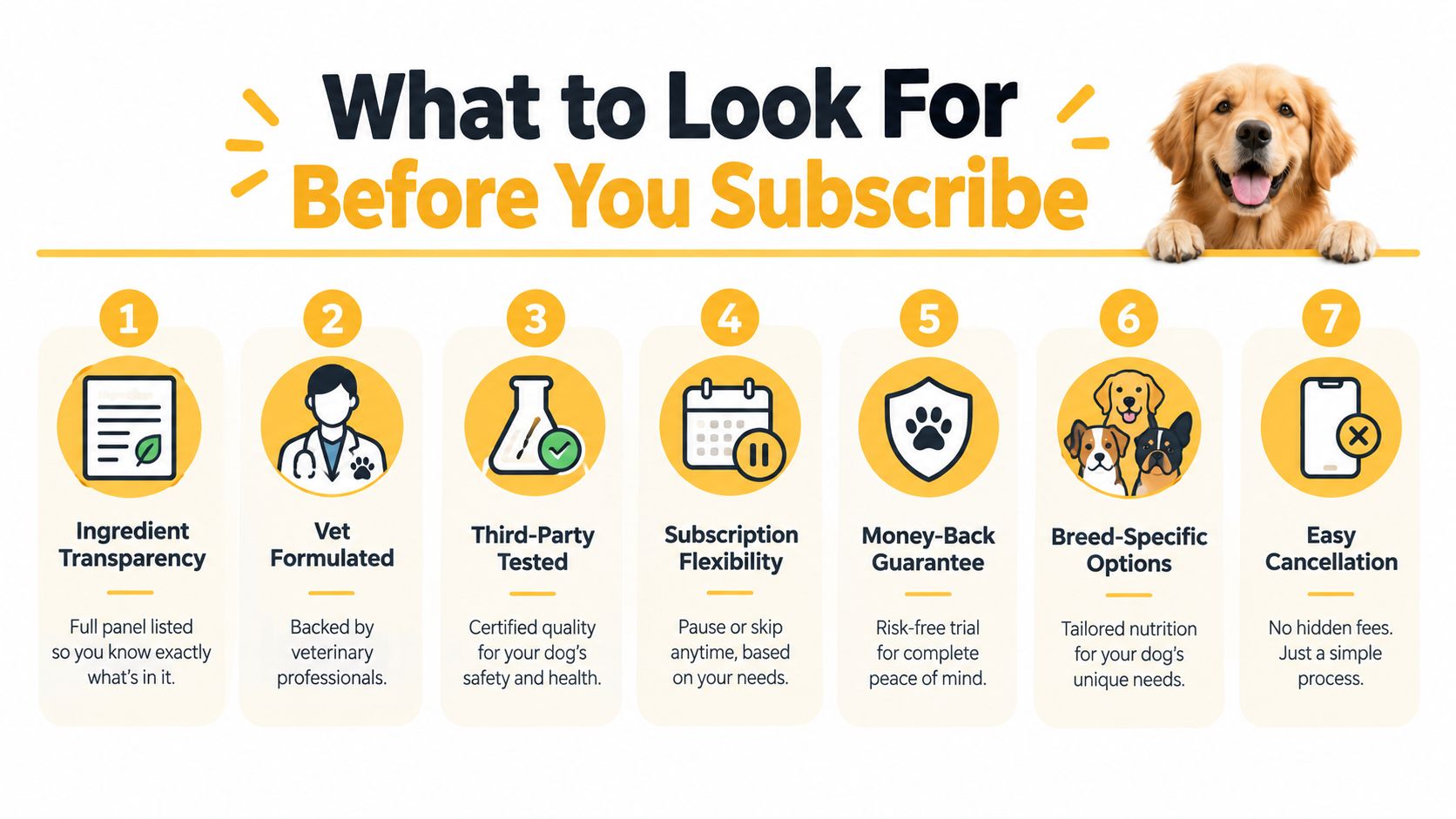
Run the seven-filter check
- Ingredient transparency: Look for a complete panel with named ingredients and amounts. A proprietary blend that hides individual quantities makes it difficult to judge what your dog is receiving. For a practical label-reading process, use this guide on how to read supplement labels.
- Professional formulation: Check whether the company explains who formulates the product and what type of professional review is involved. “Vet formulated” should lead to understandable product information, not replace it.
- Independent quality checks: Look for third-party testing, batch traceability, or a recognized quality seal. These details don't prove that a formula suits every dog, but they give you more to verify than a polished claim alone.
- Fit for your dog: Age, body size, diet, medications, diagnosed conditions, and the reason for supplementing all matter. A senior dog with mobility concerns may need a different conversation than a young dog receiving general nutritional support. Ask your veterinarian before starting a supplement if your dog has a health condition or takes medication.
- Weight-based dosing: Instructions should connect serving size to clear weight brackets. “One scoop daily” is only useful when you know what that scoop contains and how the amount applies to your dog.
- Delivery flexibility: Choose a plan that lets you pause, skip, or change frequency. The best schedule is the one that matches actual scoop or serving usage, not an arbitrary calendar setting.
- A usable guarantee and cancellation path: A satisfaction or refund guarantee can lower the risk of trying the first bottle or two. Cancellation should work online without a phone call, business-hours restriction, or retention script.
Treat subscription controls as part of product quality
Before you click buy, open the account area and look for the controls you'll need later. Can you change the next order date? Can you reduce frequency if the container lasts longer than expected? Can you stop the plan without contacting support?
A product such as DA-1™ Daily All-in-One - Senior Dog Support, Joints, Skin/Coat & More illustrates the all-in-one format. Its product snapshot describes one scoop with 18 human-grade ingredients for cells, gut, and joints, with no pills and a 60-day money-back guarantee. Those details are worth checking against your dog's needs and the subscription terms rather than accepting them as a substitute for evaluation.
Shortlist two or three formulas, apply the same seven filters, and only then compare total cost. Skip any plan with locked delivery intervals, shipping fees that erase the recurring discount, cancellation limited to live chat, or vague clinical language that doesn't explain ingredients and amounts.
One Product or a Stack of Niche Supplements
The all-in-one versus stack decision comes down to trade-offs, not ideology. A single daily formula is easier to administer and easier to reorder. A stack can be more targeted, but every added product creates another dose, another label, another delivery date, and another opportunity for the routine to fail.
| Factor | All-in-One Daily Formula | Stacked Niche Supplements |
|---|---|---|
| Daily routine | One product and one serving to remember | Several servings, often with different directions |
| Targeting | Broad support across selected systems | More precise focus on separate concerns |
| Delivery management | One shipment schedule | Multiple schedules that can drift apart |
| Ingredient flexibility | Less control over individual components | Easier to add or remove one category |
| Adherence risk | Lower administrative burden | More chances to miss, duplicate, or stop a dose |
| Budget visibility | One recurring charge | Several charges that can be harder to total |
Choose the format you'll actually administer
If your dog has one clearly defined need, a targeted product may make more sense than a broad formula. You can track one change, ask better questions, and avoid paying for ingredients that don't fit the goal. That approach also makes it easier to stop if the product isn't useful.
An all-in-one formula is usually the more practical choice when you're already juggling joint, skin and coat, digestive, immune, or stress-related support. Fewer products mean fewer palatability battles and less chance that one neglected tub breaks the whole routine. The trade-off is reduced flexibility. You can't remove one ingredient from a combined formula just because your dog no longer needs that category.
The honest test: If you won't reliably give three products every day, don't subscribe to three products.
Think in total active value, not container count
A stack can look economical when each individual product has a manageable price. The meaningful comparison is the total daily spend, the amount of active ingredients delivered, and the percentage of servings your dog receives. Discounts don't rescue a regimen that creates dose fatigue.
Independent research on canine supplementation found that adherence and ease of administration can be good at three months but fall significantly by six months in a long-term osteoarthritis trial. A separate levothyroxine study reported 98.4% overall compliance, showing that simple routines can perform well while still requiring attention over time. The canine supplement study is available through PubMed Central.
For most owners, the best starting point is one product with one purpose or one clearly justified all-in-one formula. Add a niche supplement only when there's a specific reason, a clear dose, and a plan for measuring whether it earns its place.
Signing Up and Taking Control of Deliveries
The checkout page tells you what the company wants you to buy. The account dashboard tells you whether you'll remain in control afterward. Check that dashboard before the first shipment if possible, and save the order confirmation as soon as payment goes through.

Follow the account setup in order
First, confirm the exact product, serving instructions, renewal price, shipping charge, and next billing date. Don't rely on a discount banner. Read the order summary that shows what will recur after the introductory purchase.
Next, open the subscription management area. You should be able to:
- Pause the plan: Confirm whether the pause has a defined duration and whether billing stops immediately.
- Skip the next shipment: Use this when the current container still has plenty left.
- Change frequency: Match the schedule to actual consumption rather than choosing the default.
- Edit the order: Check whether you can change quantity, formula, or flavor without creating a second subscription.
- Cancel online: Complete cancellation without a phone call or a support-agent approval step.
A plan that requires service hours, a retention conversation, or an email request for basic cancellation deserves serious caution. The issue isn't that customer support exists. The issue is whether support is the only exit.
For a more detailed process, review the guidance on subscription management. Then save the confirmation email, the order number, and the next billing date somewhere searchable. If a shipment goes missing or a charge looks wrong, those details are faster than trying to reconstruct the transaction from memory.
Use this short video as a visual reminder of the controls and account steps worth checking before you leave the dashboard.
Give the first delivery a fair chance to become part of the meal routine, but don't let the renewal date surprise you. Put the next charge on your calendar, record when the container is opened, and adjust the schedule as soon as your real usage becomes clear.
Smart Ways to Lower Your Annual Cost
Subscription savings come from coordination, not from clicking every discount box. Look at three levers together: the first-order offer, the recurring discount, and shipping. A headline discount can disappear if the plan sends too much product or adds delivery charges to every order.
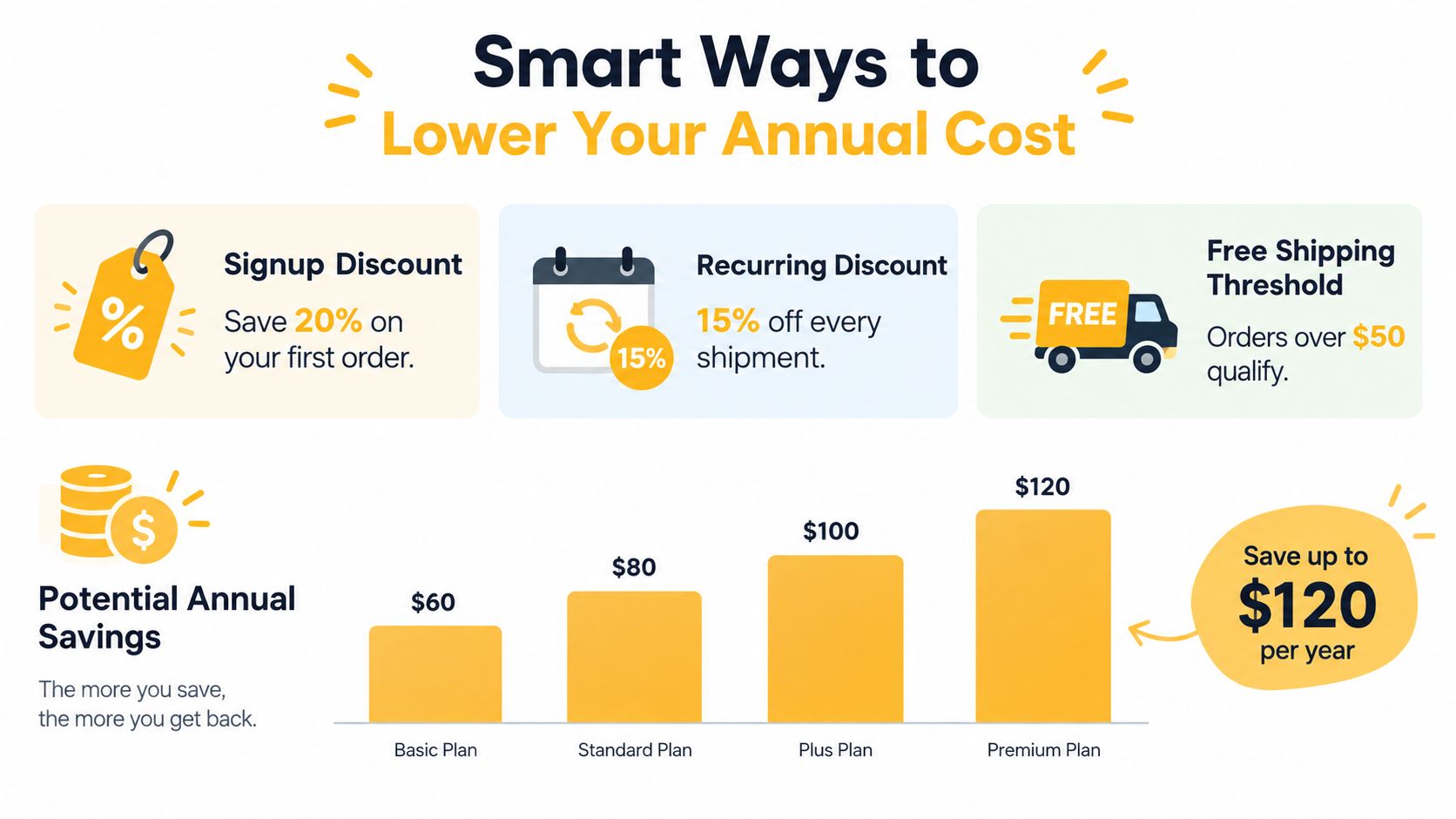
Calculate the real recurring cost
Write down the amount charged after the first order, not just the introductory amount. Then add shipping, account for the actual number of deliveries your dog needs, and check whether a free-shipping threshold forces you to buy more than you can use.
The most useful calculation is:
Recurring product charge + shipping × actual deliveries = annual subscription cost
For a broader framework on estimating the annual cost of subscriptions, separate temporary signup savings from discounts that continue on every shipment. A first-order offer helps once. A recurring discount matters only if the product remains suitable and the plan stays active.
Before comparing formulas, read independent dog supplement reviews with a skeptical eye. Use reviews to identify palatability, shipping, and cancellation patterns, but return to the label and terms for facts about ingredients, dosage, and billing.
Avoid savings that create waste
Annual prepayment can reduce the effective price, but it trades cash flow for commitment. Only consider it after the first 90 days have shown that your dog accepts the product and the delivery quantity matches consumption. Referral credits and promotional codes can help, but they shouldn't persuade you to keep a formula that isn't working.
Watch for the traps that erase the apparent savings:
- Oversized deliveries: A larger quantity isn't a bargain if it sits unused or expires.
- Duplicate subscriptions: A free trial or second checkout can create two recurring plans under one account.
- Expired loyalty pricing: A discount may apply for an introductory period and then disappear.
- Threshold shopping: Adding unnecessary products to qualify for shipping can cost more than paying the delivery fee.
- Unnoticed quantity changes: A plan may shift to a larger size or higher serving count without matching your dog's needs.
Don't chase the lowest first charge. Choose the lowest sustainable cost for the product your dog will take.
Staying on Track and Knowing When to Move On
A subscription doesn't make a health decision for you. It only makes the next purchase easier. That's useful when the formula is appropriate, but dangerous when the owner keeps paying because stopping feels like admitting the trial didn't work.
The first 90 days should function as a measured trial. Start with a baseline note covering the reason for the supplement, current energy, appetite, stool quality, coat condition, mobility, and willingness to take the serving. You don't need a complicated spreadsheet. A few dated observations and occasional photos are enough to compare trends instead of relying on one good or bad day.
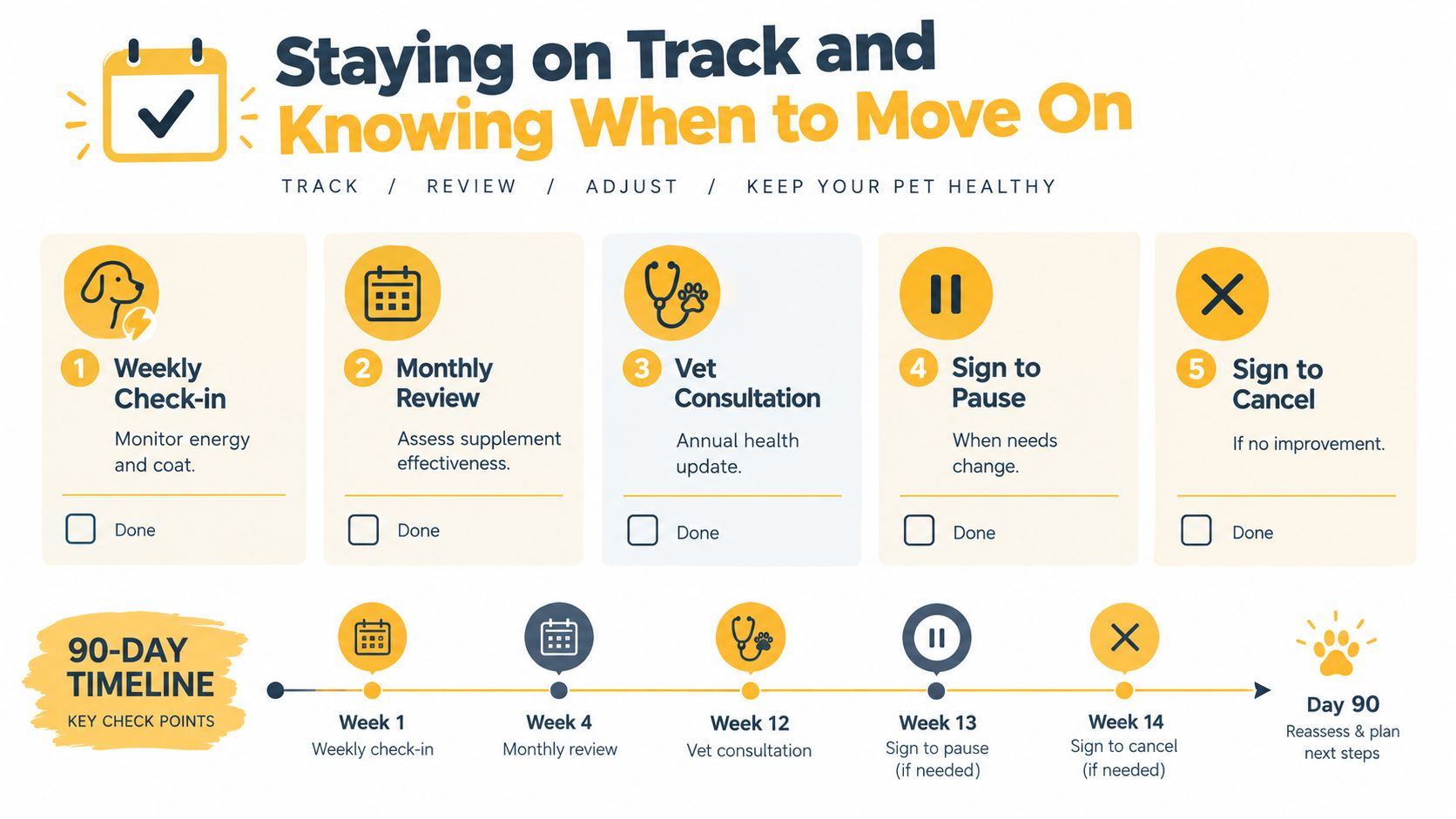
Use a simple review rhythm
Each week, check whether the dog takes the full serving, whether the routine is easy to maintain, and whether there are obvious changes in appetite, stool, energy, skin, coat, or movement. A dog refusing the dose is a practical failure, even if the ingredient panel looks excellent.
Each month, compare the current notes with the baseline and check inventory. If the container is lasting longer than expected, delay the next shipment. If you're running out early, change the frequency or quantity rather than placing emergency one-off orders.
At the 90-day point, decide whether the product has earned another cycle. Look for a consistent benefit that matters to your original goal, acceptable administration, tolerable cost, and a delivery schedule that doesn't create waste. If you can't identify a meaningful reason to continue, the discount isn't a reason.
Pet subscription benchmarks place monthly churn at about 3.4% and annual retention around 65% to 70%, with cancellation risk concentrated in the first one to three months. Retention improves after the third shipment, which is why the early routine deserves deliberate attention. The subscription benchmark details come from Ringly.
Know when to pause, switch, or cancel
Pause when the dog is traveling, the product is accumulating, or the need has temporarily changed. Switch when the dog won't take the serving, the formula doesn't match the goal, or the label leaves important dosing questions unanswered. Cancel when there's no meaningful improvement, the plan creates repeated waste, or the dog's veterinarian recommends a different approach.
If symptoms are persistent, worsening, or medically significant, contact your veterinarian rather than adding another supplement. Supplements shouldn't replace diagnosis or prescribed care.
Once a year, review the formula, ingredient panel, guarantee, shipping terms, and account price. Check whether the dog has entered a different life stage, whether the product has been reformulated, and whether another format would be easier to administer. Then make a clear decision: stay because the plan works, switch because the fit has changed, or quit because the evidence in your own household isn't strong enough.
Pure Paw Labs offers DA-1™ Daily All-in-One as a once-daily powdered formula with 18 human-grade ingredients positioned for support across cells, gut, and joints, along with a 60-day money-back guarantee. If a simpler all-in-one routine fits your dog's needs, review the formula and subscription controls at Pure Paw Labs before committing, and use the first 90 days to judge actual acceptance, consistency, and value.