


You're standing in the kitchen at dinner time, one hand on the kibble bag and the other lined up over a row of supplement jars, trying to remember which scoop goes with skin, which one is for joints, and whether the gut powder got used this morning. That's exactly why dog superfood powder has become so appealing. It promises one daily routine instead of a shelf full of partly used products, but the key question is simpler than the marketing around it: what does it really do, and where does it fall short?
A well-made powder is not magic, and it's not just fluff either. It sits in the middle ground between a complete diet and a targeted supplement, which is why owners get confused. The useful way to think about it is as a scoopable layer of functional ingredients added on top of a complete base food, not as a replacement for proper nutrition.
Table of Contents
- What Dog Superfood Powder Actually Is
- Core Ingredients and the Evidence Behind Them
- All-in-One Powder vs Single-Purpose Supplements
- Dosing, Mixing, and Matching to Your Dog
- Can a Superfood Powder Complete a Home-Cooked Diet
- How to Evaluate Quality Before You Buy
- Safety, Vet Guidance, and When to Pause
What Dog Superfood Powder Actually Is
A dog superfood powder is a shelf-stable, mix-in supplement designed to combine several functional ingredients in one daily serving. The goal is convenience with breadth, so the same scoop can support skin, coat, gut comfort, mobility, or antioxidant intake without requiring four separate products.
Why the format caught on
Powders are easier to dose by weight than tablets, and they blend into wet or dry food without much effort. That matters for dogs that refuse pills or spit out chews, because the supplement only works if the dog eats it. The format also lets brands combine ingredients that play different roles, such as omega-3s, probiotics, collagen peptides, antioxidants, greens, mushrooms, and joint-support compounds.
Practical rule: if a powder claims to do everything, check whether it actually contains meaningful amounts of anything. A long ingredient list is not the same as a useful formula.
The smarter version of the format is built around ingredient synergy. For example, a skin-support powder might pair omega-3s with antioxidants, while a gut-support powder might pair probiotics with prebiotic fibers or postbiotic compounds. That approach can make sense because one ingredient family may support the absorption, stability, or function of another.
A product like DA-1™ Daily All-in-One - Senior Dog Support, Joints, Skin/Coat & More is positioned around that idea, with a single scoop combining multiple human-grade ingredients in one routine. The key question isn't whether the format is convenient, it's whether the active ingredients are targeted enough to matter at the delivered dose.
That's the line to keep in mind with any powder. Broad support is realistic. Therapeutic replacement for a diagnosis-specific supplement usually isn't.
Core Ingredients and the Evidence Behind Them
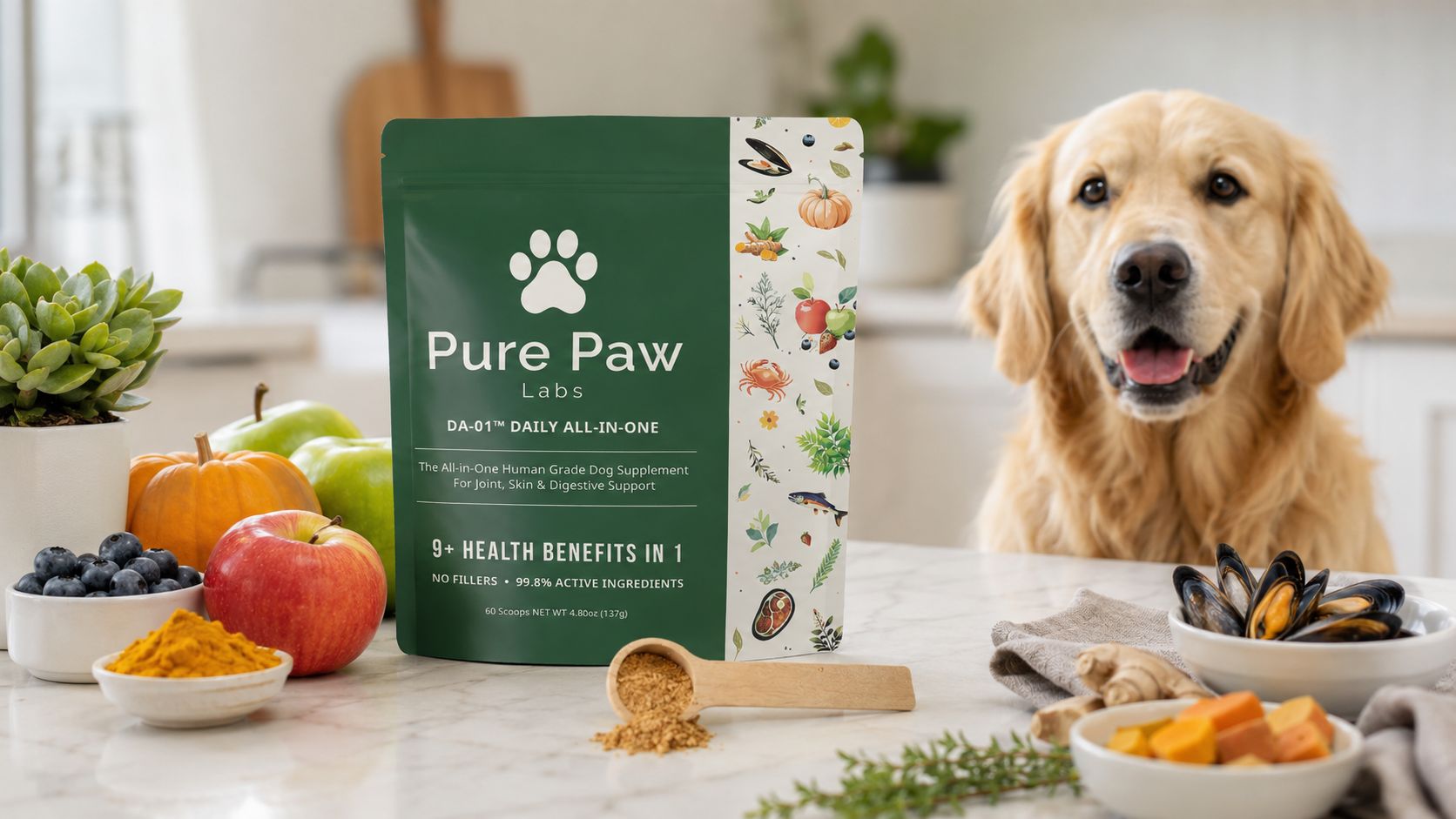
Product image: a daily dog supplement powder presented for joint, skin, coat, and broader senior-dog support.
The ingredient panel deserves more attention than the front label. A powder is a delivery format, not proof that every claimed benefit has strong canine research behind it. Some ingredient families have clearer uses, while others rely mainly on indirect evidence. That difference should determine what you expect from the product.
Ingredients with the clearest use cases
Omega-3 fatty acids from fish oil or algae are often the first family to examine. They are commonly used for skin, coat, and inflammation support. A useful label states the amounts of EPA and DHA, rather than listing only a source such as fish oil.
Probiotics and postbiotics relate to the gut microbiome, stool quality, and digestive resilience. A major evidence review of 17 canine probiotic studies found that the overall effect on acute gastrointestinal disease was limited and may not have been clinically important. For chronic gastrointestinal disease, dietary intervention remained the main driver of improvement rather than probiotic supplementation (Wiley review).
That finding does not make biotic ingredients worthless. It shows why strain selection, dose, and stability through processing matter more than the word probiotic on a label. A helpful explanation of how these categories differ is this guide to prebiotics, probiotics, and postbiotics.
A randomized, double-blind, placebo-controlled canine study found that an indole-rich postbiotic reduced scratching by 20% from baseline, improved human-perceived pruritus scores by 27% compared with placebo after 14 days, and increased gut microbiome Shannon diversity by 4.6% (PubMed study). The result supports a narrower conclusion: a targeted, biologically active postbiotic can produce measurable effects at its delivered dose. It does not show that every digestive powder will do the same.
| Ingredient Family | Primary Target | Evidence Strength |
|---|---|---|
| Omega-3s | Skin, coat, inflammation | Stronger |
| Probiotics and postbiotics | Gut support, stool quality | Mixed, strain-specific |
| Collagen peptides | Skin and joint support | Moderate, often indirect |
| Glucosamine and chondroitin | Osteoarthritis support | Moderate for some dogs |
| Green-lipped mussel | Mobility support | Moderate |
| Antioxidants | Oxidative stress support | Moderate |
| Spirulina, flaxseed, mushrooms, greens | General wellness claims | Weaker, often extrapolated |
Collagen, glucosamine, chondroitin, and green-lipped mussel appear frequently in joint-oriented formulas. Their role is clearest when the product names mobility support as its purpose, rather than making a vague whole-body claim. Antioxidants such as vitamin E, vitamin C, astaxanthin, blueberries, and turmeric are generally positioned around oxidative stress and recovery. Their presence alone is not enough. The amount supplied still shapes whether the formula can matter.
The least specific claims often surround spirulina, flaxseed, functional mushrooms, and dried greens. Research for these ingredients is frequently drawn from humans or rodents instead of direct canine studies. They may fit a formula, but they should not be the main reason to buy one.
Bottom line: read the label for active-ingredient amounts, not only the ingredient list. A proprietary blend can conceal how much of each component your dog receives.
The strongest formulas are specific before they are broad. If the label does not disclose the amount of its key ingredient, it asks you to rely on branding rather than measurable nutrition. A general powder may support several areas at once, but it cannot automatically replace targeted support or correct a nutritional gap in a home-cooked diet.
All-in-One Powder vs Single-Purpose Supplements
The right choice depends on whether your dog needs broad maintenance support or a more focused supplement for a specific issue. A general powder is designed for routine coverage, while a single-purpose product concentrates its formula on one defined goal.
Coverage versus precision
An all-in-one powder can address several areas at once, including skin, coat, digestion, and mild mobility support. That combination suits a healthy dog whose complete diet needs practical nutritional backup, rather than treatment for a diagnosed condition.
Single-purpose supplements concentrate more of their formula on one job. Fish oil can provide a higher omega-3 contribution, joint products can focus on mobility ingredients, and probiotic products can provide more direct gut support. When a veterinarian has identified a specific problem, a focused option is usually easier to match to that need.
The difference is similar to a daily tool kit versus a specialized instrument. The tool kit covers common tasks, but the specialized instrument gives you more control over one task.
Why missing-dose risk matters with all-in-one formulas
An all-in-one powder may list many appealing ingredients while supplying too little of the one your dog needs most. That missing-dose risk matters more when the concern involves moderate osteoarthritis, recurring itchy skin, or clear digestive instability. Broad coverage does not guarantee meaningful support in every category.
Ingredient overlap creates a second concern. If a dog already eats fortified kibble, adding another broad formula may repeat nutrients without adding enough of the active compound to change the result. Reviewing both labels helps prevent unnecessary duplication.
For a closer explanation of mixed formulas, see this guide to all-in-one supplements.
Use this decision rule:
- Choose a powder for simple, everyday support across a healthy dog's routine.
- Choose a single-purpose supplement when one main problem needs more direct support.
- Check for duplicated actives when the base food already supplies broad nutritional coverage.
General maintenance can suit a powder. A clinical concern usually calls for greater precision.
Cost follows the same principle. A jar may appear less expensive, but the useful comparison is the amount of active material delivered each day. Price per scoop can make a lightly dosed formula look stronger than it is. A general powder also cannot automatically replace targeted support or correct a nutritional gap in a home-cooked diet.
Dosing, Mixing, and Matching to Your Dog
Dosing a powder correctly is where a lot of good intentions go sideways. The same product can't be used the same way for a 10-pound puppy and a 70-pound senior, because the label is usually built around body weight, life stage, and the dog's actual needs.
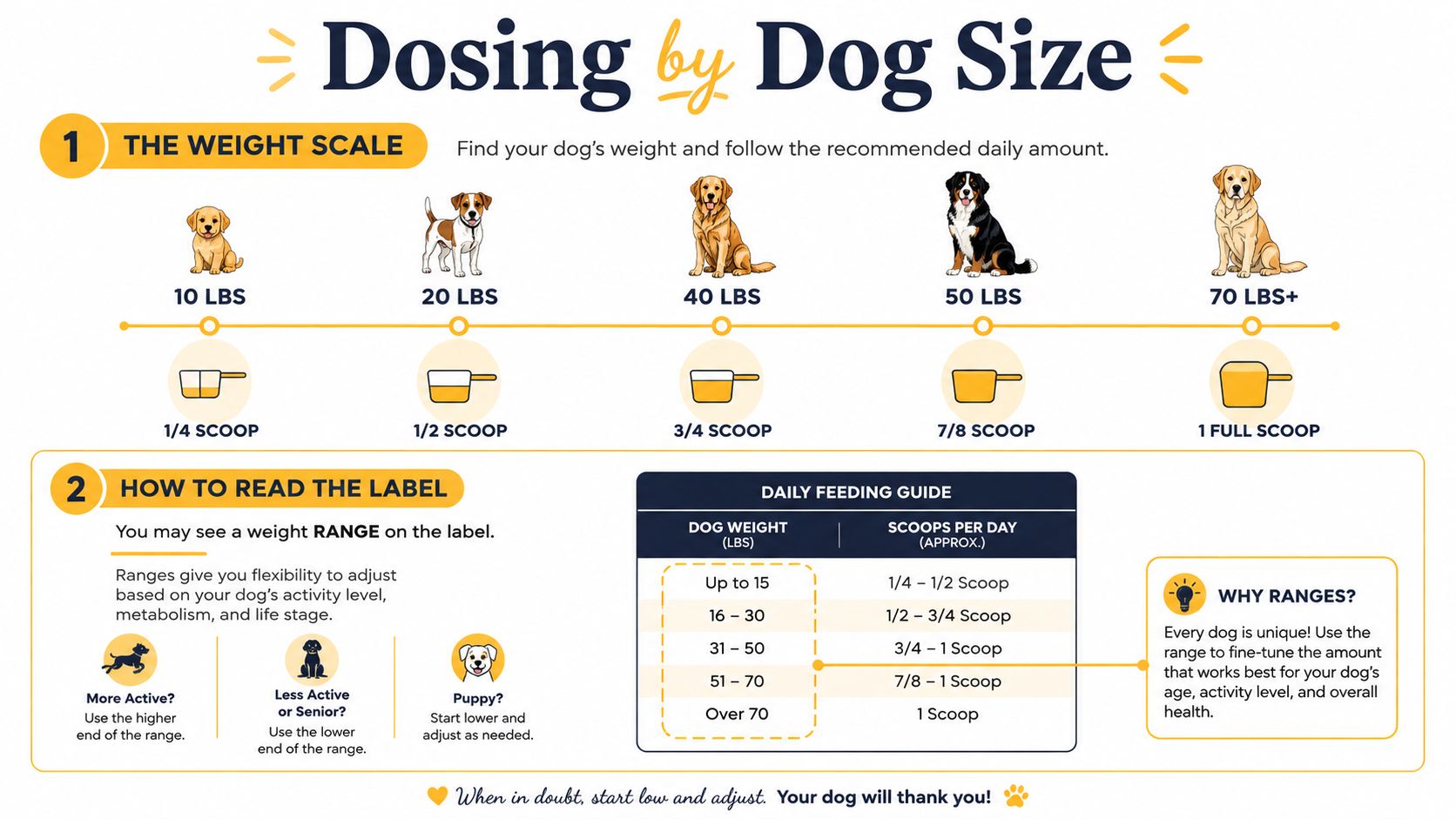
How to read the scoop chart
Most labels give a range instead of a single fixed scoop. That's intentional, because age, activity, and body size all change how much support a dog needs. A younger dog on a maintenance formula may need the lower end of the range, while an older dog or one with a more obvious issue may need the full labeled amount.
Mixing is usually simple. Sprinkle the powder over kibble, stir it into wet food, or blend it into raw or home-cooked meals. For picky eaters, hydrating the powder first can improve acceptance and keep the texture from turning chalky.
The transition period matters too. When a formula includes probiotics, novel proteins, or new fibers, a 5 to 7 day transition helps lower the chance of loose stool. Start smaller, then work up to the label dose instead of jumping straight to the full amount on day one.
Matching the formula to the dog
Different dogs need different support profiles.
- Young adult dogs usually do better with lighter joint support and general wellness ingredients.
- Itchy dogs often need a formula that puts more emphasis on omega-3s.
- Sensitive stomachs tend to respond better to gentle gut-focused blends than to formulas loaded with too many extras.
- Senior dogs often benefit from antioxidant-plus-mobility combinations because the goals shift from prevention to daily function.
Practical rule: partial daily use often under-delivers. If the label says a full scoop, the full scoop is usually where the formula was designed to work.
A powder only helps if it's used consistently. That sounds basic, but it's the point most owners miss when they try to stretch a jar too far. Consistency beats occasional hero dosing.
Can a Superfood Powder Complete a Home-Cooked Diet
A green label can make a product look complete, but a dog superfood powder is not the same thing as a balancing supplement. Home-cooked diets need exact formulation, because homemade meals must meet nutritional targets for things like calcium, phosphorus, vitamins, and trace minerals, not just a few “healthy” ingredients.
Why the gap exists
The core issue is balance. Guidance on home-prepared canine diets stresses that recipes usually need specific calcium, vitamin, mineral, and amino acid supplementation to avoid deficiencies or excesses, and it repeatedly emphasizes calcium targets around 800 to 1,000 mg per pound of food and the need for a proper calcium-to-phosphorus ratio (home-cooked diet guidance). A general wellness powder usually doesn't provide that kind of precision.
That means most superfood powders can play a support role, but not a balancing role. They may contribute phytonutrients, omega-3s, or probiotics, and those can be useful. They do not usually cover the full nutritional architecture of a cooked diet.
Important distinction: a topper can enrich a meal. It does not automatically complete one.
What each product type is actually for
| Nutrient Category | General Superfood Powder | Recipe-Specific Vitamin-Mineral Premix |
|---|---|---|
| Calcium and phosphorus balance | Usually incomplete | Designed to supply precise amounts |
| Trace minerals | Often partial or missing | Built to cover the recipe gap |
| Vitamins | Sometimes included, often incomplete | Formulated to fill recipe needs |
| Omega-3s or probiotics | May be included | Usually not the main purpose |
| Phytonutrients and extras | Often included | Usually limited |
That table is the heart of the issue. A powder can be a useful topper, especially for dogs that need a bit more digestive support or extra functional ingredients. A premix is what you reach for when you need the meal itself to be balanced.
For owners making food at home, the safer mindset is to treat a superfood powder as a bonus layer, not the nutritional foundation. If you want a cooked diet to stand on its own, use a recipe-specific supplement built for that purpose and verify that the recipe still meets the intended nutrient profile.
How to Evaluate Quality Before You Buy
A good label should answer a few basic questions fast. If it doesn't, the formula is asking for trust it hasn't earned.
The two-minute label check
Start with sourcing. Look for human-grade ingredients, named protein sources instead of vague meal language, and the country of origin for the main actives. That won't guarantee quality, but it gives you a clearer picture than a glossy front panel.
Then check manufacturing. An FDA-registered facility, GMP or NASC certification, batch traceability, and a publicly posted certificate of analysis all point to a more disciplined process. If a company won't explain how it tests batches, that's a reason to slow down.
Next, look at transparency. You want active-ingredient amounts listed by weight, not hidden in a proprietary blend. If the label doesn't tell you how much glucosamine, EPA/DHA, or probiotic CFUs are present, you can't judge whether the dose is meaningful.
The article on batch testing is worth a read if you want to understand why lot-level testing matters before you trust a supplement for everyday use.
Red flags that usually matter
- Vague blends: “botanical blend” or “proprietary mix” without amounts.
- Cheap fillers: too much rice hulls or other bulk ingredients with no clear function.
- Artificial extras: unnecessary colors or flavors that don't help the dog.
- Missing origin data: no country of origin for the main ingredients.
- No lab proof: no certificate of analysis, no third-party testing, no batch reference.
Third-party testing seals can help, but the seal alone isn't the point. The useful part is whether the brand publishes results or explains what the testing covers.
A product can also look affordable until you do the math on active ingredients. Compare cost per gram of EPA/DHA or cost per billion CFUs, not just the price per scoop. That's the only way to tell whether a big jar is a better buy than a smaller, more concentrated formula.
Safety, Vet Guidance, and When to Pause
The safest way to use a powder is to treat it like a real supplement, not a flavored add-on. That means checking medications, health history, and age before you start, especially if the formula contains omegas, joint ingredients, probiotics, or vitamin-mineral support.
The interaction list that matters most
Omega-3s can matter if your dog is taking anticoagulants, because blood-thinning effects are the first thing a vet will want to evaluate. Glucosamine needs extra caution if a dog is on NSAIDs or insulin, since any supplement that changes the body's rhythm deserves a medication review. Probiotics deserve caution alongside immunosuppressants, and vitamin-mineral blends can be a poor fit for dogs with kidney or liver disease.
Puppies need extra care too. Extra copper, vitamin A, or other fat-soluble vitamins can be a bad idea without growth-phase guidance, because young dogs are still building the body they'll live in for years. Senior dogs with a history of cardiac disease, renal disease, or pancreatitis need an even tighter check before anything new goes into the bowl.
What label language really means
A label saying “not evaluated by the FDA” doesn't mean the product is illegal or useless. It means you should not read the label like a drug fact sheet. Words like “supports” or “helps maintain” are describing a nutritional role, not claiming to treat disease.
Pause and call your vet if you see any of these after starting a powder:
- Vomiting or diarrhea that doesn't settle within 48 hours.
- Itching or hives, especially if they appear quickly.
- Sudden lethargy or a clear change in energy.
- Behavior changes within the first two weeks, such as refusing food or acting unusually uncomfortable.
Bring these questions to the next visit:
- Current medications: What interactions should I worry about?
- Diet format: Is this dog eating kibble, wet food, cooked food, or raw?
- Lab values: Are there bloodwork or organ-health concerns that change the choice?
- Goal of supplementation: Is the goal skin support, gut comfort, mobility, or home-cooked balance?
A supplement is easiest to use safely when the goal is clear and the dog's medical picture is simple. If the picture is complicated, the vet conversation should come first.
If you want a simpler daily routine without guessing which ingredient belongs in which jar, take a look at Pure Paw Labs. Their approach centers on human-grade, science-backed powder formulas for dogs, which fits the same question this guide has focused on, when one scoop can support multiple needs, and when a more targeted plan still makes more sense.