


Your dog eats breakfast like nothing's wrong, then by lunch you hear the stomach gurgles. One day the stool looks normal, the next day it's soft, urgent, or full of mucus. You switch treats, change foods, add pumpkin, remove chicken, then start over. A lot of dog owners live in that loop for months.
If that sounds familiar, you're not overreacting. A sensitive stomach can be frustrating because the problem doesn't always look dramatic. It looks inconsistent. Your dog seems mostly okay, until the next flare-up makes you wonder what you missed.
That's where probiotics come in. Not as a magic fix, and not as something every dog needs forever, but as a tool that can support the gut when it's used for the right dog, in the right order, and with realistic expectations.
Table of Contents
- The Unpredictable World of a Sensitive Stomach
- What Are Dog Probiotics and How Do They Help
- Key Probiotic Strains Your Dog's Gut Needs
- How to Choose a High-Quality Probiotic Supplement
- Starting Probiotics The Right Way
- When You Must Talk to Your Vet First
- The All-in-One Advantage for Total Gut Wellness
- Frequently Asked Questions About Dog Probiotics
The Unpredictable World of a Sensitive Stomach
A sensitive stomach rarely follows a neat pattern. A dog may do well for a week, then have loose stool after a new treat, a stressful car ride, boarding, or no obvious trigger at all. Owners often tell me the hardest part isn't one bad episode. It's the uncertainty.
Maybe your dog begs for dinner but acts nauseous in the morning. Maybe stools swing between firm and pudding-soft. Maybe you've already tried bland meals, slow transitions, and ingredient changes. If you're still sorting out the food side, a guide on dog food for sensitive stomachs can help you think through the diet piece alongside supplements.
Sensitive stomachs don't always mean one single cause. Sometimes you're looking at a mix of diet sensitivity, stress, gut imbalance, and irritation.
That's why a dog probiotic for sensitive stomach problems can be helpful, but only if you understand what it can and can't do. Probiotics may help support stool quality, digestion, and gut balance. They don't replace a diagnosis when something deeper is going on.
The good news is that the science is much more specific than many product labels make it seem. Certain strains have been studied in dogs for specific digestive problems. Certain situations respond better than others. And one step matters more than most owners realize. Before you add “good bacteria,” you need to know whether your dog's gut is out of balance, or actively inflamed.
What Are Dog Probiotics and How Do They Help
A probiotic is a live microorganism given in an amount intended to support your dog's digestive system. In simple terms, it adds selected helpful microbes to the gut. The key word is selected. The effect depends on the strain, the dose, and whether your dog's problem is mild imbalance, stress-related upset, or something more inflamed.
Many owners hear “good bacteria” and assume any probiotic should help any stomach problem. Dog guts are more specific than that.
A helpful way to sort the terms is to picture how a healthy gut is built and maintained. Probiotics are the living microbes. Prebiotics are the fibers and compounds that feed those microbes. Postbiotics are the useful substances microbes make, such as short-chain fatty acids, after they do their job.

A garden comparison still helps here, even if we use it carefully. The microbiome works like a patch of soil that needs the right mix of organisms, nutrients, and conditions. If that environment is stable, digestion is usually steadier and stool is more predictable. If the balance gets disrupted, less helpful microbes can crowd in, and you may notice gas, soft stool, urgency, or those frustrating good day, bad day swings.
Research in dogs suggests probiotics may support stool quality, short-chain fatty acid production, mucosal immune function, and the intestinal barrier in some digestive settings, as summarized in this canine probiotic research review. That does not mean probiotics fix every gut problem. It means they can support the environment inside the gut when the right strain is used for the right situation.
Why gut imbalance often shows up in the stool first
Your dog's digestive tract does more than break food into smaller pieces. It also helps regulate what gets absorbed, what stays out, and how the immune system responds to everyday exposures. You can think of the gut lining as a screened window. It should let the useful things through while keeping larger irritants and unwanted material where they belong.
When that system gets irritated or out of balance, stool often changes before anything else does. That is why owners so often notice soft stool, inconsistent bowel movements, or extra gas before they see any other clear sign.
Here's the practical takeaway:
- Probiotics may help support a steadier microbial balance, which can make digestion more predictable.
- Some strains may support the gut lining, which matters for dogs whose stomachs seem reactive to small changes.
- Some dogs handle stress, diet transitions, or routine disruptions better when the microbiome has better support.
If you want a broader look at how probiotics fit with fiber, enzymes, and other gut-support tools, this guide to dog digestive support can help connect the bigger picture.
Just keep one important limit in mind. Probiotics support the gut environment. They do not rule out active inflammation, infection, parasites, or food-responsive disease. That missed step is one reason owners sometimes feel disappointed by a supplement that was never the right first move.
Key Probiotic Strains Your Dog's Gut Needs
A probiotic label can look reassuring until you notice it lists a dozen microbes with no clue what any of them do. For a dog with a sensitive stomach, that matters. Choosing strains without understanding their roles is a little like planting random seeds in a struggling garden and hoping something fixes the soil.
Different strains support different jobs inside the gut. Some are better known for helping with loose stool. Some are studied for support during chronic digestive flare-ups. Others are discussed more often in relation to the gut lining itself, which matters because a sensitive stomach is not always just a “bad bacteria” problem. Sometimes the bigger issue is an irritated gut environment that needs calm, consistency, and time.
That is also why this step comes after understanding the basics, and before choosing a product. If a dog has active inflammation, parasites, infection, or food-responsive disease, even a well-chosen probiotic may not do much until the underlying problem is addressed.
Strains to recognize on the label
A stronger label names the strains clearly instead of hiding behind the broad word “probiotics.” Here are a few names that are worth knowing and what they are generally used for in practice:
- Bifidobacterium animalis AHC7 is commonly discussed for dogs with diarrhea or short-term digestive upset.
- Saccharomyces boulardii is a beneficial yeast, not a bacteria. It often comes up in conversations about loose stool and chronic digestive sensitivity.
- Lactobacillus acidophilus LA1 has been studied for support related to intestinal barrier function.
- Lactobacillus strains are often included in formulas aimed at longer-term microbiome balance and mucosal immune support.
- Bifidobacterium strains are often used for stool quality and a steadier gut environment.
- Enterococcus strains appear in some canine digestive formulas for general gut support.
A quick note that helps prevent confusion. The strain name matters more than the family name alone. “Lactobacillus” is a group. “Lactobacillus acidophilus LA1” is a specific member of that group with a more defined use case. That is similar to saying “dog” versus naming a specific breed with known traits.
Top Probiotic Strains for Canine Sensitive Stomachs
| Probiotic Strain | Primary Benefit | Best For |
|---|---|---|
| Bifidobacterium animalis AHC7 | Support during diarrhea and short-term digestive upset | Dogs with loose stool or temporary stomach disruption |
| Saccharomyces boulardii | Support for stool consistency and digestive stability | Dogs with chronic digestive sensitivity under veterinary guidance |
| Lactobacillus acidophilus LA1 | Support for intestinal barrier function | Dogs needing gut lining support |
| Lactobacillus strains | Support for mucosal immunity and gut environment | Longer-term microbiome support |
| Bifidobacterium strains | Support for stool quality and barrier balance | Sensitive stomachs with ongoing inconsistency |
| Enterococcus strains | Support for gut stability in canine formulations | Dogs needing general digestive support |
One more label detail matters. CFU count should be high enough to make sense, but bigger is not automatically better. The right amount depends on the strain, the formula, and the dog in front of you. For many sensitive dogs, a targeted formula with clearly named strains is more useful than a flashy product with a huge number on the front and very little explanation on the back.
The practical rule is simple. Match the strain to the problem, and rule out active gut disease before expecting a probiotic to fix chronic symptoms on its own.
How to Choose a High-Quality Probiotic Supplement
A good product doesn't have to look fancy. It has to make practical sense for your dog and show you what's inside.
Format matters more than people think
Some dogs will happily eat a powder mixed into wet food. Others detect one teaspoon of anything new and walk away like you've offended them personally. The “best” format is the one your dog will reliably take.
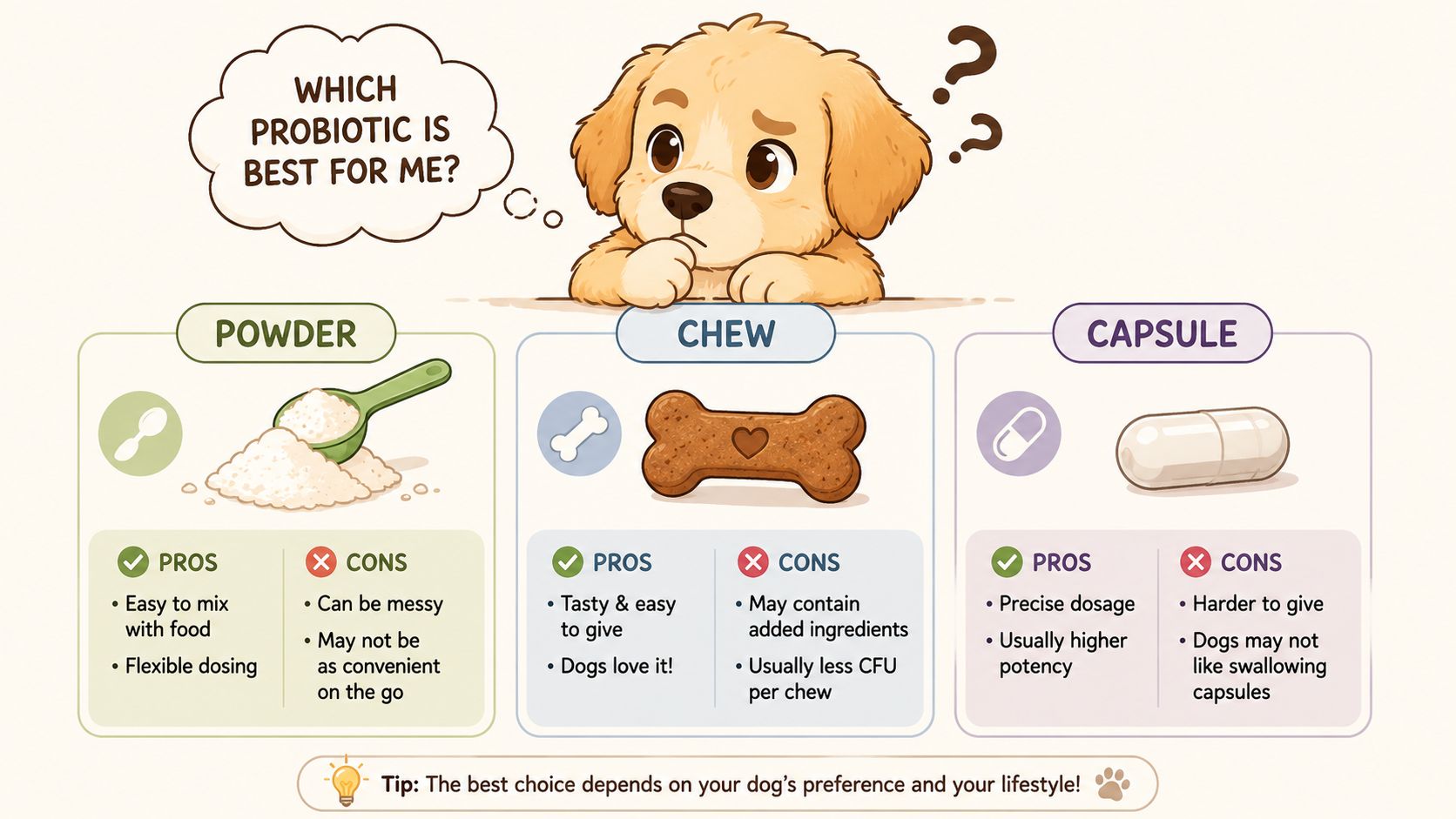
A quick way to sort formats:
- Powders work well for dogs eating meals with some moisture. They're easy to spread through food and useful for gradual dose changes.
- Chews can be convenient for routine use, but some sensitive dogs react poorly to extra flavorings or added ingredients.
- Capsules can be useful when you want a more exact serving. They're less practical for dogs who hate pills.
A dog with dental pain may do better with powder. A dog with a very limited ingredient diet may need a simpler formula. A dog who guards food but loves treats may take a chew more easily. Compliance matters because the best supplement on paper won't help if your dog never eats it.
What to look for on the label
Skip the front-of-pack promises for a minute. Turn the container around.
Look for these quality markers:
- Named strains rather than only broad group names. “Lactobacillus” alone tells you less than a full strain listing.
- CFU information that gives you a meaningful sense of potency.
- Storage directions that are clear and realistic.
- Few unnecessary extras if your dog already reacts to additives.
- Third-party testing or manufacturing transparency when available.
- A format your dog can take daily without a fight.
If the label makes grand claims but doesn't tell you the strains, that's a weak sign. Specific products should be specific about what they contain.
For sensitive dogs, I also prefer formulas that don't make you stack five different products unless there's a medical reason to separate them. Simpler routines are easier to follow, and owners are less likely to skip doses when everything fits into one habit.
Starting Probiotics The Right Way
Most dogs do better when you ease in instead of going all in on day one.
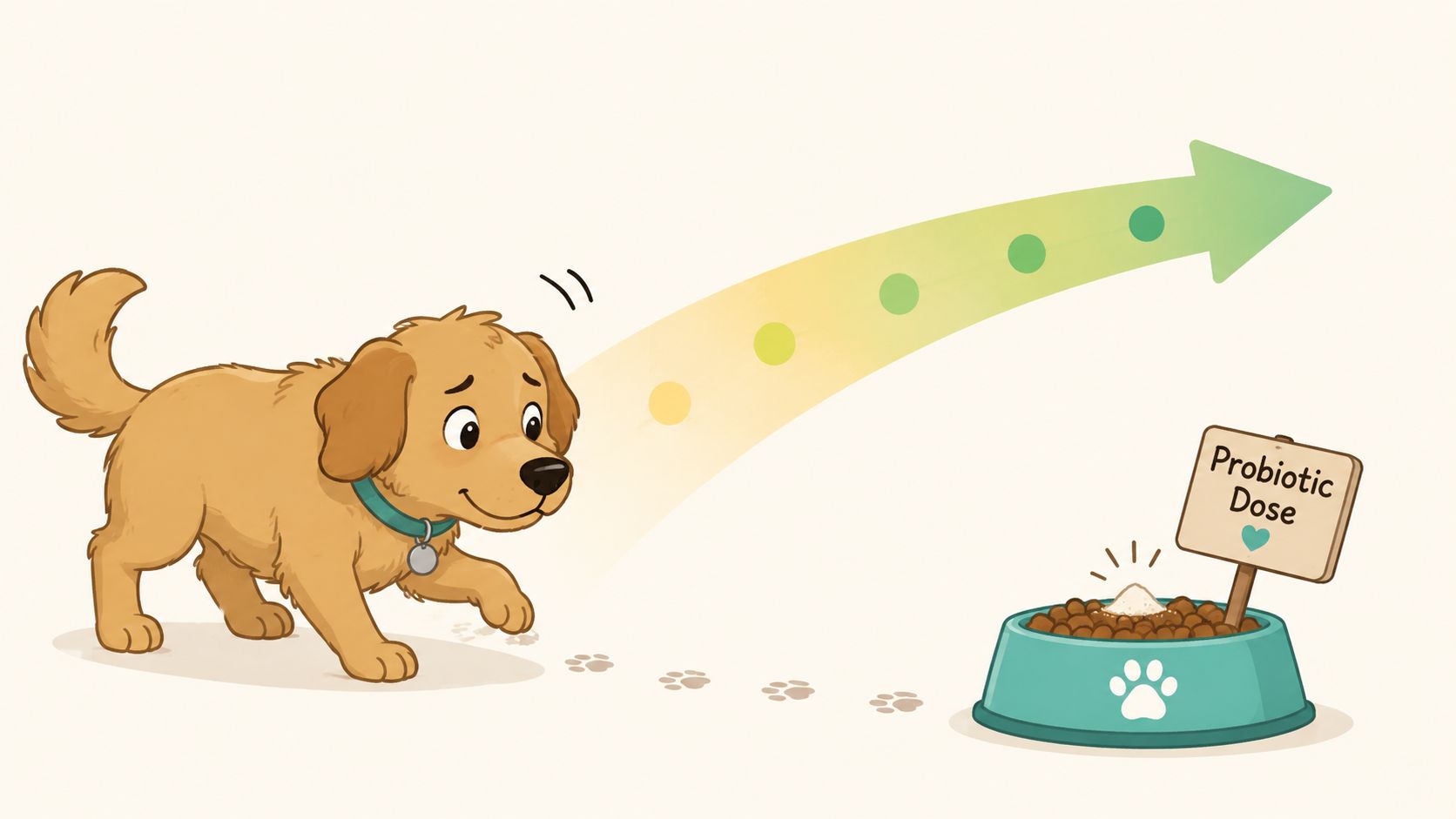
A simple way to begin
Start with a partial serving if the product allows for it, then work up over several days. That gives the gut time to adjust and helps you tell the difference between a brief adjustment period and a true intolerance.
Here's the basic rhythm I usually suggest owners discuss with their vet:
- Pick one change at a time. Don't start a probiotic on the same day you change food, treats, and toppers.
- Use meals as your anchor. Mix it into a consistent meal so your dog gets the full serving.
- Track stool, appetite, gas, and energy. A note on your phone is enough.
- Give it time. Improvements can be gradual.
For dogs with nonspecific dietary sensitivity, probiotic supplementation over 12 weeks has been shown to significantly improve fecal score and reduce defecation frequency, and that study noted this longer window may be necessary for Lactobacillus and Bifidobacterium strains to modulate mucosal immunity and support gut barrier integrity, according to this study on probiotic duration in dogs with dietary sensitivity.
That matters because many owners quit too early. They expect a dramatic overnight result, don't see one, and assume probiotics don't work for their dog.
What improvement usually looks like
You're usually watching for boring improvements. That's a good thing.
- Stools become more predictable.
- Urgency decreases.
- Gas becomes less frequent or less intense.
- Your dog seems more comfortable after meals.
This video gives a simple visual overview of introducing support into a daily feeding routine.
If your dog gets mild gas at first, that can happen during adjustment. If symptoms clearly worsen, stop and talk to your vet.
When You Must Talk to Your Vet First
This is the part many product roundups skip. A dog probiotic for sensitive stomach symptoms is not always the right first step.
Red flags that change the plan
If your dog has any of the signs below, don't treat it like a routine tummy issue:
- Blood in the stool
- Repeated vomiting
- Weight loss
- Poor appetite that lasts
- Lethargy
- Obvious abdominal pain
- Symptoms that keep returning
- A puppy who's repeatedly sick

A dog can have loose stool because of diet sensitivity. A dog can also have loose stool because of parasites, pancreatitis, inflammatory bowel disease, infection, or another condition that needs treatment first. The symptom may look similar to you at home, but the plan is different.
Why inflammation comes first
Clinical veterinarians caution that probiotics can be ineffective for dogs with active gut inflammation, and that the priority should be resolving the inflammation before introducing microbial support. They also note that adding probiotics to an inflamed gut lining can be counterproductive, as discussed in this veterinary discussion on inflammation before probiotics.
That idea surprises owners because probiotic marketing often sounds universal. In real life, an inflamed gut is more like raw skin. You don't start by piling extras onto it. You calm it down first.
A helpful sequence is often this: identify the cause, calm active inflammation if present, then consider targeted microbiome support.
If your dog has chronic digestive trouble, ask your vet direct questions. Is this simple stomach sensitivity, or could there be active inflammation? Should we run fecal testing? Is there reason to trial a diet first? Those questions can save you weeks of guessing.
The All-in-One Advantage for Total Gut Wellness
Sensitive stomachs rarely exist in a vacuum. Dogs with digestive trouble may also deal with stress sensitivity, skin flare-ups, or the general wear and tear that comes with aging. From an owner's side, that often turns into a supplement pile on the counter and a daily routine that's hard to keep up with.
Why one scoop can simplify care
When support needs overlap, a combined formula can make practical sense. Instead of chasing one symptom at a time, you're looking at the dog as a whole system.

Pure Paw Labs offers DA-1™ Daily All-in-One - Skin/Coat, Joints, Gut Health & More as a once-daily human-grade powder designed to combine support for joints, skin and coat, digestion, immunity, and stress in one scoop. According to the company information provided, the formula is positioned as a way to reduce the complexity of juggling multiple supplements.
That kind of all-in-one approach isn't about replacing veterinary care. It's about making a routine more manageable when your dog benefits from broad daily support, especially if you know missed doses happen when care gets too complicated.
Frequently Asked Questions About Dog Probiotics
Can I give my dog a human probiotic
I wouldn't make that your default. Dog products are formulated with canine use in mind, and human supplements may include ingredients, flavors, or dosing assumptions that don't fit your dog well. If you already have a human probiotic at home and are tempted to use it, ask your vet first.
Do dog probiotics need to be refrigerated
Some do, some don't. Follow the storage instructions on the label exactly. Stability matters with probiotics because they contain living organisms, and poor storage can reduce usefulness.
How long should I try a dog probiotic for sensitive stomach issues
Think in weeks, not days. Some dogs show early stool changes fairly quickly, but longer support may be needed before the gut environment shifts in a meaningful way. Keep the routine consistent and track what you're seeing.
Can probiotics cause side effects
They can cause mild digestive changes during the adjustment period, especially gas or temporary stool changes. That's one reason I like the “start low, go slow” approach. If your dog seems clearly worse, stops eating, or develops more serious symptoms, stop and call your vet.
Mild adjustment is one thing. Escalating symptoms are another.
A final reminder. Probiotics are a tool, not a shortcut. They're most useful when you match the right strain to the right problem, introduce them thoughtfully, and don't ignore signs that your dog needs medical evaluation first.
If you're trying to simplify your dog's routine without losing sight of gut support, Pure Paw Labs offers daily supplement options built around a single-scoop approach. For many owners, the biggest win isn't chasing a miracle fix. It's building a steady, realistic routine their dog can stick with.