


Yes, some joint supplements work for some dogs, but the evidence depends heavily on the active ingredients and the individual dog. In a 2007 controlled trial, a glucosamine and chondroitin product improved several clinical measures by day 70, while a 2022 review found omega-3 products helpful for pain but described glucosamine-chondroitin nutraceuticals as showing a “very marked non-effect” for osteoarthritis pain.
So why do many owners still hear that every joint chew “supports mobility” as though all formulas are interchangeable? The label category is broad, but the evidence isn't. A marine omega-3 product, a newer multimodal formula, and a traditional glucosamine-chondroitin chew may have very different prospects.
The useful question isn't just do joint support supplements work. It's which ingredient, in which formulation, for which dog, with what outcome and timeline? The answer becomes clearer when you separate proposed biology from clinical evidence, then judge a product against a measurable goal.
Table of Contents
- Do Joint Support Supplements Work for Dogs
- How Joint Supplements Are Supposed to Work
- What the Evidence Says About the Main Ingredients
- Why Results Vary Between Products and Dogs
- Realistic Timelines and What Improvement Looks Like
- Safety, Interactions, and When Supplements Are Not Enough
- How to Choose and Use a Joint Supplement Wisely
- A Practical Plan to Discuss With Your Vet
Do Joint Support Supplements Work for Dogs
Do joint supplements help every dog? No single answer fits the category. Joint supplements aren't a uniform treatment category. Their ingredients, formulation quality, dose, the dog's diagnosis, and disease severity all affect the likely result. A product may reduce stiffness or help a dog stay active without reversing osteoarthritis. Advanced pain may require prescription treatment, rehabilitation, weight management, or several approaches together.
Evidence is strongest when a study measures clinical change rather than relying only on enthusiastic owner reports. In a controlled trial of 35 dogs with hip or elbow osteoarthritis, a glucosamine-chondroitin product produced statistically significant improvements in pain scores, weight-bearing ability, and overall disease severity by day 70, with P < 0.001. The response developed more slowly than with carprofen. The controlled canine osteoarthritis trial therefore supports a measured conclusion: some products may help diagnosed osteoarthritis, but improvement can be gradual and may not match an NSAID's speed or strength.
Start with the active ingredient
The buying decision begins with the formula, not the word “joint” on the label. Omega-3-focused products and newer multimodal blends have a stronger evidence case than many classic glucosamine-chondroitin stacks. A 2022 systematic review and meta-analysis found a beneficial analgesic effect for omega-3 products, while chondroitin-glucosamine products showed a very marked lack of pain-management effect and were not recommended specifically for osteoarthritis pain control. The systematic review and meta-analysis also found mixed glucosamine and chondroitin research. That helps explain why personal testimonials can sound positive while controlled trials remain less convincing.
Other formulas may contain green-lipped mussel, eggshell membrane, MSM, hyaluronic acid, avocado-soybean unsaponifiables, curcumin, or Boswellia. These ingredients should be judged by canine clinical evidence, dose, product quality, and a defined goal rather than by a long ingredient list. For practical owner-focused context, see managing canine joint discomfort with MEDISTIK.
How Joint Supplements Are Supposed to Work
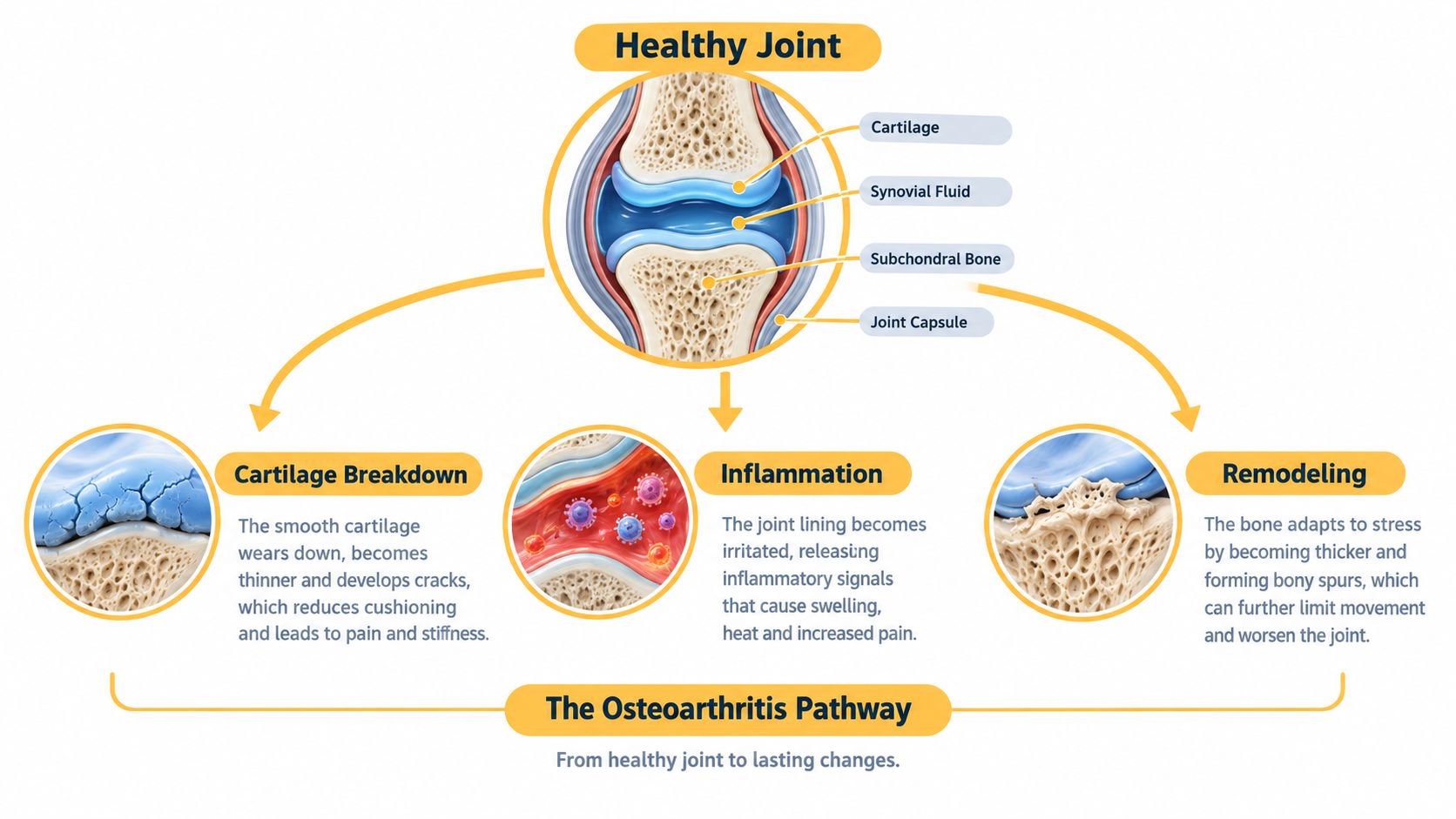
A dog's joint is more than cartilage. Cartilage covers the ends of bones and reduces friction. Synovial fluid lubricates the joint and helps absorb movement-related stress. Subchondral bone sits beneath the cartilage, while the joint capsule encloses and stabilizes the joint.
Osteoarthritis develops when repeated stress, injury, abnormal joint structure, or aging changes this system. Cartilage becomes less resilient, inflammatory signals irritate the joint, the capsule can thicken, and the bone beneath the cartilage remodels. Pain may come from several of these tissues, not just from cartilage itself.
What each ingredient is intended to do
- Glucosamine and chondroitin are associated with cartilage matrix components. The theory is that they provide building blocks or influence cartilage metabolism, but that biological rationale doesn't prove meaningful pain relief in everyday patients.
- Omega-3 fatty acids, especially EPA and DHA, are used to influence inflammatory pathways. This is the ingredient group with the clearest supportive evidence in the current review.
- Green-lipped mussel supplies marine lipids and glycosaminoglycans. Its proposed benefit combines anti-inflammatory lipid activity with structural joint support.
- MSM is marketed for antioxidant and inflammatory support. Its canine evidence is less settled than the evidence for omega-3 products.
- Hyaluronic acid may help support the viscosity and lubricating qualities of synovial fluid, although oral absorption and clinical effects remain important uncertainties.
- Eggshell membrane contains structural substances associated with collagen and elastin. Newer multimodal research has increased interest in this ingredient.
- ASU, or avocado-soybean unsaponifiables, is proposed to help protect cartilage and regulate inflammatory activity.
- Curcumin and Boswellia are botanical ingredients intended to influence inflammatory pathways. Formulation and absorption matter greatly, and evidence from other species can't automatically be applied to dogs.
Most supplements aim to reduce inflammatory pressure or support remaining joint tissue. They aren't proven to regrow badly damaged cartilage, correct a torn ligament, or replace a necessary operation. That distinction matters when owners assess whether a dog is “better.” Easier rising and greater willingness to walk are realistic outcomes, while a restored joint is not.
Some owners also explore non-supplement approaches, including regenerative care for osteoarthritis. If you're comparing a multi-system option, DA-1™ Daily All-in-One - Senior Dog Support, Joints, Skin/Coat & More is described as a once-daily formula with 18 human-grade ingredients targeting cells, gut, and joints, without pills or fillers.
What the Evidence Says About the Main Ingredients
The evidence becomes easier to interpret when you rank it by ingredient and study design, rather than treating every product as equally supported. Randomized, blinded, controlled trials generally provide more dependable information than owner surveys or uncontrolled observations because they reduce the chance that normal day-to-day variation gets mistaken for treatment response.
A practical evidence hierarchy
Omega-3 products currently stand out. The 2022 systematic review and meta-analysis found a beneficial analgesic effect for omega-3 nutraceuticals in canine and feline osteoarthritis research. That doesn't mean every fish oil product will work, because source, EPA and DHA content, oxidation, dose, and compliance still matter.
Newer multimodal formulas also deserve attention, but their results shouldn't be generalized to every blend. A 2025 randomized, double-blind, placebo-controlled study reported improved mobility and quality of life from a formula built around eggshell membrane, krill meal, astaxanthin, hyaluronic acid, and Boswellia serrata. A 2023 prospective trial found no positive treatment effect from glucosamine and chondroitin on peak vertical force, while carprofen and some marine-based fatty acid compounds produced benefits. These findings raise a useful question: are newer formulas helping because of their combined design, or because marine anti-inflammatory ingredients do more of the clinical work?
Glucosamine and chondroitin sit in the mixed-to-weak category. The earlier controlled trial was positive, but the broader evidence remains inconsistent. An independent veterinary review concluded that the evidence was too weak to confirm a clinically meaningful benefit, and noted that few supplements other than fish oil had been definitively proven to slow orthopedic degeneration. The veterinary review of canine osteoarthritis supplements provides an important counterweight to confident label language.
| Ingredient | Proposed action | Canine evidence strength | Key trial notes |
|---|---|---|---|
| Omega-3 EPA and DHA | Modulate inflammatory pathways and pain | Strongest among the categories discussed | A 2022 systematic review found a beneficial analgesic effect |
| Green-lipped mussel | Provide marine lipids and glycosaminoglycans | Promising, but formulation-dependent | Results vary by product and study design |
| Eggshell membrane | Supply structural compounds linked with connective tissue | Promising and emerging | Included in a positive 2025 multimodal randomized trial |
| Glucosamine and chondroitin | Support cartilage matrix and metabolism | Mixed to weak | A positive 2007 trial contrasts with later inconsistent findings |
| ASU | Support cartilage protection and inflammatory regulation | Preliminary to moderate | Evidence is less extensive than for omega-3 products |
| MSM | Provide antioxidant and anti-inflammatory support | Limited or mixed | Standalone canine evidence remains less established |
| Hyaluronic acid | Support synovial fluid properties | Preliminary | Oral effects and clinical relevance remain uncertain |
| Curcumin and Boswellia | Influence inflammatory pathways | Preliminary and formulation-dependent | Boswellia appeared in a positive newer multimodal formula, but that result doesn't validate every botanical blend |
For practical background on arthritis symptoms and supportive care, the Thermo Recovery Wear arthritis resource may help owners organize questions before an appointment. Product labels and ingredient choices are also discussed in this guide to dog mobility supplements, but a product's ingredient list still needs to be judged against the quality of the evidence behind those ingredients.
Why Results Vary Between Products and Dogs
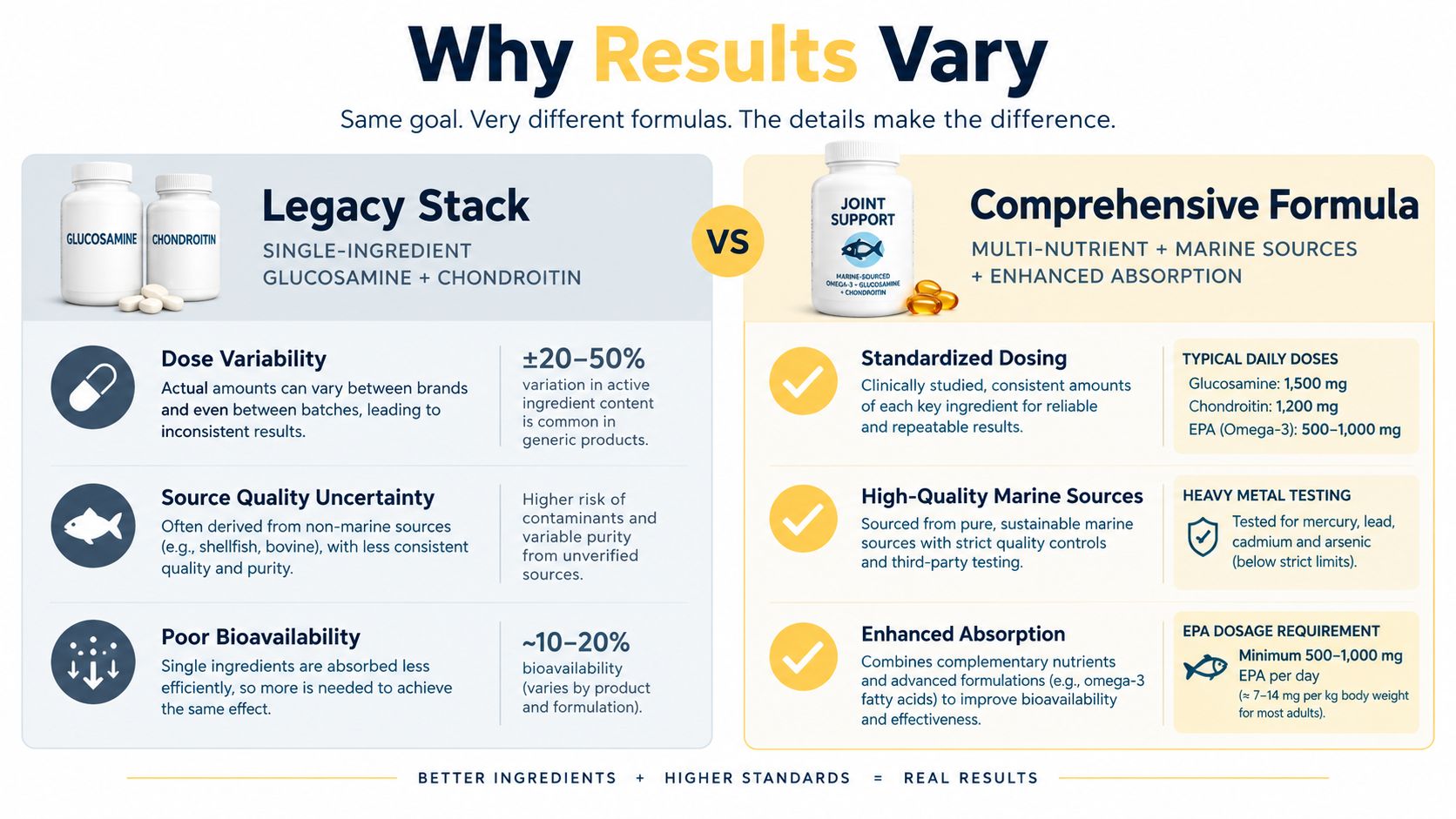
Two owners can use products described as “joint support” and see opposite outcomes without either person being mistaken. The products may share a front-label category while differing in active amounts, ingredient sources, stability, absorption, and whether the formula contains an ingredient with meaningful evidence.
A traditional glucosamine-chondroitin stack may be reasonable for an owner who wants to test that approach, but it shouldn't be treated as equivalent to an omega-3-centered or newer multimodal formula. The 2022 review found that the glucosamine-chondroitin evidence was inconsistent, while omega-3 products showed a more favorable analgesic signal. A newer blend containing eggshell membrane, krill meal, astaxanthin, hyaluronic acid, and Boswellia also produced positive findings in a controlled 2025 study, but that result applies to the studied formula, not automatically to every product using one of its ingredients. The randomized multimodal study illustrates why formula-level evidence matters.
The dog contributes another layer of variation. A young dog with an unstable joint, an older dog with chronic osteoarthritis, and a dog whose stiffness comes from a spinal problem don't have the same treatment target. Body condition, breed-related orthopedic risk, activity level, disease stage, and concurrent medication can all change what an owner notices.
Practical rule: A supplement trial should answer a defined question, such as whether the dog rises more easily or walks farther, rather than relying on a vague impression that the dog seems “brighter.”
Realistic Timelines and What Improvement Looks Like
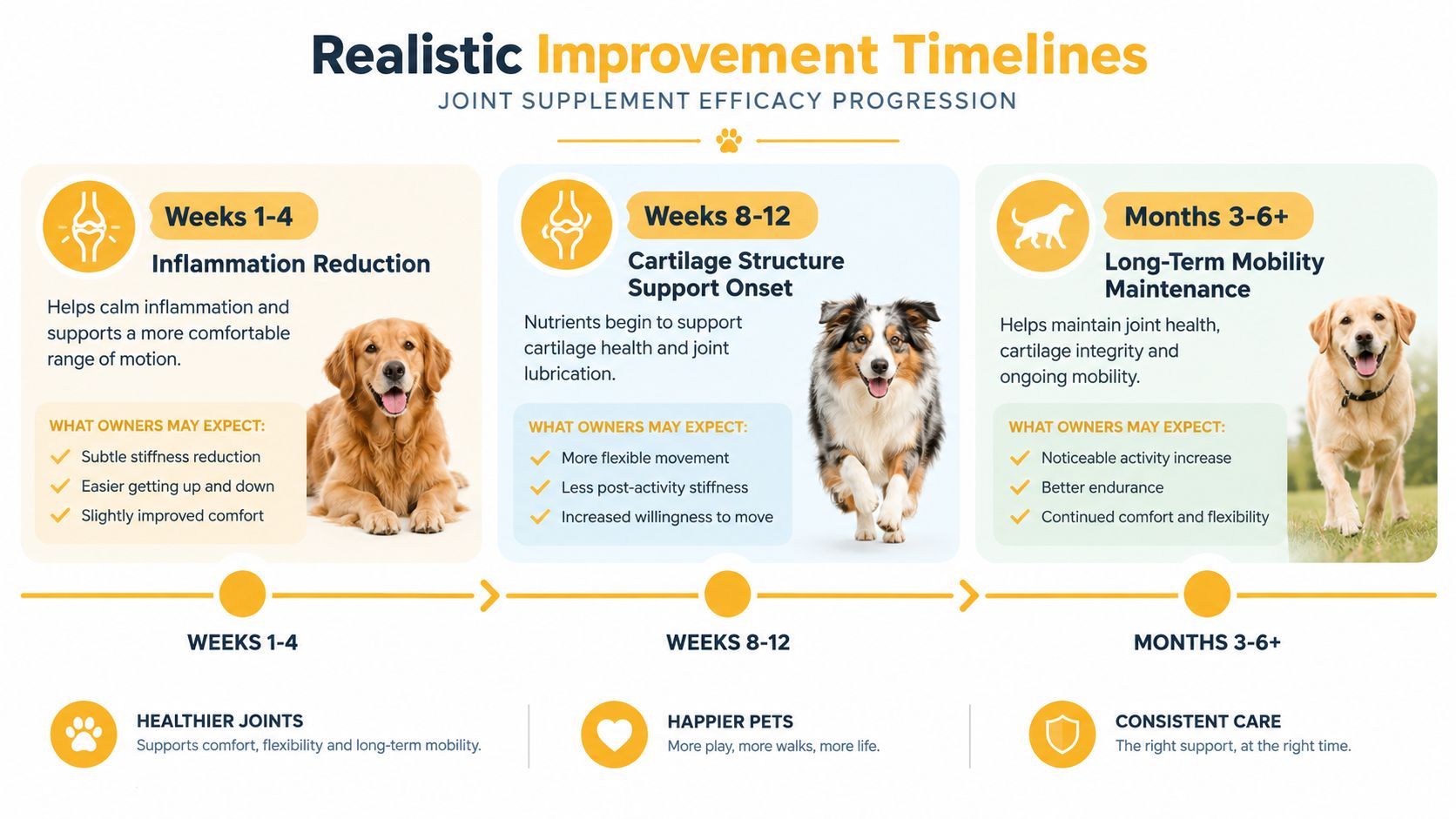
Supplements aren't fast painkillers. Their effects, if they occur, usually emerge gradually, and the timeline depends on the ingredient, the formulation, and the dog's underlying condition.
Owners often notice functional changes before dramatic changes in gait. A dog may stand up with less hesitation, settle more comfortably after a walk, climb a familiar step more readily, or show more interest in gentle activity. These changes can be subtle, so recording a short video of the dog rising and walking gives you a more reliable comparison than memory alone.
Judge change against a baseline
A sensible trial uses the same observations at the start and throughout the trial:
- Record movement: Film rising, walking on a flat surface, and turning.
- Track routines: Note willingness to walk, stiffness after rest, and difficulty with stairs.
- Avoid changing everything: Don't start several new supplements or alter exercise dramatically at the same time.
- Review critically: Continue only if the change is meaningful, consistent, and safe.
The evidence doesn't justify promising a universal timeline for every ingredient. The earlier controlled glucosamine-chondroitin trial found improvement by day 70, while the broader literature remains mixed. Use a measured trial period agreed with your veterinarian instead of increasing the dose because improvement hasn't appeared quickly.
A supplement isn't the right response to acute lameness, visible swelling, sudden inability to bear weight, appetite loss, severe lethargy, or pain when the joint is handled. Those signs need prompt veterinary assessment. They can indicate an injury, infection, neurological problem, or another condition that supplements won't diagnose or treat.
Safety, Interactions, and When Supplements Are Not Enough
Many commonly used canine joint ingredients have a generally favorable safety record when given at label directions, but “natural” doesn't mean risk-free. Dogs can react to the active ingredient, the flavoring, the carrier, or an interaction with medication.
Omega-3 products deserve particular care because high intake can affect platelet function, and excessive use of fat-soluble vitamins can create accumulation concerns. Sugar-containing excipients may matter for diabetic dogs. Human products can also contain ingredients that are unsafe for dogs, including xylitol, or provide a dose that doesn't match canine use.
| Ingredient | Typical safety | Key cautions | Notable interactions |
|---|---|---|---|
| Glucosamine | Often tolerated at label directions | Digestive upset, source and excipient concerns | Review use with anticoagulants and chronic medications |
| Chondroitin | Often tolerated at label directions | Product quality and combination ingredients vary | Discuss with the veterinarian if bleeding risk is relevant |
| Omega-3 oils | Often useful when appropriately formulated | Oxidation, digestive upset, platelet effects, excessive dosing | Review alongside NSAIDs, anticoagulants, and some heart medications |
| MSM | Often tolerated, but evidence is limited | Quality and dose vary | Confirm compatibility with prescribed treatment |
| Green-lipped mussel | Usually tolerated in suitable canine products | Digestive sensitivity and ingredient-source concerns | Review the full formula with the prescribing veterinarian |
A product's label should identify the active ingredients and amounts clearly. Look for species-specific directions, transparent sourcing, and independent quality checks such as an NASC quality seal or relevant third-party testing. These markers don't prove clinical effectiveness, but they can reduce uncertainty about what the dog is receiving.
For a focused review of possible adverse effects, see this guide to dog joint supplement side effects. Always show the full label to your veterinarian, especially if your dog receives an NSAID, anticoagulant, or heart medication.
How to Choose and Use a Joint Supplement Wisely
Choose by active ingredient and measurable purpose, not by the number of claims on the front of the container. If osteoarthritis pain is the concern, omega-3 content deserves close attention because it has the clearest favorable signal in the evidence summarized above.
Read the label in this order
- Identify the marine actives: Check whether EPA and DHA are declared separately rather than hidden inside a generic “fish oil” amount.
- Check source and testing: Prefer marine oils with clear sourcing and heavy-metal testing information.
- Look for a defined formulation: Green-lipped mussel or eggshell membrane may be reasonable options when the product states what it contains and how much.
- Treat glucosamine-chondroitin as optional: The evidence is inconsistent, so don't assume a familiar combination is automatically the best choice.
- Reject proprietary ambiguity: A blend that hides individual amounts makes it difficult to compare the product with research or judge whether the dose is appropriate.
Learning how to read dog supplement labels can help you distinguish a declared amount of an active ingredient from a larger headline quantity that includes carriers or flavoring.
Give the product according to the label's weight range, ideally with food if the directions allow it. Split dosing only when the label or veterinarian recommends it. Don't combine several products that contain the same oil, vitamin, or botanical without adding their totals together.
Build the foundation around the supplement
A joint product can't compensate for excessive body weight or complete inactivity. Ask your veterinarian to assess body condition and set a safe feeding plan. Controlled, low-impact movement, such as leash walks or swimming when appropriate, can preserve strength without repeatedly provoking pain.
Keep a simple log. Record the product, amount, start date, mobility observations, digestive effects, and other medications. If there is no meaningful change after the agreed trial, stop and reassess rather than escalating indefinitely. Human supplements aren't interchangeable with canine products because of ingredient toxicity, dosing differences, and unsuitable combinations.
A Practical Plan to Discuss With Your Vet
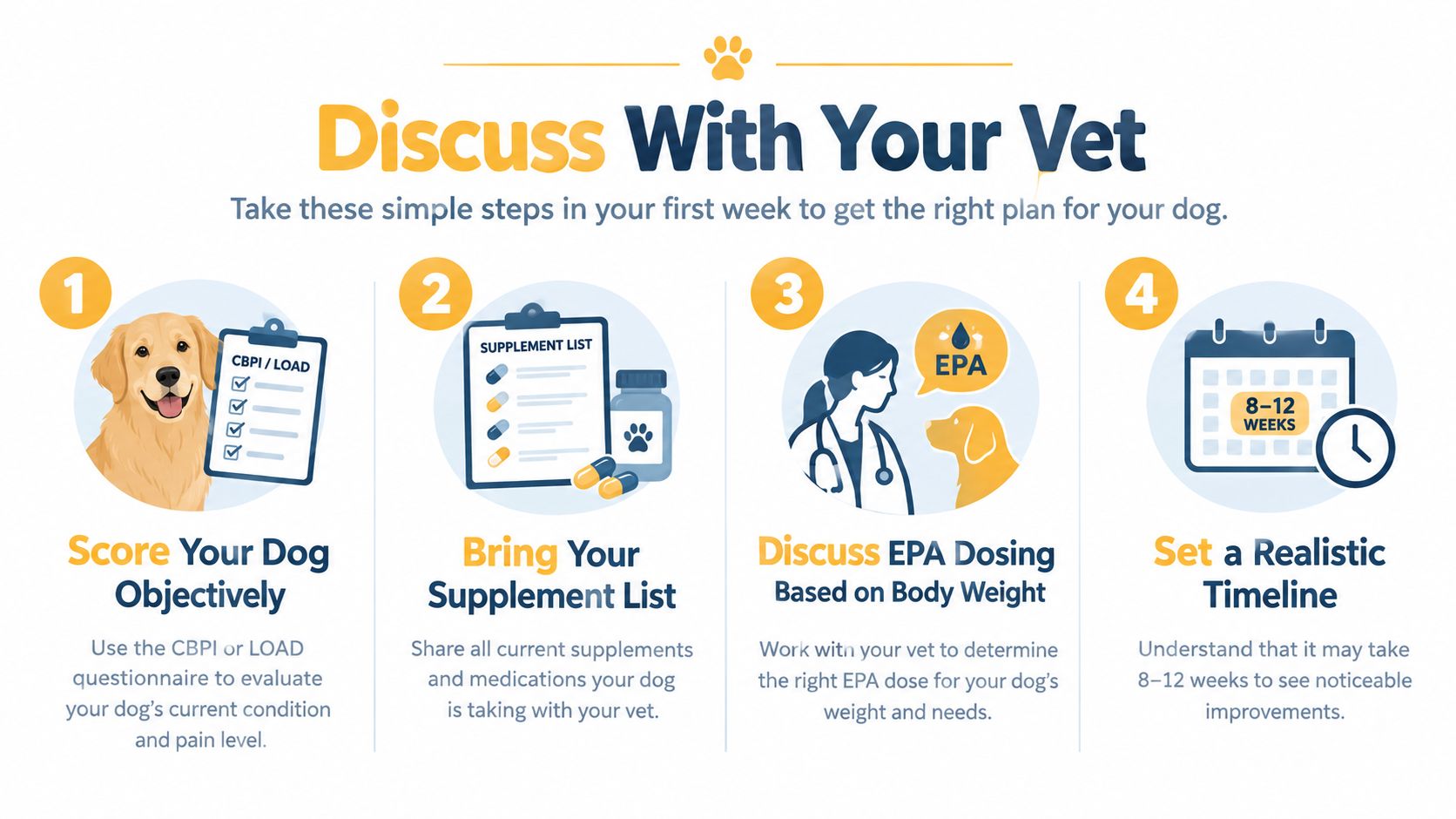
Use the first week to create a baseline instead of immediately buying several products. A clear record gives your veterinarian something more useful than a general statement that your dog “seems stiff.”
- Score the dog objectively. Complete a validated owner questionnaire such as CBPI or LOAD if your veterinarian recommends it. Record short videos of rising, walking, turning, and negotiating a familiar step.
- Confirm the diagnosis. Osteoarthritis is common, but cruciate disease, luxating patella, infection, spinal disease, and neoplasia can produce overlapping signs. Ask what examination or imaging is needed.
- Bring every product to the appointment. Take photographs of labels or bring the containers. Include oils, treats, human supplements, prescription medicines, and anything shared from another pet.
- Agree on targets and timing. Set a mobility goal, a weight or exercise plan, and a review date. If a supplement is appropriate, decide which active ingredient will be tested and how you'll judge success.
At the follow-up, use the same questionnaire and videos rather than relying on memory. Discuss whether the dog's comfort, activity, and daily function changed enough to justify continuing. If there's no improvement, the answer may be a different active ingredient, a broader pain-management plan, or a revised diagnosis.
Ask three direct questions:
- Which ingredients do you trust for this dog's condition?
- Has the chosen product been independently tested and clearly labeled?
- What result would justify continuing, and what result means we should stop?
Pure Paw Labs offers daily dog supplements, including a multi-system powder designed to support joints alongside areas such as digestion, skin and coat, immunity, and stress. Review the ingredient information at Pure Paw Labs, then bring the product label and your dog's mobility goals to your veterinarian before starting.