


At 3 a.m., your dog vomits again. Their back is slightly hunched, they won't look at breakfast, and you're standing in the kitchen wondering whether boiled chicken and rice will help or make things worse. That uncertainty is understandable, but pancreatitis isn't an ordinary upset stomach. A dog with repeated vomiting, obvious abdominal pain, weakness, or an inability to keep water down needs veterinary guidance, not a recipe.
When your veterinarian has assessed the episode and says feeding can resume, a bland diet for dogs with pancreatitis can be useful. The important distinction is that it's a short-term bridge, not a complete treatment and not a diet to continue indefinitely. The practical endpoint is a comfortable dog who can eat without vomiting, followed by a carefully managed move to a balanced, highly digestible, low-fat maintenance food.
Table of Contents
- When a Bland Diet Is the Right Call for Pancreatitis
- Safe Foods and a Simple Homemade Recipe
- Portioning, Meal Frequency, and a 7-Day Transition Plan
- Why the Bland Diet Is a Bridge, Not a Forever Plan
- Monitoring Recovery and Knowing When to Call the Vet
- Moving From Recovery to Long-Term Gut Support
- Quick Checklist and Common Questions
When a Bland Diet Is the Right Call for Pancreatitis
The right moment for bland feeding usually comes after the vet has ruled out a more serious obstruction, severe dehydration, or another condition that needs urgent treatment. Consider a dog sent home after a mild pancreatitis flare. Vomiting has stopped, the dog can take small amounts of water, and the veterinarian has approved refeeding. That's the setting where plain, low-fat food may support recovery.
A bland meal doesn't “cure” pancreatic inflammation. It reduces digestive complexity while calories are brought back gradually. Fat is the central nutritional concern, because high-fat diets are recognized as a recurrence risk in dogs with pancreatitis. Veterinary guidance commonly places pancreatitis diets below 10% fat on a dry matter basis, while another veterinary review identifies a ceiling of 20 grams of fat per 1,000 kcal, approximately 7% fat on a dry matter basis. These targets are discussed in the Royal Canin veterinary review of canine pancreatitis.
Three situations that look similar but aren't
- A diagnosed mild flare: Your vet has given feeding instructions, vomiting is settling, and your dog is hydrated enough to recover at home. Bland food may be appropriate temporarily.
- A suspected flare overnight: Don't assume pancreatitis from vomiting alone. Call the veterinary clinic for guidance, especially if pain, lethargy, diarrhea, or poor appetite accompanies it.
- Chronic or recurrent pancreatitis: Homemade chicken and rice is rarely an adequate long-term strategy. These dogs often need a carefully selected therapeutic low-fat food and follow-up with the veterinary team.
The traditional bland ration is boiled, skinless chicken breast with plain cooked white rice. It's easy to digest and usually palatable, but it's incomplete. Veterinary guidance describes this combination as a temporary bridge, with some recommendations limiting it to 5–7 days before changing to a nutritionally balanced low-fat diet. The modern goal is controlled refeeding, not prolonged fasting or weeks of improvised meals.
Practical rule: Start cooking only after your veterinarian has cleared your dog to eat. Stop treating the situation as a home-feeding problem if vomiting returns, water won't stay down, or your dog seems painful or collapsed.
Safe Foods and a Simple Homemade Recipe
The safest shopping list is deliberately boring: skinless chicken breast, plain white rice, plain pumpkin, and optional low-fat cottage cheese. Cook everything without oil, butter, salt, seasoning, onion, garlic, gravy, or skin. The familiar chicken-and-rice pairing works because it's simple and relatively easy to digest, but the ingredients still need to remain lean enough for the pancreas.
Use the fat benchmarks as guardrails rather than pretending a kitchen recipe can deliver laboratory precision. Many veterinary sources use under 10% fat on a dry matter basis, and some use 20 grams of fat per 1,000 kcal as a practical ceiling. Severe or recurrent cases may need an even lower target, so ask your veterinarian for the specific limit before relying on homemade food. The veterinary nutrition guidance summarized by SpectrumCare's pancreatitis diet resource emphasizes measurable fat targets, digestibility, small meals, and a prompt handoff to balanced food.
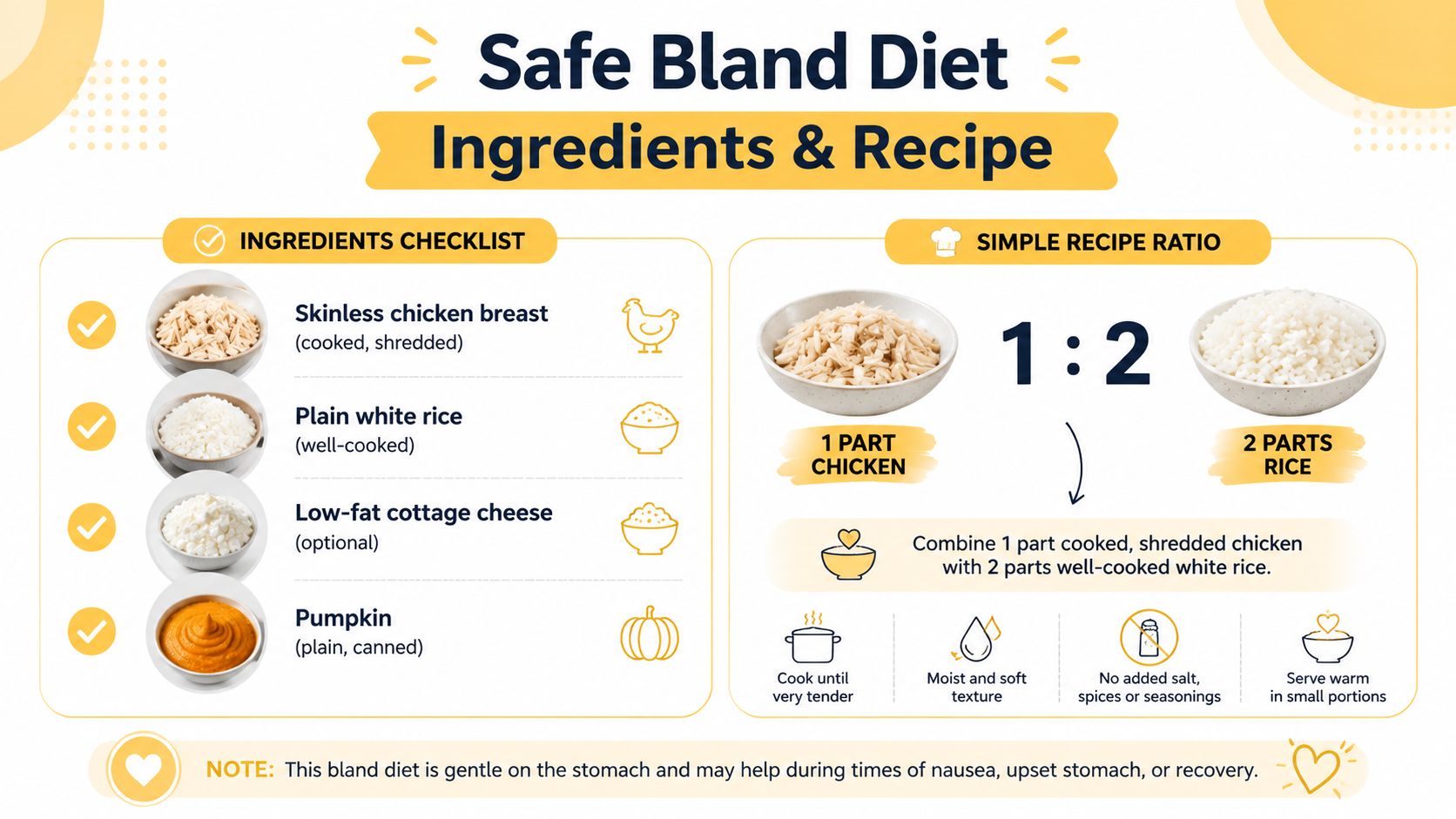
A simple starter recipe
For a temporary batch, combine:
- Cooked skinless chicken breast: 1 part, shredded and cooled
- Plain cooked white rice: 2 parts
- Plain pumpkin: a small optional addition if your veterinarian approves it
- Low-fat cottage cheese: an optional small rotation ingredient, only if dairy is tolerated
The classic ratio is 1 part chicken to 2 parts rice, with rice providing the larger share. Weighing cooked ingredients helps you repeat the same mixture, but it doesn't prove the finished food meets a dry matter fat target. Trim visible fat, drain cooking liquid, and don't add broth unless you've confirmed it contains no onion, garlic, seasoning, or concentrated fat.
Lean ground turkey with plain sweet potato can be another rotation, provided the turkey is lean and drained. Low-fat cottage cheese with plain pumpkin may suit some dogs, but dairy can worsen digestive signs in others. During an acute flare, avoid fatty red meats, fish oils, full-fat dairy, bacon, sausage, rich treats, and bone broth made from fatty bones.
If you're considering broth, use a veterinary-approved, fat-free preparation rather than improvising from drippings. This plain bone broth recipe for dogs should still be reviewed against your dog's pancreatitis instructions before use.
The following video may help with basic preparation technique, but it doesn't replace your veterinarian's feeding plan.
Switch to a veterinary recovery or prescription low-fat diet sooner if your dog has recurrent disease, significant weight loss, ongoing vomiting, or difficulty meeting calorie needs. Homemade bland food is useful because it's simple, not because it's nutritionally complete.
Portioning, Meal Frequency, and a 7-Day Transition Plan
A recovering pancreas generally handles small, frequent meals better than one or two large servings. Veterinary sources commonly recommend 3–4 meals per day during recovery, with calories reintroduced gradually. Early enteral feeding is also supported by a retrospective study of hospitalized dogs, where feeding within 48 hours was associated with voluntary intake at 2.1 days versus 2.7 days with delayed feeding, and maximum intake at 3.0 days versus 3.4 days. The study also reported less gastrointestinal intolerance, as described in the PubMed study on early enteral nutrition in dogs with acute pancreatitis.
Don't use a rigid volume as a substitute for observation. A toy dog may begin with a teaspoon-sized taste, while a large dog may start with a tablespoon-sized taste, then wait to see whether it stays down. For a dog already tolerating food, divide the veterinarian-approved daily amount into four portions. As a rough kitchen framework, owners may divide the usual daily volume into portions such as a quarter cup per 10 pounds of body weight, but this should be adjusted to the dog's condition, calorie needs, and veterinary instructions rather than treated as a prescription.
The seven-day script
| Day | Meals per day | Portion guidance | Watch for |
|---|---|---|---|
| 1 | 3–4 | Tiny tastes, then cautiously increase only if food stays down | Vomiting, lip licking, worsening pain |
| 2 | 3–4 | Add a second or subsequent small meal if tolerated | Water intake, nausea, energy |
| 3 | 3–4 | Increase each meal modestly, keeping ingredients very low fat | Stool quality and abdominal comfort |
| 4 | 3–4 | Continue gradual volume increases | Appetite without begging or overeating |
| 5 | 3–4 | Approach the planned daily amount if signs remain settled | Loose, greasy, or unusually pale stool |
| 6 | 3–4 | Hold the tolerated volume steady | Stable appetite and normalizing stool |
| 7 | 3–4 | Begin the handoff to balanced low-fat food if cleared | Any relapse after the new food appears |
If food comes back up, don't immediately offer a full replacement meal. Contact your veterinarian for the next step, especially if vomiting repeats or water also fails to stay down. Keep a written log of meal time, approximate amount, vomiting, stool, water, and energy. The guide to fiber sources for dogs may be useful for general digestive planning, but don't add fiber products during pancreatitis recovery without veterinary approval.
Why the Bland Diet Is a Bridge, Not a Forever Plan
Chicken and rice feels safe because it's familiar and often looks better tolerated than a normal meal. The danger is that “tolerated” gets mistaken for “complete.” A dog can eat the same bowl for weeks while receiving an inadequate balance of essential nutrients.
Home-cooked chicken and rice lacks enough calcium for long-term feeding and doesn't reliably provide the full range of vitamins and minerals a dog needs. It also doesn't automatically supply appropriate omega-3 fatty acids, vitamin E, zinc, B vitamins, or a carefully balanced amino acid profile. These gaps matter even when the dog's stool looks normal.
Some veterinary guidance recommends limiting this bland approach to 5–7 days, as outlined in the earlier veterinary nutrition source. That ceiling isn't a claim that the food becomes toxic on the next day. It's a reminder that a temporary ration shouldn't replace a balanced diet.
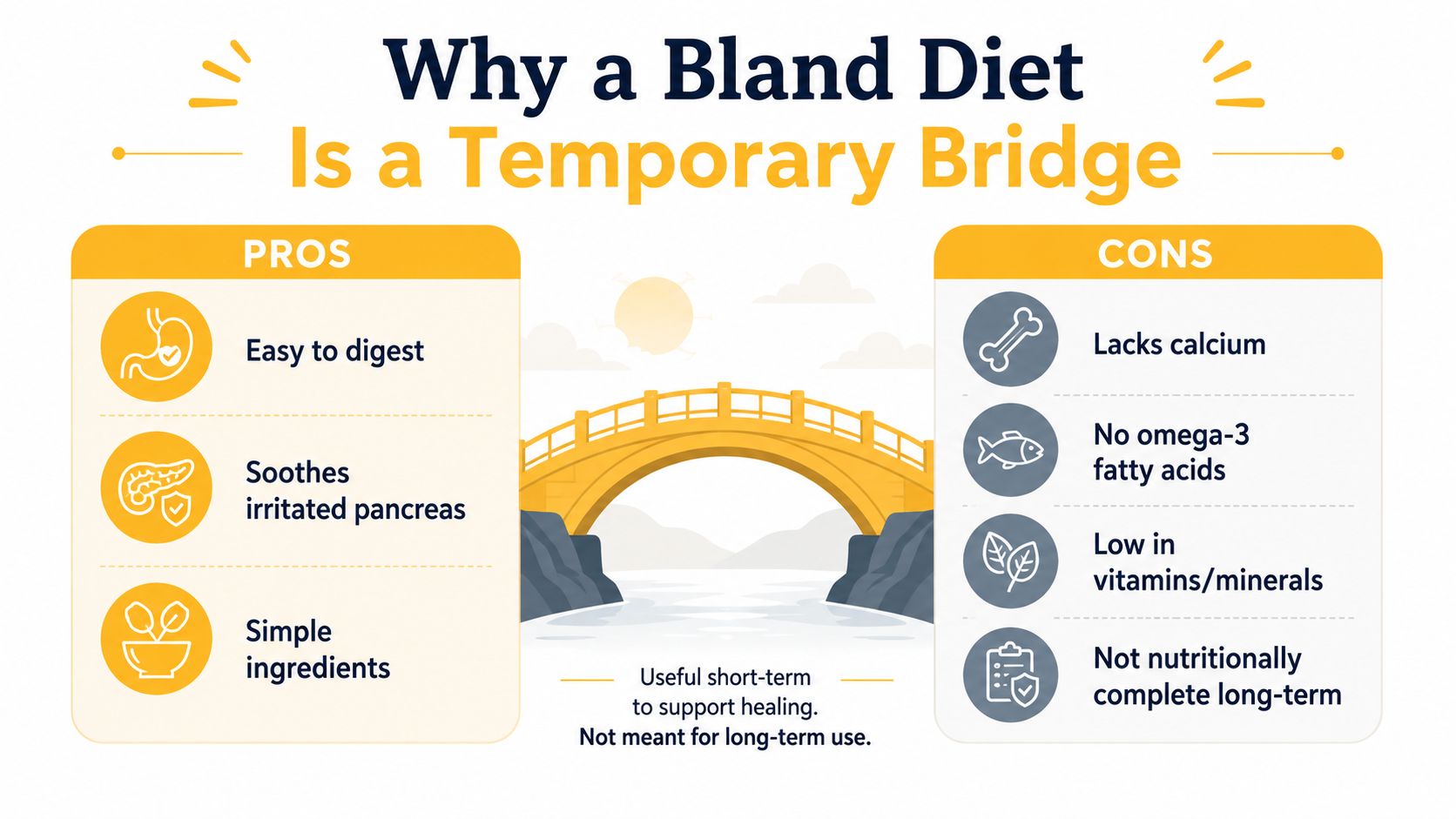
Keep cooking or change food
| Continue briefly with homemade food | Move to balanced low-fat food |
|---|---|
| Your veterinarian has approved short-term bland feeding | Vomiting has resolved and food is staying down |
| Your dog accepts the recipe and needs a gentle reintroduction | The dog needs complete nutrition beyond the temporary period |
| You're tracking symptoms and arranging follow-up | The episode was severe, recurrent, or associated with weight loss |
| The ingredients remain plain and low fat | You need controlled fat, vitamins, minerals, and calorie density |
The handoff should be gradual, not a sudden return to the old diet. A regular food can be too fatty even if the label sounds wholesome, and a single rich treat can undo several quiet days of recovery. The AVMA review of canine pancreatitis nutrition also stresses that recommendations are often based on limited-quality evidence, which is why your dog's response and veterinary oversight matter.
Monitoring Recovery and Knowing When to Call the Vet
Recovery is more than the absence of vomiting. Within the first day after feeding resumes, you want to see small meals staying down, water being tolerated, and no clear increase in abdominal discomfort. Over the next couple of days, appetite should become more reliable, energy should begin returning, and stool should trend toward normal rather than becoming increasingly watery or greasy.
A single isolated vomit still deserves attention in a dog with diagnosed pancreatitis, but it doesn't carry the same meaning as repeated vomiting with pain and weakness. Don't wait at home if your dog keeps vomiting, refuses water, becomes markedly lethargic, or adopts a hunched or prayer-like posture. Abdominal guarding, trembling, collapse, or an inability to settle can indicate pain that needs assessment.
Use this decision tree
- Food stays down and your dog is comfortable: Continue the approved small-meal plan and monitor closely.
- One concerning symptom appears: Call your veterinarian the same day, particularly for renewed vomiting, worsening diarrhea, reduced appetite, or unusual lethargy.
- Vomiting persists, water won't stay down, or the belly is painful: Seek urgent veterinary care.
- Your dog collapses, appears severely weak, or seems distressed: Treat it as an emergency rather than trying another recipe.
Stool deserves context. Mild looseness can occur during a diet change, but repeated watery diarrhea, blood, black stool, greasy stool, or diarrhea paired with vomiting should prompt a veterinary call. Appetite is also not a pass-fail test. A dog that eats a little but becomes increasingly quiet or painful may be deteriorating despite taking food.
Keep the symptom log beside the feeding area. Write down what was offered, how much was eaten, whether vomiting occurred, stool appearance, water intake, posture, and energy. Those observations give your veterinarian a far more useful picture than “he seems off.”
Moving From Recovery to Long-Term Gut Support
Once your dog is eating comfortably, the next meal should serve a long-term plan. Choose a complete, balanced, highly digestible low-fat maintenance food with a fat level appropriate to the dog's history. Many veterinary sources use under 10% fat on a dry matter basis as a practical target, while severe or recurrent cases may need a stricter limit. Ask your veterinarian to interpret the label, especially for wet foods, because moisture changes how the fat percentage appears.
Transition gradually over about a week. Start with mostly bland food and a smaller share of the approved maintenance diet, then increase the balanced food only when appetite, stool, and comfort remain stable. If symptoms worsen at any stage, pause the transition and call the veterinary team rather than pushing through.
Habits that reduce avoidable stress
Feed at consistent times and divide the daily ration into meals your dog can finish comfortably. Avoid table scraps, fatty leftovers, skin, rich chews, and unplanned treats from family members. Weight management matters because excess body weight can complicate long-term digestive care, and a slow feeder may help dogs that gulp.
For broader routine ideas, see this guide to digestive support for dogs. Probiotic foods or supplements may suit some dogs, but they aren't interchangeable with a low-fat diet and shouldn't be introduced during an unstable flare without professional advice.
After your dog is back on a balanced maintenance food, a supplement can be considered as an optional part of general wellness, not as treatment for pancreatitis. DA-1™ Daily All-in-One, Senior Dog Support, Joints, Skin/Coat & More is described as a single-scoop formula with 18 human-grade ingredients, 99.8% active ingredients, no fillers, third-party batch testing, and a 60-day results-or-refund guarantee. Check the full ingredient and calorie information with your veterinarian before adding it to a pancreatitis-prone dog's food, and introduce any new product cautiously.
A workable routine is simple: measure the approved food, divide it into consistent meals, reserve only veterinarian-approved low-fat treats, record stool and appetite changes, and keep everyone in the household informed. The bland diet ends when balanced nutrition takes over, not when the cooking becomes inconvenient.
Quick Checklist and Common Questions
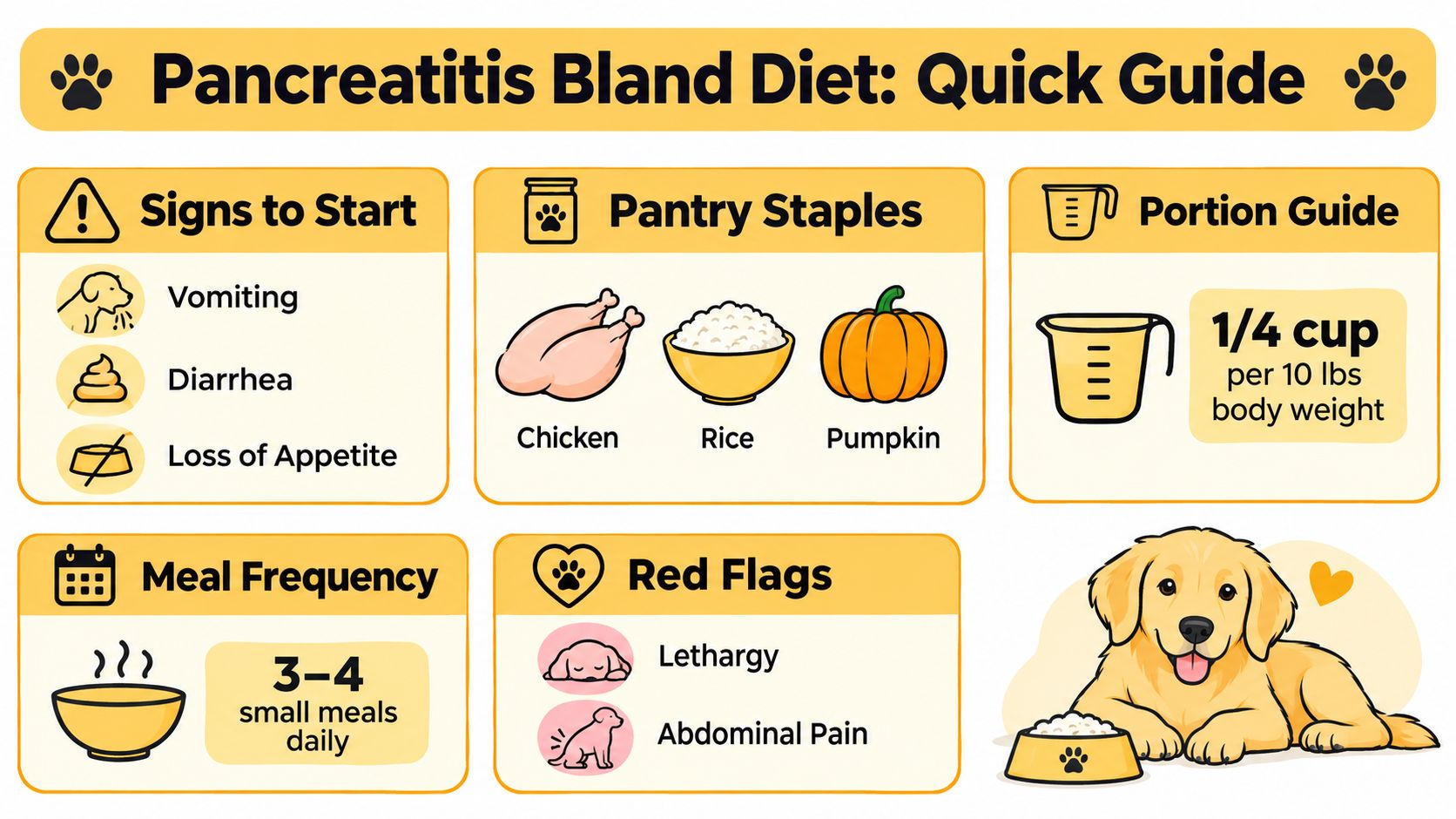
Kitchen checklist
- Start only with guidance: Use bland food after your veterinarian has assessed the situation and approved refeeding.
- Keep ingredients plain: Skinless chicken, white rice, and optional plain pumpkin are the basic staples.
- Keep fat controlled: Many veterinary plans target under 10% fat on a dry matter basis, with stricter targets for some dogs.
- Feed small meals: Divide food into 3–4 meals during recovery.
- Track response: Record vomiting, stool, appetite, water, posture, and energy.
- Know the red flags: Repeated vomiting, refusal of water, painful abdomen, collapse, or severe weakness needs prompt care.
- Plan the exit: Move to a complete, balanced low-fat food once your dog is stable and your veterinarian approves it.
Common questions
Can my dog stay on chicken and rice permanently? No. It's incomplete and some veterinary guidance limits it to 5–7 days, so use it as a bridge.
How strict is the fat ceiling? Under 10% dry matter fat is a commonly used target, while the cited veterinary ceiling of 20 grams per 1,000 kcal is approximately 7% dry matter fat. Your dog's history determines the appropriate limit.
When can treats return? Only after stable eating and stool, and only if the treat fits the approved low-fat plan.
Is a daily supplement appropriate? It may be considered after your dog is stable on balanced food, but it can't replace pancreatitis treatment, a complete diet, or veterinary follow-up.
Pure Paw Labs offers human-grade daily supplements designed to support areas such as digestion, joints, skin and coat, immunity, and stress with one scoop. Once your dog has moved beyond bland food and your veterinarian approves additions, visit Pure Paw Labs to review whether that type of routine fits your dog.