


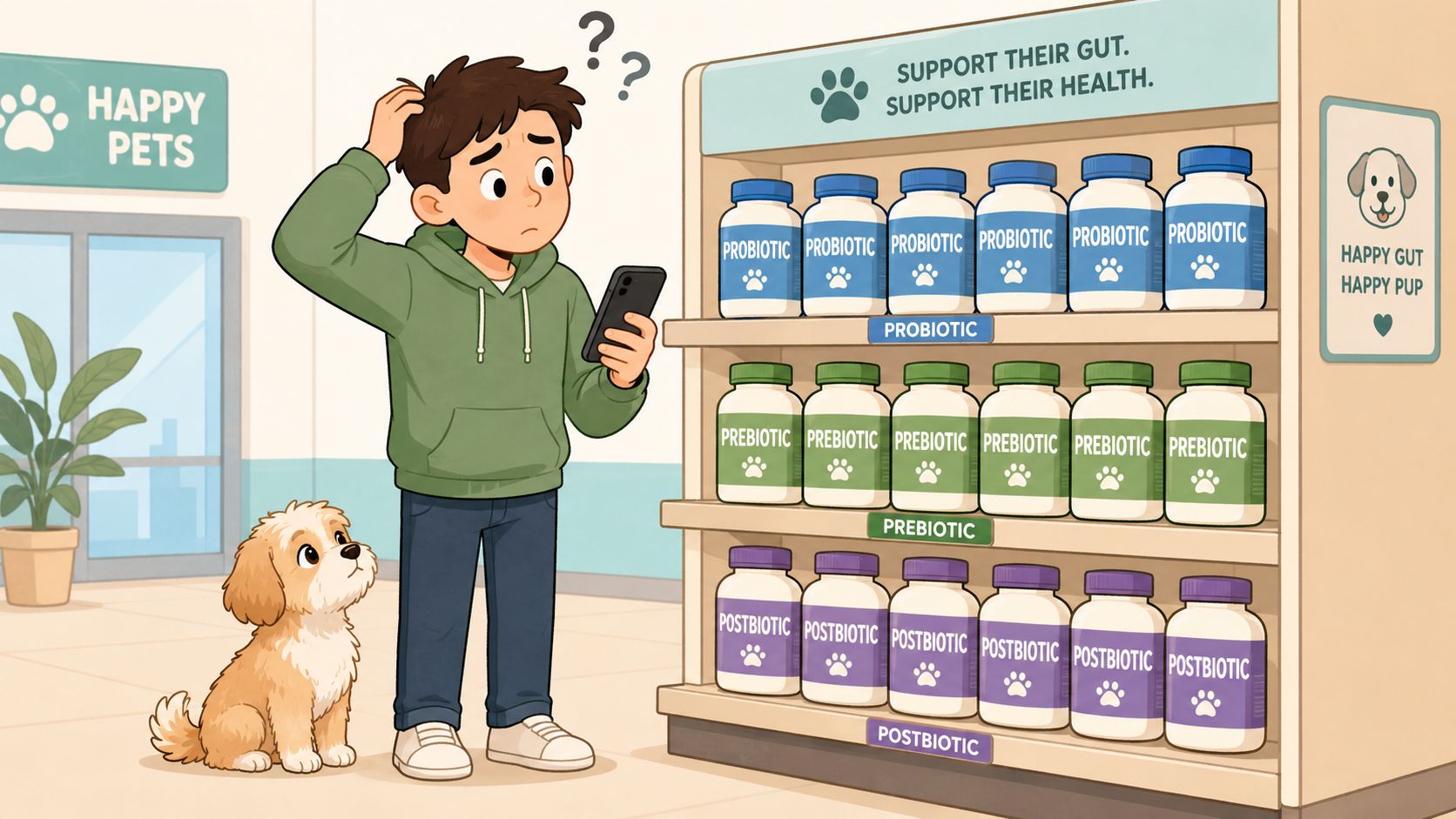
You're standing in the pet aisle with three bottles in your hand. One says probiotic, another promises prebiotic fiber, and a newer product highlights postbiotics. Your dog has occasional loose stools, a sensitive stomach, or itchy skin, and you're wondering whether to choose one supplement, combine several, or skip the shelf altogether.
That confusion is understandable. These products aren't interchangeable, but they also aren't isolated solutions. Prebiotics, probiotics, and postbiotics form a connected gut-support system, and the right choice depends on your dog's diet, symptoms, health status, and the quality of the formulation.
The pet supplement category has grown well beyond a niche. One market estimate valued pet probiotics at US$4.4 billion in 2023, with a projection of US$7.1 billion by 2031, while another estimated the dog-and-cat probiotic market at US$1.145 billion in 2024, projecting US$2.017 billion by 2032. Dogs represented roughly 63% to 64.2% of the pet segment in recent analyses. These figures show why owners are seeing more gut-health products, but popularity alone doesn't tell you which formula deserves a place in your dog's bowl. (market estimate for global pet probiotics)
Table of Contents
- Why Dog Owners Are Turning to Biotic Supplements
- Understanding Prebiotics Probiotics and Postbiotics
- How to Evaluate Supplement Quality and Formulation
- Standalone Biotics Versus All-in-One Formulations
- Dosing Guidelines and What Results to Expect
- Safety Considerations and Common Misconceptions
- Your Complete Buying and Usage Checklist
Why Dog Owners Are Turning to Biotic Supplements
A dog owner may start looking for gut support after a bout of diarrhea, repeated diet changes, antibiotics, or months of unexplained digestive inconsistency. Others arrive through a different route. Their dog scratches constantly, has recurring ear trouble, produces unusually soft stools, or seems unable to tolerate foods that once caused no problem. The supplement aisle becomes appealing because it offers a practical action to take while the owner tries to understand what's happening.
Gut health matters because the digestive tract does more than process food. It helps break down nutrients, interacts with immune defenses, and provides an environment where microbial communities produce compounds that influence the intestinal lining. Changes in digestion can also appear alongside skin, coat, or general wellness concerns, although a supplement shouldn't be treated as a diagnosis or a replacement for veterinary care.
The three categories solve different problems
Probiotics are living microorganisms included to provide a benefit when consumed in adequate amounts. Prebiotics are fermentable substrates, often specific fibers, that selected microbes can use as fuel. Postbiotics are non-living microbial products or components, such as metabolites and cell fragments, that may interact with the host.
That means these products aren't three competing versions of the same thing. A probiotic adds organisms, a prebiotic supplies material those organisms and existing microbes can ferment, and a postbiotic delivers or supports compounds produced through microbial activity.
Practical rule: Don't choose a biotic because its label sounds newest. Choose it because you can identify its role, dose, quality controls, and reason for use.
Owners also need realistic expectations. A dog with persistent vomiting, blood in the stool, weight loss, pain, or severe diarrhea needs veterinary assessment rather than a supplement trial. For general daily support, however, understanding the system can make a crowded shelf much easier to evaluate. A plain-language overview of the broader topic is available in this guide to dog gut health.
Understanding Prebiotics Probiotics and Postbiotics
A dog's gut works like a garden, but the owner usually manages more than one “planting” product at a time. Understanding how each biotic category contributes can make a crowded supplement routine easier to assess.
Probiotics are the seeds. They are live microorganisms intended to provide a benefit when consumed in adequate amounts. Labels may list organisms such as Lactobacillus acidophilus or Bifidobacterium animalis. A useful label identifies the organism precisely instead of using only a broad phrase such as “friendly bacteria.”
Prebiotics are the fertilizer. These are fibers or other substances that a dog does not fully digest in the upper gastrointestinal tract. Microbes in the colon can ferment them. Examples include inulin, fructooligosaccharides, or FOS, and chicory root.
Postbiotics are the harvest. They include non-living microbial products or components, including compounds generated during microbial activity, enzymes, peptides, and bacterial cell wall fragments. Short-chain fatty acids, including butyrate, are examples discussed in gut-health formulations.

How the sequence works
The basic sequence is straightforward, although the response varies between dogs:
- A dog consumes a prebiotic substrate. Some material reaches the colon without being digested.
- Microbes ferment the substrate. The result depends on the fiber type, amount, existing microbial community, and the rest of the diet.
- Microbial products appear. Fermentation can produce short-chain fatty acids, while microbial cells may contribute other bioactive components.
- The gut environment responds. These products can interact with intestinal cells and immune signaling, with effects shaped by the individual dog and the formulation.
This sequence explains why adding a live microorganism without considering its available food may create an incomplete plan. It also explains why a large increase in fermentable fiber can cause discomfort when a dog is not accustomed to it. The garden needs seeds and nutrients, along with suitable conditions and time.
A combined prebiotic and probiotic formula is sometimes called a synbiotic, although labels do not always use that term consistently. This guide to prebiotic, probiotic, and postbiotic differences provides a clearer explanation of the categories.
Owners often combine gut support with products for other needs. DA-1™ Daily All-in-One - Skin/Coat, Joints, Gut Health & More is described as an all-in-one human-grade powder used as one daily scoop on a dog's food, with support categories including gut health, skin and coat, joints, immunity, and stress.
Why the garden analogy has limits
The analogy describes the direction of the relationship, not a guaranteed outcome. A dog's existing microbiome, food, medications, age, and underlying health can influence the response. Postbiotics are also a newer scientific category, and canine evidence is less mature than some labels imply.
A 2025 meta-analysis of canine postbiotic studies found no statistically significant overall effect on fecal parameters or gut microbiota composition. A 2026 veterinary review noted that studies had not specifically investigated postbiotic use in dogs with chronic enteropathy at the time of publication. (canine postbiotic evidence review)
How to Evaluate Supplement Quality and Formulation
A quality label should let you answer four questions quickly: What organisms or compounds are included? How much is present? Will the product remain stable? Can the manufacturer verify the contents?
Start with specificity. “Proprietary probiotic blend” tells you very little if it doesn't identify the genus, species, strain designation, and amount supplied. A label naming Lactobacillus acidophilus is more informative than a label that only says “Lactobacillus blend,” but strain-level documentation is stronger still because probiotic effects can vary between strains.
Read the potency statement carefully
Probiotic potency is generally expressed in colony-forming units, or CFUs. The useful question isn't whether the number looks large. Ask whether the stated amount applies per serving, whether it's guaranteed through the expiration date, and whether each strain has an identifiable quantity.
A formulation can list several strains while disclosing only one combined CFU total. That makes it difficult to know whether one organism dominates the blend or whether each appears at a meaningful level. The label should also explain storage requirements, because heat, moisture, oxygen, and light can affect live microorganisms.
Examine the delivery system
A shelf-stable powder isn't automatically inferior to a refrigerated product, and refrigeration isn't automatically proof of quality. The relevant issue is whether the manufacturer has protected viability through appropriate packaging, moisture control, and stability testing.
Look for:
- Expiration dating: The date should be clear and legible.
- Storage instructions: The label should explain whether the product needs refrigeration or protection from heat and humidity.
- Packaging barriers: An airtight, moisture-resistant container can help protect live cultures.
- Testing documentation: A manufacturer should be able to explain how it verifies identity, potency, contamination control, and stability.
- Animal-specific rationale: Canine research or veterinary formulation experience is more relevant than assuming a human product works identically in dogs.
For a broader explanation of how supplement makers discuss testing and formulation decisions, the Supplement Science page offers useful background. It shouldn't replace a veterinary review or a product-specific Certificate of Analysis, but it can help you understand why testing and transparency matter.
Compare the label, not the front panel
| Quality Marker | What to Look For | Red Flags |
|---|---|---|
| Strain identity | Genus, species, and strain information | “Probiotic blend” with no strain details |
| Potency | CFUs listed per serving, ideally guaranteed through expiration | CFUs omitted or stated only for the entire container |
| Prebiotic source | Named fibers such as inulin, FOS, or chicory root | Unidentified “fiber matrix” |
| Postbiotic content | Named compounds or clearly described microbial components | Vague claims about “fermented benefits” |
| Stability | Expiration date, storage instructions, moisture protection | No storage guidance or unclear dating |
| Quality control | Independent testing, certification information, or available documentation | No explanation of identity or purity testing |
| Ingredient panel | Clear amounts and recognizable ingredients | Excess fillers, artificial preservatives, or unexplained additives |
You can also use this practical guide to read dog supplement labels before comparing products. If a company won't tell you what's in the blend, how much is present, or how it protects the formula, move on.
Standalone Biotics Versus All-in-One Formulations
Buying separate products gives you control. You can introduce a prebiotic slowly, add a specific probiotic later, and leave out postbiotics if your veterinarian doesn't think they're appropriate. That approach can make sense for a dog with a sensitive digestive system, a history of reacting to new foods, or a clearly defined need for a particular ingredient.
The trade-off is management. You'll need to compare serving sizes, calculate the combined fiber load, monitor overlapping ingredients, and remember several administration instructions. Dogs often resist tablets, dislike strong flavors, or just refuse food once a new powder changes its smell.
The practical differences
| Factor | Standalone Biotics | All-in-One Formulations |
|---|---|---|
| Flexibility | Easier to adjust one category at a time | One formula provides a fixed combination |
| Routine | May require several products or administration times | Usually simpler for owners and dogs |
| Troubleshooting | Easier to identify which product caused a reaction | Harder to isolate one ingredient |
| Formulation | Each product can focus on a specific biotic | The manufacturer must protect compatibility and stability across ingredients |
| Dose control | Allows targeted changes | Depends on the product's serving instructions |
| Compliance | More opportunities to miss a dose | Fewer daily steps may support consistency |
A standalone probiotic may disclose a higher total CFU count or provide extensive strain detail, while a combined product may prioritize ease of use. Neither format wins automatically. The right choice is the one that gives your dog a transparent formulation you can administer consistently.
How to audit an all-in-one label
Don't accept “complete gut support” as evidence that all three categories are present. Look for a named probiotic organism with a stated CFU amount, a clearly identified prebiotic fiber, and a defined postbiotic ingredient or microbial component. If the formula uses a proprietary blend, check whether the label discloses the amount of each category rather than hiding everything inside one total.
A simpler routine only helps if the formula is transparent enough to evaluate.
For a dog with an active gastrointestinal disorder, a veterinarian may prefer a controlled, single-change approach. For a healthy dog whose owner is struggling to maintain several separate products, an all-in-one powder mixed with food may be more realistic. Convenience isn't a substitute for quality, but it can determine whether a carefully selected supplement is used consistently.
Dosing Guidelines and What Results to Expect
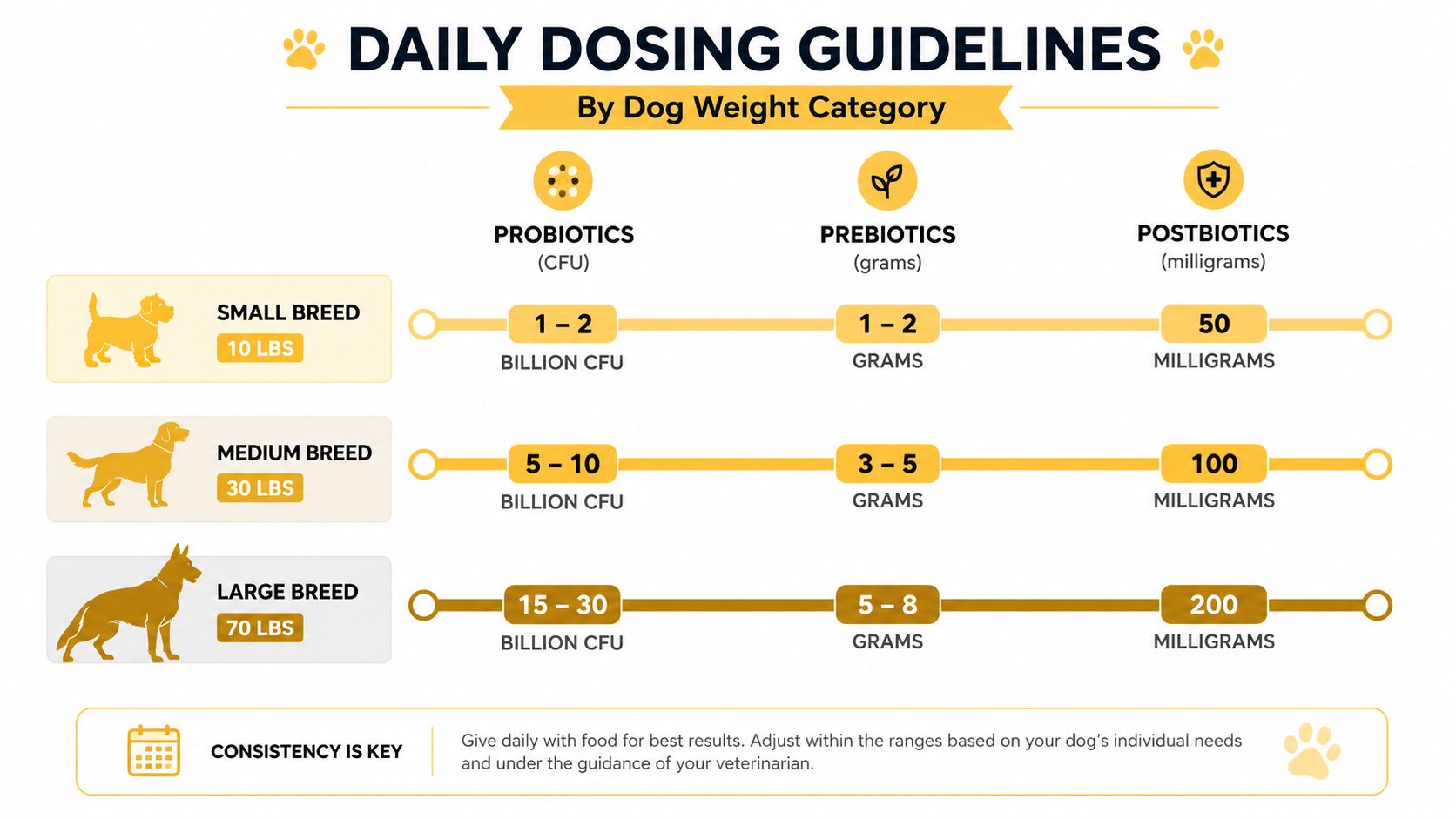
There isn't a universally reliable weight-based dosing chart for every prebiotic, probiotic, or postbiotic ingredient. Product concentrations differ, canine research is strain-specific, and a dog's diet and medical history affect tolerance. Use the manufacturer's label and your veterinarian's advice rather than treating a generic chart as a prescription.
The important technical point for prebiotics is that more isn't automatically better. A canine prebiotic meta-analysis found that doses up to 1.40% of food intake on a dry-matter basis might increase beneficial bacterial populations and fecal short-chain fatty acids, while potentially lowering crude protein digestibility. (canine prebiotic meta-analysis)
Introduce changes gradually
Begin with the product's recommended amount or a veterinarian-approved reduced introduction, especially if your dog reacts to dietary changes. Mixing the supplement with a normal meal can improve acceptance and may be gentler than giving it on an empty stomach. If gas or softer stools appear, pause the increase and contact your veterinarian if symptoms persist or worsen.
Track the basics in a simple journal:
- Stool consistency and frequency
- Vomiting, gas, or straining
- Appetite and water intake
- Itching, ear discomfort, or other symptoms relevant to your dog
- Diet changes, antibiotics, and other supplements
A short adjustment period can happen when a dog receives new fermentable material, but severe diarrhea, blood, repeated vomiting, marked lethargy, or pain isn't a routine transition response. Those signs warrant veterinary attention.
Probiotics are measured in CFUs, while prebiotics are measured by weight and postbiotics may be listed by milligrams or another compound-specific amount. Because those units don't translate directly, stacking products requires care. Don't increase several categories at once, or you won't know which change helped or caused trouble.
This video provides a visual overview of the topic and can complement, not replace, individualized veterinary guidance.
Safety Considerations and Common Misconceptions
A dog may be healthy yet still react poorly to a biotic supplement. Dogs with serious illness, weakened immune defenses, or treatment involving immunosuppressive medication should receive veterinary advice before using live microorganisms or a new fermentable ingredient. This matters especially when several supplements are already part of the daily routine, because overlapping ingredients can make a reaction difficult to identify.
More isn't automatically better
A larger CFU number does not guarantee a stronger result. Strain identity, delivery format, storage history, dose, and your dog's condition all influence how a product performs. A modest formula with clear documentation may be a better choice than a high-count blend that omits strain details or fails to guarantee potency through its expiration date.
Human probiotics should not be assumed to work the same way in dogs. Dogs differ in diet, gastrointestinal conditions, and microbial environment. Canine-specific evidence and veterinary guidance are more useful when a product claims to address a particular digestive concern.
Separate adjustment from harm
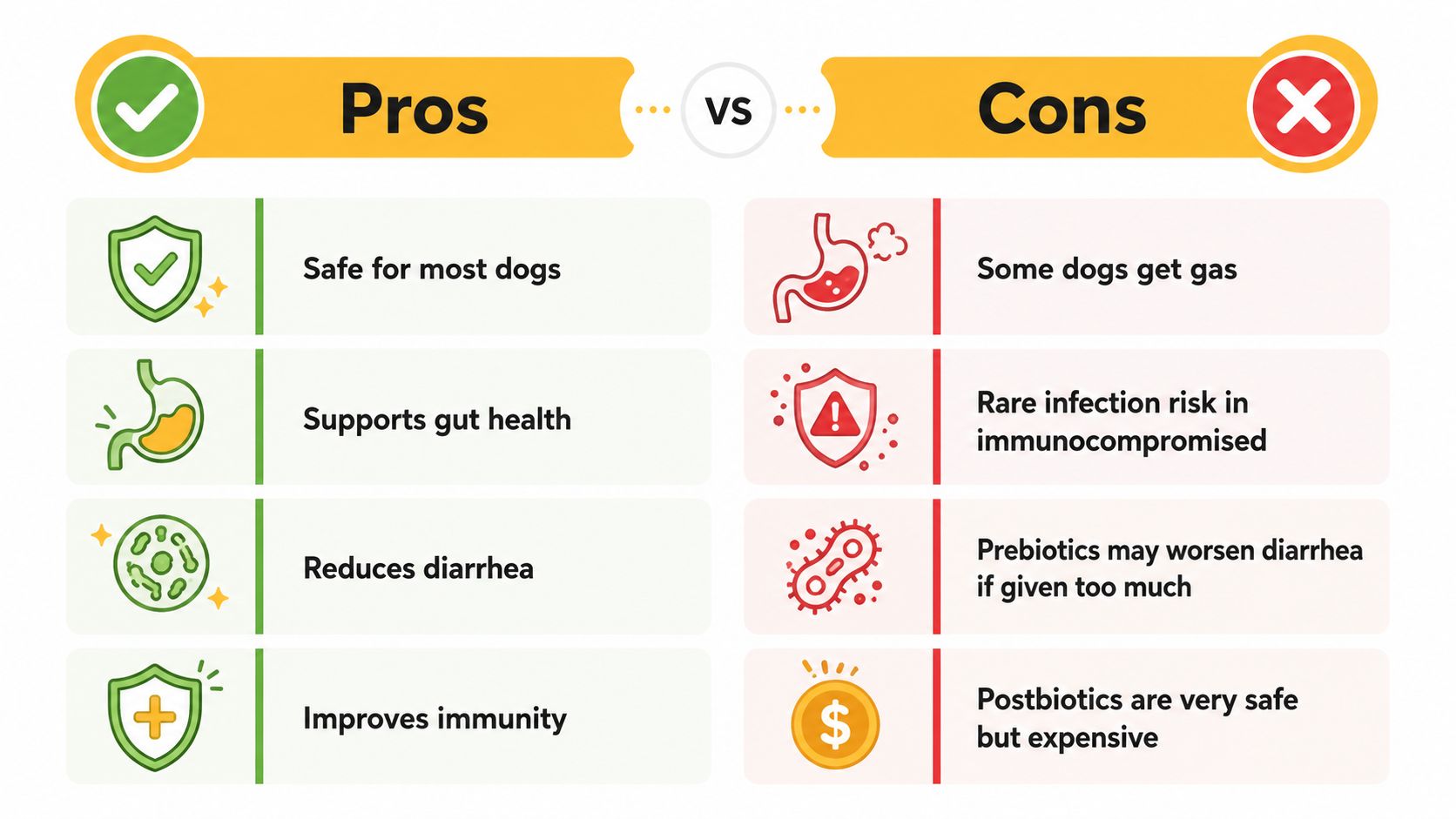
A temporary increase in gas or a mild stool change can occur after introducing fermentable material. Prebiotics may worsen loose stools when added too quickly or given in an amount your dog cannot tolerate. Stop treating the reaction as routine if symptoms are intense, persistent, or accompanied by weakness, pain, repeated vomiting, or other signs of illness.
Postbiotics do not contain living microorganisms, but that does not make every product appropriate for every dog. The canine research base remains limited, and formulas can differ in the compounds they provide and in how clearly those compounds are identified. Evidence should guide expectations, not replace an assessment of the underlying problem.
Avoid products with missing expiration dates, vague organism descriptions, unexplained additives, or promises to diagnose and cure disease. A supplement can support a balanced diet, but it cannot correct an incomplete diet, untreated parasites, food intolerance, inflammatory disease, or another cause of digestive symptoms. When multiple products are involved, review their full labels with your veterinarian before combining them.
Your Complete Buying and Usage Checklist
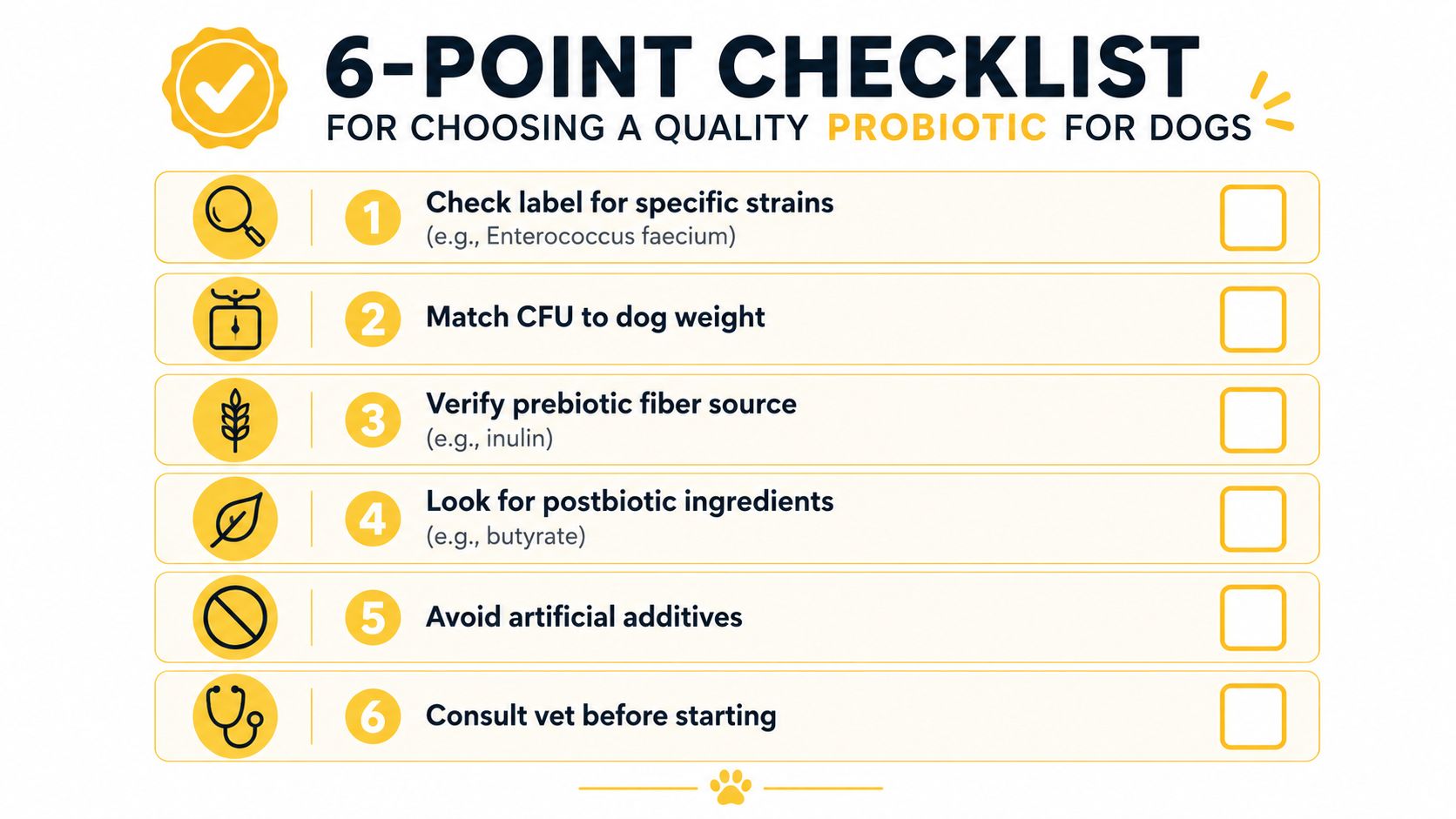
Use this checklist before placing a new product in your cart:
- Identify the probiotic precisely. Look for genus, species, and strain information, not only “proprietary blend.” Specificity helps you understand what you're giving your dog.
- Confirm the CFU statement. Check whether the amount is per serving and whether potency is guaranteed through the expiration date.
- Name the prebiotic. Look for a clearly identified source such as inulin, FOS, or chicory root, then consider whether your dog tolerates fermentable fiber.
- Look for defined postbiotics. A named compound or clearly described microbial component is more useful than a broad “fermented” claim.
- Review quality controls. Check for third-party testing, certification information, manufacturing details, and the possibility of obtaining product documentation.
- Choose the routine you can maintain. A standalone product may offer more flexibility, while an all-in-one formula may reduce missed doses. Compare the actual label rather than the front-panel wording.
- Plan the introduction. Add one meaningful change at a time, mix it with food when appropriate, and keep a symptom journal.
- Store it correctly. Follow the package instructions and protect live cultures from the heat, moisture, light, and oxygen conditions that can reduce stability.
- Ask your veterinarian first when needed. Seek guidance for puppies, seniors with chronic disease, immunocompromised dogs, dogs taking immunosuppressive medication, or any dog with serious gastrointestinal signs.
Once you've chosen a transparent product, use it consistently with your dog's normal meal, introduce it carefully, and evaluate changes rather than guessing. If your dog refuses powders, try a small amount mixed into a strongly flavored food your veterinarian considers appropriate, but don't conceal a supplement in a meal your dog may later need to avoid.
Pure Paw Labs offers human-grade daily dog supplements, including a single-scoop powder designed to combine gut, joint, skin and coat, immune, and stress-support categories. Visit Pure Paw Labs to review the formulation and decide whether its all-in-one routine fits your dog's supplement plan.