


The default advice on joint support for dogs still leans on glucosamine and chondroitin, but the evidence doesn't support treating that combo as a gold standard. Recent synthesis points in a different direction, toward ingredients with clearer pain-modulating effects, especially omega-3 fatty acids (systematic review and meta-analysis). If you want the best joint support for dogs, the first step is to separate legacy marketing from ingredients with measurable clinical backing.
| Ingredient | Evidence Strength | Primary Benefit | Best For |
|---|---|---|---|
| Omega-3 fatty acids | Strongest support in recent reviews | Helps modulate osteoarthritis pain | Dogs with diagnosed joint discomfort |
| Glucosamine | Uncertain | Structural support is proposed, clinical benefit unclear | Owners prioritizing low-risk legacy ingredients |
| Chondroitin | Uncertain | Cartilage support is proposed, analgesic effect not established | Dogs already on a broad supplement plan |
| MSM | Limited | Soft-tissue support is often claimed | Formulas built around multi-ingredient stacks |
| Collagen | Limited in the verified data set | General connective tissue support is often implied | Products that position themselves as comprehensive |
That ranking matters because canine joint care isn't just about what sounds familiar. A 2017 review of glucosamine and chondroitin concluded that their benefit in dogs could neither be confirmed nor denied, while also noting the evidence base is limited by product variability and study design (review). A newer synthesis goes further and says omega-3 intake beneficially modulates osteoarthritis pain, while glucosamine-chondroitin nutraceuticals showed strong evidence of non-effect and no analgesic effect (meta-analysis).
Practical rule: if a label leads with glucosamine and chondroitin, that doesn't make it evidence-first. It usually means the formula is following habit, not the most current synthesis.
Table of Contents
- Rethinking the Gold Standard for Joint Health
- The Hidden Prevalence of Canine Joint Issues
- Ranking Ingredients by Clinical Evidence
- Prevention Versus Therapeutic Management
- Evaluating Product Quality and Bioavailability
- The Case for Multi-System Support
- Dosing and Safety Best Practices
Rethinking the Gold Standard for Joint Health
The phrase best joint support for dogs is often used as if it automatically points to glucosamine and chondroitin. That assumption is too loose. The question is simpler, does an ingredient measurably improve mobility or comfort in dogs with joint disease? In canine osteoarthritis, familiarity and market history do not count as evidence.
A 2022 systematic review and meta-analysis found the clearest treatment signal in omega-3 products, not in the traditional glucosamine-chondroitin pairing (review). That does not make structural ingredients irrelevant in every setting, but it does push them out of the automatic top slot. The long-held idea that joint support should begin with glucosamine is weaker than many labels suggest.
What the evidence actually rewards
The evidence has to match the goal. For pain modulation, omega-3s have the most consistent support in the verified research set. For a low-risk, long-term add-on with a generally mild side-effect profile, glucosamine and chondroitin can still fit into a routine, but the evidence does not support treating them as the main event.
Common use is not the same as strong proof. A 2017 review found that the clinical benefit of glucosamine and chondroitin in dogs could neither be confirmed nor denied, which is very different from proven efficacy (review).
Recent reviews point in the same direction. Omega-3 intake beneficially modulates osteoarthritis pain, while glucosamine-chondroitin nutraceuticals showed strong evidence of non-effect and no analgesic effect. That distinction matters most when the goal is therapeutic management rather than routine prevention.
Bottom line: the strongest joint-support choice is the ingredient most likely to produce a relevant effect, not the one with the most familiar name.
The Hidden Prevalence of Canine Joint Issues
Joint degeneration often starts before a dog looks stiff. In a 2024 cross-sectional study of dogs aged 8 months to 4 years, 39.8% had radiographic osteoarthritis in at least one appendicular joint, and 16.3% to 23.6% showed clinical signs depending on the pain threshold used (study). Imaging changes can appear well before obvious limping or reluctance to move.
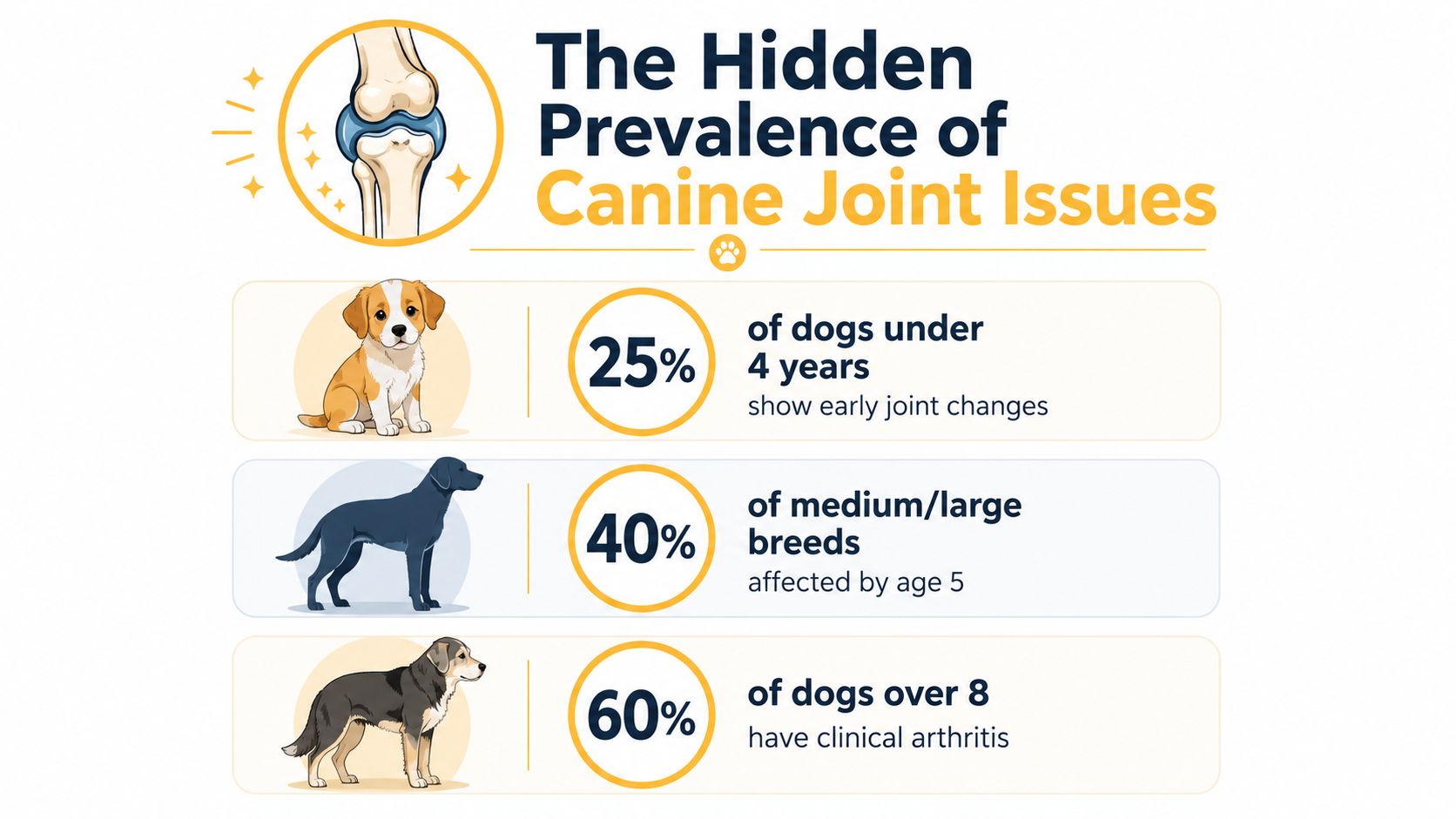
By the time an owner notices a visible gait change, the joint problem may already be established. That is why daily support has become part of long-term canine care for many households, not just a response to senior-dog stiffness.
Why early changes matter
Radiographic osteoarthritis and clinical osteoarthritis signs do not always appear together. Imaging can show structural change without clear outward pain, while clinical signs tend to emerge after a dog has already started compensating. The disease can be present before the owner sees it.
A large UK primary-care study estimated the annual period prevalence of diagnosed appendicular osteoarthritis at 2.5% among 455,557 dogs, which projected to just over 200,000 affected dogs per year in an estimated UK dog population of 8 million (study). The same work found an average osteoarthritis duration of 2 years, meaning affected dogs spent about 11% of their lives with the condition (study). The broader literature also shows prevalence estimates vary widely by method, so studies based only on obvious cases can miss part of the burden.
Read the data, not the age assumption. Young and middle-aged dogs can already carry joint changes that justify proactive support.
Ranking Ingredients by Clinical Evidence
The evidence hierarchy is clearer than the marketing hierarchy. Omega-3s sit near the top because recent reviews found a treatment signal for osteoarthritis pain in dogs and cats. Glucosamine-chondroitin nutraceuticals did not show the same analgesic effect in that synthesis. That does not make every omega-3 product equal, but it does make the category more defensible when the goal is mobility support.
The familiar glucosamine and chondroitin pair sits in a weaker tier. A dog-focused review said their benefit could neither be confirmed nor denied, and it pointed to a practical problem, studies often mix very different formulations, strengths, and regimens (review). That kind of inconsistency limits confidence in real-world use. These ingredients may be well tolerated, but tolerability is not the same as measurable effect.
A separate review of canine nutraceuticals reached a similar conclusion, most evidence is weak, with omega-3 fatty acids standing out as the clearest exception (review). The ingredients with the longest marketing history are not the ones with the strongest clinical backing.
Joint Supplement Ingredients Ranked by Clinical Signal
| Ingredient | Clinical signal | Main takeaway | Practical use case | Evidence note |
|---|---|---|---|---|
| Omega-3 fatty acids | Strongest | Best supported for pain modulation in osteoarthritis | Dogs with diagnosed OA or clear mobility concerns | Use a product with meaningful EPA and DHA content |
| Glucosamine | Weak to uncertain | Structural support is proposed, not well proven | Low-risk add-on when side effects must be minimal | Evidence is inconsistent across formulations |
| Chondroitin | Weak to uncertain | Cartilage support is proposed | Maintenance formulas | Often paired with glucosamine, but not clearly superior |
| MSM | Limited | Commonly included in blends | Multi-ingredient products | More of a supporting ingredient than a lead ingredient |
| Collagen | Limited in the reviewed data | Broad connective-tissue positioning | General wellness formulas | Evidence remains sparse for therapeutic use |
That ranking leads to a contrarian but practical conclusion. A formula with the strongest evidence should put its most active ingredient in the most important role, and that usually means omega-3-forward formulas deserve more attention than glucosamine-first blends.
For readers who want a closer look at the fish-oil side of the evidence, this guide to fish oil for dogs is a useful starting point. A single product can still be practical too. For example, DA-1™ Daily All-in-One - Senior Dog Support, Joints, Skin/Coat & More is described as a once-daily, multi-system powder with 18 human-grade ingredients targeting cells, gut, and joints, which may suit owners who want one routine instead of several separate supplements.
Prevention Versus Therapeutic Management
Preventive use and therapeutic use answer different questions. Owners often reach for joint supplements before a diagnosis exists, but the evidence supports that habit unevenly. A 2022 survey found joint products were the most common daily supplement category, and many dogs without an osteoarthritis diagnosis were already receiving one survey. That pattern shows how often these products are used proactively, even though clinical testing has been stronger after diagnosis than before it.

A simple decision framework
Use preventive maintenance for a healthy, active dog when the goal is low-intensity support over time. In that setting, the evidence does not show proven prevention, so expectations should stay modest.
Use therapeutic support for a dog with diagnosed joint disease or a clear mobility change. Here, the target is pain and function, so ingredient choice should follow the stronger evidence base rather than habit. Omega-3-centered formulas have the clearest practical role in that setting.
The 2022 survey also highlights a communication gap. Owners often ask whether a supplement should start before symptoms appear, but the study notes that clinical efficacy has been tested after OA diagnosis, not as prevention (Frontiers survey, 2022). That leaves preventive use as a judgment call and therapeutic use as the more evidence-supported pathway.
Decision rule: prevention calls for a gentle daily routine and restrained expectations. Active mobility problems call for the most evidence-backed ingredient profile available.
Evaluating Product Quality and Bioavailability
The right ingredient can still underperform if the product is poorly built. That's why product quality and bioavailability matter as much as ingredient selection. A supplement label can look busy while delivering little useful support if the active ingredients are underdosed, hidden in a proprietary blend, or formulated in a way that's hard for the dog to absorb.
What to check before you buy
- Ingredient sourcing: human-grade or pharmaceutical-grade sourcing is easier to verify than vague sourcing claims.
- Absorption support: formulations that include research-backed bioavailability enhancers are more practical than ingredient lists alone.
- Batch verification: independent testing matters because it helps confirm purity and potency, which you can learn more about through batch testing standards.
- Label transparency: the concentration of active ingredients per serving should be visible, not buried.
The deeper point is that formulation design changes results. Two products can list the same ingredient and still behave differently in the body if one is better absorbed or more clearly dosed. That's why vague proprietary blends are a red flag for serious buyers.
A human-grade, single-scoop routine can be easier to evaluate than a cabinet full of separate jars. If a product lists its actives clearly, is tested by batch, and keeps the formula straightforward, the owner has a better chance of knowing what the dog is getting.
The Case for Multi-System Support
Joint health doesn't operate in isolation. Dogs with mobility concerns often benefit from a routine that also considers gut function, overall vitality, and the day-to-day burden of taking multiple products. A single, consolidated formula can be easier to keep consistent, and consistency matters more than enthusiasm on day one.

The practical case for multi-system support is mostly behavioral. Owners miss fewer doses when the routine is one scoop instead of several products, and a simpler routine is easier to keep stable across meals, travel, and schedule changes. That matters because the best ingredients don't help if they sit in the pantry.
An example of that approach is DA-1™ Daily All-in-One, which is positioned as a once-daily powder for joint, skin and coat, gut health, immunity, and anxiety-related support. For readers focused on this topic, the relevant detail is that it's built as a single-scoop routine, not a scattered stack.
When one formula makes sense
A multi-system formula fits best when the owner wants simplified maintenance rather than a highly segmented plan. That can be useful for aging dogs, dogs with multiple daily care needs, or households trying to avoid supplement fatigue.
It also helps when the owner wants a more disciplined routine around joint care. The harder it is to give, the less likely it is to become a daily habit. A well-designed all-in-one can reduce that friction without forcing the owner to choose between convenience and consistency.
Practical takeaway: the value of an all-in-one isn't magic, it's adherence. If the dog gets the supplement every day, the plan is more likely to matter.
Dosing and Safety Best Practices
Start with the label and stay consistent. Joint-support routines work best when they're given daily, because intermittent use makes it harder to judge whether the dog is improving or just having a better week. The early window to watch is measured in weeks, not days, so owners should track movement, stair use, and willingness to get up from rest rather than expecting overnight change.
If a dog is already on NSAIDs or other discomfort-management medication, the supplement plan should be discussed with a veterinarian. That's especially true when adding a new omega-3-based product or layering several supplements together, because the goal is to simplify support, not create overlap that nobody is monitoring.
What to watch for
- Mobility signals: easier rising, smoother stairs, better willingness to walk.
- Behavior shifts: less hesitation, more interest in activity, improved comfort after rest.
- Routine fit: whether the dog reliably takes the product without digestive upset or refusal.
One reason consolidated support can beat a complicated stack is that it lowers the odds of dosing errors. A single daily formula is easier to remember, easier to adjust, and easier to discuss with your vet if anything changes.
The safest approach is also the most sustainable one. Choose the most evidence-backed ingredient profile you can, give it consistently, and keep the plan simple enough that you'll still be following it three months from now.
If you want a cleaner way to support mobility without building a cabinet full of separate products, visit Pure Paw Labs and review how its daily supplement format fits into a joint-care routine. Their approach is built around a single daily scoop, which makes it easier to keep support consistent for dogs that need long-term care.