


Your dog is scratching through dinner, licking the same paw until it's damp, or shedding a coat that suddenly looks dull. You search for the best dog skin supplement and find oils, chews, powders, probiotics, vitamins, and “complete” allergy blends, all promising comfortable skin. The difficult part isn't finding a product. It's separating a useful adjunct from an expensive shortcut.
A good decision starts with the diagnosis, then moves to evidence, transparent dosing, product quality, and a routine you can follow consistently. Supplements can support skin and coat health, but they shouldn't replace veterinary care for persistent itching, redness, hair loss, odor, sores, or recurrent ear problems.
Table of Contents
- Why Your Dog's Skin Problem Needs a Smarter Approach
- Canine Skin Problems: Understanding Prevalence and Impact
- Key Ingredients That Support Dog Skin Health
- How to Evaluate Product Quality and Testing Standards
- Dosing Administration and Tracking Results Over Time
- Simplifying Your Routine with an All-in-One Supplement
Why Your Dog's Skin Problem Needs a Smarter Approach
A few months ago, a typical owner might have described the situation this way: the dog started scratching, the owner changed food, bought a flea product, added a skin chew, then tried an oil when the first product didn't seem to help. The dog still licked its paws. The owner had a cupboard full of supplements but no clear answer about what was causing the irritation.
That pattern is understandable, but it creates two problems. First, changing several things at once makes it impossible to tell what helped. Second, a supplement can't correct an untreated infection, parasite problem, environmental trigger, or inflammatory skin disease. Itching is a sign, not a diagnosis.

Start with the cause, not the bottle
Canine atopic dermatitis involves skin barrier dysfunction and an abnormal immune response, which helps explain why skin formulas often focus on barrier-support nutrients and anti-inflammatory ingredients such as marine omega-3 fatty acids. But not every itchy dog has atopic dermatitis, and even dogs with the same diagnosis can respond differently.
Use this practical filter before buying:
- Mild, occasional dryness: A carefully selected skin and coat supplement may be reasonable after checking the diet and grooming routine.
- Persistent scratching or licking: Arrange a veterinary assessment rather than relying on a supplement trial.
- Redness, odor, discharge, open skin, or hair loss: Prioritize diagnosis and treatment. These signs can indicate complications that a nutritional product won't resolve.
- A dog taking medication or eating a homemade diet: Ask your veterinarian to review the full regimen before adding nutrients.
Some dogs also become anxious or difficult to handle during examinations and procedures. If handling or sedation is part of your veterinary plan, Passpaw's dog sedation advice can help you prepare questions for your veterinarian. Don't administer sedating products without professional direction.
Practical rule: Use a supplement to support a defined care plan, not to postpone finding out why your dog is uncomfortable.
The right product choice is therefore narrower than the marketing suggests. You're not looking for a miracle cure. You're looking for a clearly dosed formula that matches your dog's needs, fits the veterinary plan, and can be given consistently long enough to judge.
Canine Skin Problems: Understanding Prevalence and Impact
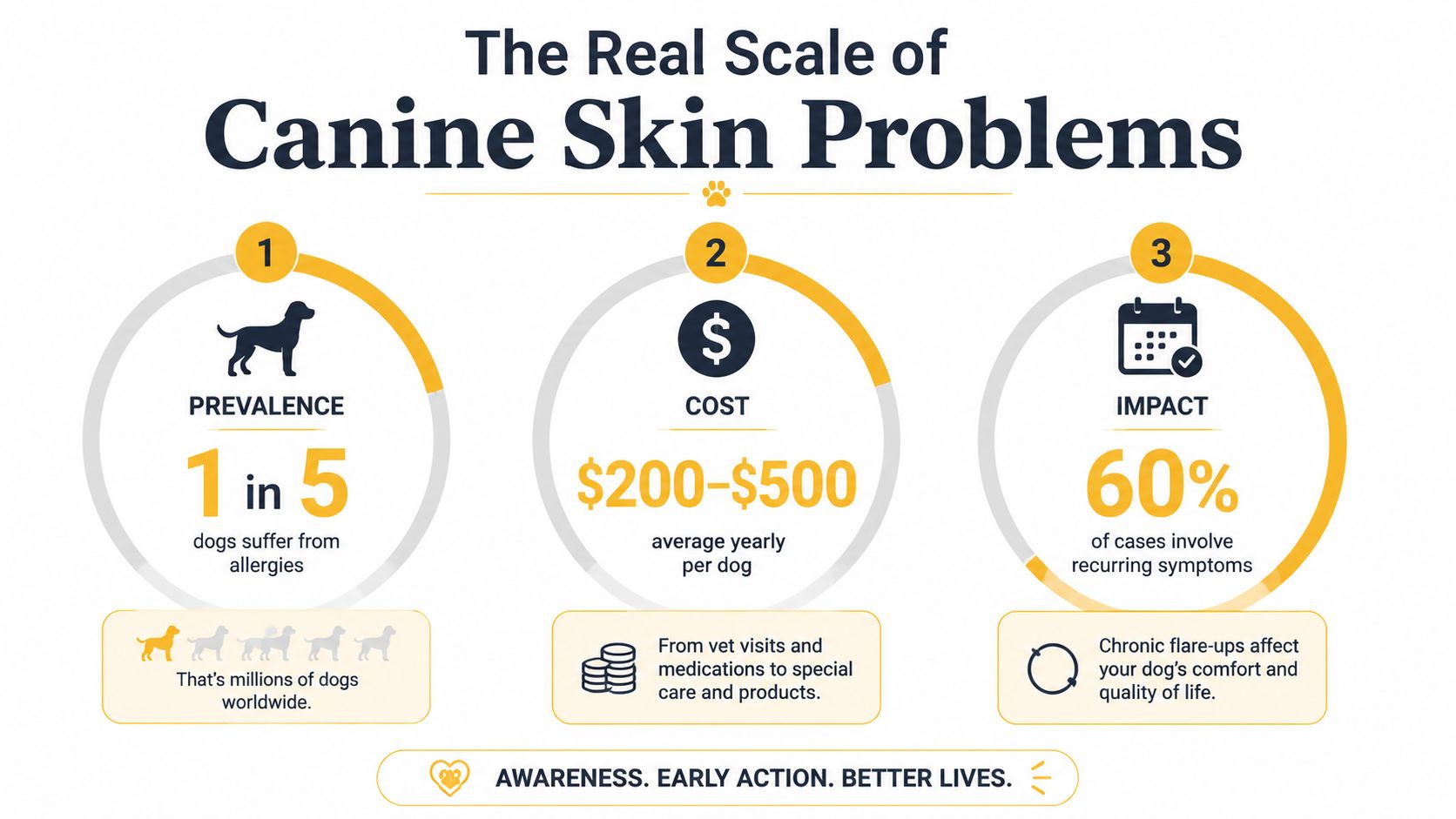
A dog that scratches through the night can leave an owner searching for fast answers. The clinical picture is broader than supplement labels suggest. Peer-reviewed and veterinary sources estimate canine atopic dermatitis in roughly 3% to 15% of the general dog population, while published estimates vary by setting and case mix. One large U.S. study cited in a 2024 review found atopic or allergic dermatitis in 4.7% of 31,484 dogs examined for skin problems at 52 veterinary practices. These figures are not interchangeable, but they show why recurrent itching and dermatitis deserve proper assessment. The 2024 veterinary review provides the clinical context for canine atopic dermatitis.
Pruritus is one of the most common presenting signs. A veterinary summary cited in that review reported itching in 30% to 40% of canine patients in one study, while published reports ranged from 1% to 50%, depending on the population studied. General practices, referral hospitals, and dermatology services see different mixes of conditions, so owners should use any single percentage as context, not as a diagnosis.
Why demand keeps growing
Insurance data shows the financial burden of recurring skin care. Nationwide Pet reported that skin allergies were the number one claim in dogs for 13 consecutive years. In 2024, it received more than 450,000 individual skin-allergy claims across cats and dogs, a 13% increase from 2023. Skin allergies represented 16% of all dog-related claims that year, with estimated treatment costs of about $266 during the first 30 days after diagnosis and up to $841 over one year. Nationwide Pet's veterinary insurance summary details these claim and cost figures.
That recurring burden explains the appeal of a daily supplement. Nutritional support can fit a long-term care plan when the goal is maintaining coat quality or adding a measured source of EPA and DHA. It fails as a strategy when marketing implies that one scoop can diagnose, cure, or replace treatment for allergic disease. Clinical evidence supports supplements as adjuncts, not standalone cures.
A 2026 industry report projected the global dog skin and coat supplement market at about $3.1 billion, rising to roughly $4.8 billion by 2029, with a projected CAGR near 6.5%. This is a projection, not a guarantee, but it shows the commercial incentive behind increasingly ambitious claims. Owners should judge the active dose and evidence, not the promise printed on the front of the package.
For owners who prefer one product covering several routine goals, DA-1™ Daily All-in-One - Senior Dog Support, Joints, Skin/Coat & More is described as a multi-system formula with 18 human-grade ingredients, no fillers, and one scoop intended for daily use. Treat that type of product as nutritional support, while keeping diagnosis and treatment of skin disease with your veterinarian.
Key Ingredients That Support Dog Skin Health
Start with the active amount, form, source, and purpose, not the length of the ingredient list. A formula can display many appealing nutrients yet provide too little of the key active to compare with controlled research. Choose a clear goal first. For most skin-focused routines, examine EPA and DHA before considering additional ingredients.
Omega-3 fatty acids deserve the closest scrutiny
Marine-sourced EPA and DHA have the clearest adjunctive evidence in this category. One randomized, double-blind, placebo-controlled study used approximately 43 mg/kg EPA and 30 mg/kg DHA and reported reductions in CADESI-4 scores, pruritus, and inflammation. Another crossover study used roughly 39 mg/kg EPA and 26 mg/kg DHA and reported improvements in pruritus, alopecia, self-mutilation, and coat quality. The veterinary evidence review explains the trial designs, amounts, and limitations for canine omega-3 supplementation.
Use those findings to set expectations, not to promise a cure. Results vary, study diets are not always nutritionally identical, and omega-3s generally provide medication-sparing support rather than replace treatment for allergic dermatitis. A label that lists only “fish oil” or “salmon oil” leaves you unable to compare the product with the studied amounts. Buy by the stated EPA and DHA content, not by the total oil weight.
Other ingredients need a more modest interpretation
- Zinc: Supports normal skin and coat maintenance, but extra zinc is not automatically useful. Dogs eating a complete, balanced diet may not need more, and inappropriate supplementation can create nutritional problems.
- Biotin: Commonly included for coat support, although marketing often presents it more confidently than clinical evidence allows. Use it for a defined nutritional reason, not because it lengthens the label.
- Vitamin E: An antioxidant often paired with oils. It may fit a balanced formula, but it is not a standalone solution for allergy-related disease.
- Probiotics: Strain identity, viable count, storage, and research relevance all matter. A generic “probiotics” label does not show that the product matches evidence for a particular strain or condition.
- Postbiotics: These can fit a broader gut-support formula when the product explains its role. They do not replace dental care, infection treatment, or allergy management.
A 2025 review of canine atopic dermatitis found only minimal support for probiotics, fatty acids, vitamin E, vitamin D, zinc, or cannabinoids, while allowing that these options may help as adjuncts. The review's abstract summarizes the limited evidence and adjunctive role. That distinction should guide your purchase: nutritional support can complement a veterinary plan, but it should not become a substitute for diagnosis.
Compare the label with the clinical question
| Ingredient | Evidence level | Primary benefit | Timeframe for results |
|---|---|---|---|
| EPA and DHA | Moderate, with mild and inconsistent adjunctive benefit | Supports inflammatory and skin barrier pathways | Usually assessed over 6 to 12 weeks |
| Zinc | Limited for routine atopic dermatitis support | Normal skin and coat maintenance when intake is appropriate | Depends on the underlying deficiency or need |
| Biotin | Limited for allergy-related symptoms | General coat and skin nutrition | Variable |
| Vitamin E | Limited as an atopic dermatitis intervention | Antioxidant and nutritional support | Variable |
| Probiotics | Limited and strain-dependent | Gut support that may complement a broader plan | Variable |
| Postbiotics | Product and formulation dependent | Gut or immune-support role, depending on the formula | Variable |
Before buying, ask four questions: What is the exact EPA and DHA amount? Is each major active ingredient quantified? Does the evidence match my dog's diagnosis? Can I give it consistently? If several products would create a complicated stack, choose a clearly labeled daily formula that meets the goals you can justify. For a focused review of nutritional options, read this guide to vitamins for dog skin.
How to Evaluate Product Quality and Testing Standards
A polished label doesn't prove a supplement is useful. Trustworthy buying decisions depend on what the manufacturer discloses, how the product is tested, and whether the claims stay within nutritional support rather than promising to treat disease.
Use a label audit before you purchase
| Quality marker | What strong documentation looks like | Warning sign |
|---|---|---|
| Active ingredients | Exact amounts for important nutrients, especially EPA and DHA | A proprietary blend with no meaningful quantities |
| Testing | Batch-specific third-party testing or a certificate available on request | A broad “tested for purity” statement with no details |
| Manufacturing | Clear facility and quality-control information | No manufacturing information |
| Ingredient identity | Named oils, strains, vitamins, and mineral forms | Generic terms such as “allergy blend” |
| Claims | Support for normal skin, coat, or gut function | Promises to cure allergies or replace veterinary treatment |
Third-party testing is valuable because it can address identity, purity, and consistency. It doesn't automatically prove clinical effectiveness. A product may contain exactly what its label says and still lack evidence that the finished formula improves your dog's condition.
Read the fine print
Look for serving instructions, storage requirements, expiration information, and warnings for dogs with medical conditions. Ask the manufacturer for batch documentation if the label makes strong testing claims. A company that can't explain what was tested, when it was tested, and whether the results apply to the current batch hasn't given you enough information to judge quality.

Terms such as human-grade, clinically backed ingredients, and GMP certified can be useful signals, but they're not conclusions. “Clinically backed ingredients” may refer to research on an ingredient under conditions that differ from the product's dose, combination, or target population. Your job is to connect the claim to the actual label.
The FDA disclaimer commonly printed on supplement packaging also matters. It signals that the product's statements aren't equivalent to an approved veterinary drug claim. For a practical explanation of what manufacturers mean by batch-level verification, review what batch testing means.
A certificate can support product quality. It can't turn an underdosed formula into a clinically effective one.
Dosing Administration and Tracking Results Over Time
A supplement routine fails quickly when the serving is inconsistent or the owner changes several products at once. Begin with the label directions, confirm the plan with your veterinarian, and record your dog's baseline before the first serving. This makes any later improvement easier to judge and keeps marketing claims separate from observable results.
Build a simple administration routine
Give the supplement with a meal your dog reliably finishes. A powder mixed into food can suit dogs that resist pills, while a chew may work better for others. Choose the format your dog will take consistently, but check that the label states the active amounts clearly.
Introduce one new supplement at a time. Record appetite, stool quality, vomiting, itching, and visible skin changes. Dogs with a history of pancreatitis, bleeding concerns, medication interactions, or other medical conditions need veterinary guidance before receiving concentrated oils or multi-ingredient formulas.
If your dog eats a homemade diet, do not assume a skin supplement corrects every nutritional gap. Have the complete recipe reviewed by a veterinary nutrition professional. A supplement can support a diet and treatment plan, but it cannot replace diagnosis or prescribed care.
Give the timeline a fair test
Relevant skin benefits usually require consistent use over several weeks, not a few servings. Controlled omega-3 research commonly assesses outcomes after 6 to 12 weeks. In one 24-dog placebo-controlled trial, treated dogs had significantly lower clinical scores by day 60, followed by a plateau. Fatty-acid incorporation into erythrocyte membranes began by day 30 and declined after supplementation stopped. The omega-3 evidence review covers this trial timeline and the effect of stopping supplementation.
Track the same observations each week:
- Scratching: Note whether episodes become less frequent or intense.
- Licking: Record paw or flank licking, especially at predictable times.
- Skin: Check redness, odor, flaking, sores, and moisture.
- Coat: Watch for changes in shine, breakage, shedding, or hair regrowth.
- Comfort: Observe sleep, play, and willingness to be handled.
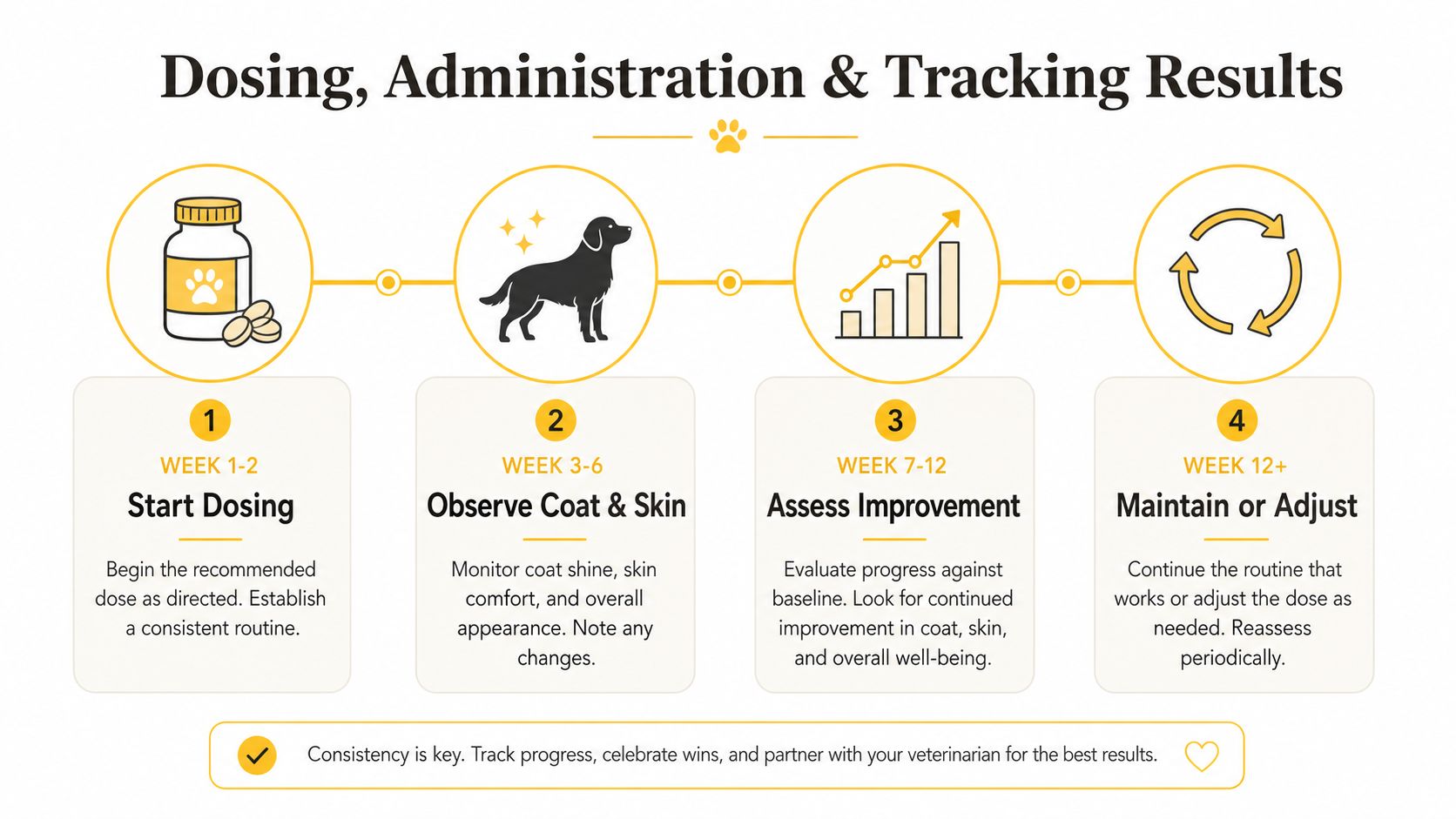
A plateau is not a reason to increase the dose automatically. It may indicate that the diagnosis needs revisiting, the formula provides too little active ingredient, or the supplement has reached its practical benefit. Worsening redness, pain, discharge, spreading lesions, or severe itching requires veterinary attention rather than a longer supplement trial.
Simplifying Your Routine with an All-in-One Supplement
Many owners start with one product for skin, another for joints, a third for digestion, and perhaps a separate general wellness formula. That stack can become difficult to measure, easy to forget, and hard to evaluate. If several products overlap in vitamins, minerals, oils, or probiotics, you may also lose track of the total intake.
An all-in-one formula can be sensible when your dog has several routine support goals and your veterinarian agrees that consolidation is appropriate. The advantage is operational, not magical. One daily serving gives you one label, one administration point, and one variable to monitor.
What to check before consolidating
- Ingredient transparency: Confirm that the formula identifies meaningful active amounts rather than hiding everything in a blend.
- Goal alignment: Make sure the product addresses your priorities, such as skin and coat, digestion, joints, or general nutritional support.
- Diet fit: Include the supplement in the calorie and nutrient picture, particularly for dogs on restricted or homemade diets.
- Medical compatibility: Ask your veterinarian to review the formula alongside prescriptions and existing supplements.
- Evaluation plan: Keep the same baseline and tracking notes you'd use for a single-ingredient product.
This guide to all-in-one dog supplements can help you think through whether consolidation fits your household. Pure Paw Labs describes DA-1™ Daily All-in-One as a once-daily powder with 99.8% active ingredients, no fillers, human-grade ingredients, and support across skin and coat, joints, digestion, immunity, and stress-related needs. Those features may simplify administration, but they don't change the need to assess your dog's diagnosis and response.
The best dog skin supplement is the one that matches the clinical question, provides a usable active dose, and stays in the routine long enough to evaluate. For many owners, a single transparent formula is easier to manage than a scattered stack. For dogs with active or severe disease, the daily supplement should sit alongside veterinary treatment, not in front of it.
Pure Paw Labs offers DA-1™ Daily All-in-One as a single-scoop, human-grade powder designed to combine skin and coat, joint, digestive, immune, and stress-related support. Visit Pure Paw Labs to review the formula and decide whether its consolidated routine fits your dog's needs and your veterinarian's guidance.