


Most advice about best dog probiotics starts in the wrong place. It jumps straight to CFU counts, price, or a long list of bacterial names, as if any probiotic can fix any gut problem. In real dogs, the evidence is narrower than the marketing copy. The winning question isn't “What's the strongest probiotic?” It's “What strain, for what symptom, with what proof?”
That shift matters because controlled canine studies point to strain-specific results. A canine-specific blend in dogs with acute diarrhea normalized stool consistency and improved appetite and well-being, while also lowering fecal counts of potentially pathogenic bacteria, which suggests a measurable biological effect rather than a vague wellness claim (Wiley study). Another trial found that a probiotic group reached the last abnormal stool sooner than placebo, with mean recovery times of 1.3 days versus 2.2 days (PMC trial). That's the standard to look for, specific organisms tied to specific outcomes.
Table of Contents
- Why Most Dog Probiotic Advice Misses the Point
- What a Dog Probiotic Does in the Gut
- How to Read a Dog Probiotic Label Like a Decision Framework
- Matching the Right Probiotic to Your Dog's Situation
- Dosing and Safety Across Life Stages and Conditions
- When an All-in-One Supplement Simplifies the Routine
- Red Flags, Vet Signals, and Smart Final Decisions
Why Most Dog Probiotic Advice Misses the Point
A dog probiotic is not a universal gut reset button. It works more like choosing the right seed for the right patch of soil. If the soil is dry, a water-loving plant will struggle, and if the strain does not match the digestive problem, a high label number will not fix it.
Start with the symptom, not the shelf
Loose stool, stress-related gut disruption, post-antibiotic recovery, and immune support are different jobs. The canine evidence is still centered on a relatively small group of organisms, especially Lactobacillus, Bifidobacterium, and Enterococcus species, with results most often reported around fecal consistency, short-chain fatty acids, and immune markers rather than broad wellness claims (review). A supplement can look impressive on the label and still miss the problem in front of you.
The same logic applies in veterinary nutrition. A dog with loose stool needs a strain studied for stool support, while a dog recovering from antibiotics may need a different target altogether.
Practical rule: if the product cannot tell you the exact strain, the exact purpose, and the exact dose, it is asking you to trust branding instead of evidence.
Why CFU alone can mislead
CFU means colony-forming units, but more is not automatically better. A product can carry a large cell count and still be the wrong fit if the strain has not been studied in dogs, if it does not survive digestion well, or if the label hides the details in a generic blend. Earlier systematic evidence also found that probiotic effects in dogs can be limited or clinically modest, especially in acute gastrointestinal disease, so the label has to earn trust with specifics, not just volume, as noted in the study above.
The smart buyer treats the label like a clinical clue. Ask which exact strain is present, what condition it was tested for, and whether the product was built for that use case. That is a much better filter than more CFU for less money.
What a Dog Probiotic Does in the Gut
The canine microbiome works like a garden. The gut is the soil, diet and stress are the weather, and the microbes already there are the plants. A probiotic does not repair the whole garden at once. It can shift conditions in one direction when the strain matches the problem.
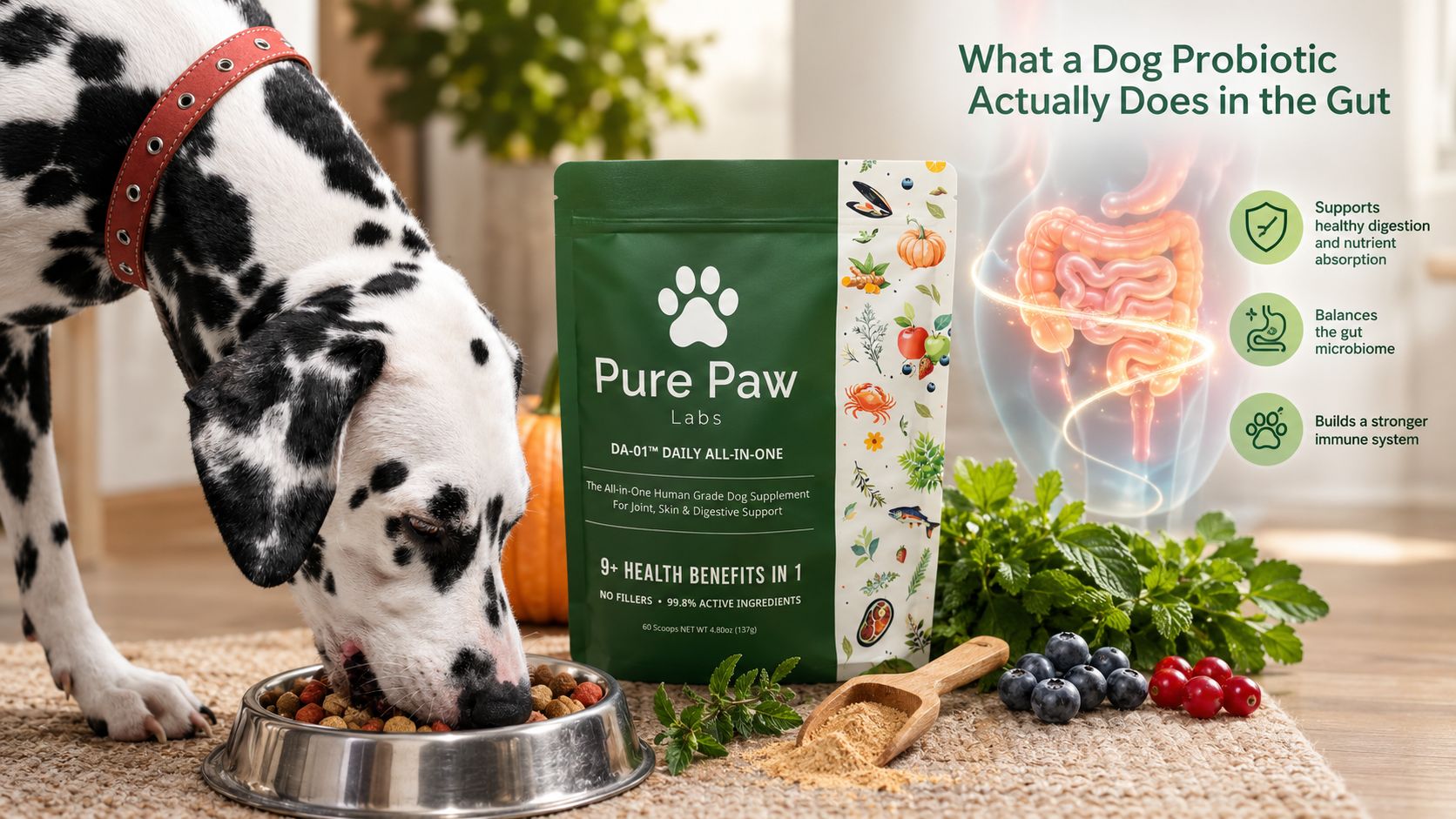
The clearest way to judge the category is by job, not label buzzwords. In dogs with acute diarrhea, a canine-specific probiotic blend containing Lactobacillus fermentum VET 9A, L. rhamnosus VET 16A, and L. plantarum VET 14A normalized stool consistency and improved appetite and well-being, while also lowering fecal counts of Clostridium perfringens and Enterococcus faecium (study). Those findings set the frame for how these products should be judged.
Another controlled trial found that dogs with acute self-limiting gastroenteritis reached the last abnormal stool sooner with probiotics than with placebo, and the mean recovery times were 1.3 days versus 2.2 days (trial). That trial reported a practical difference, not a vague wellness promise.
Common canine probiotic strains and their studied effects
| Strain | Studied Effect in Dogs |
|---|---|
| Lactobacillus rhamnosus | Studied for acute GI support and stress-related gut disruption |
| Bifidobacterium animalis | Studied for stool quality and fecal consistency |
| Enterococcus faecium SF68 | Studied for stress-related digestive disruption |
| Bacillus coagulans | Studied as a spore-based option with resilience through digestion |
| Canine-specific Lactobacillus blend | Studied for diarrhea recovery, appetite, and fecal bacterial shifts |
The pattern is straightforward. Loose stool calls for a strain tied to stool outcomes. A diet change calls for evidence on gut stability during transition. Stress calls for controlled canine work linked to stress-related digestive disruption, not just a calming label.
For owners who prefer fewer separate products, Pure Paw Labs explains when dogs can have probiotics, and that context matters when a dog needs one routine instead of several bottles. A multi-system formula belongs in the conversation when simplicity is the goal, not when you are trying to address a single acute GI problem.
The most useful label clue is whether the probiotic's biological job matches your dog's symptom. Once you read it that way, the garden comparison becomes practical, not decorative.
How to Read a Dog Probiotic Label Like a Decision Framework
A good label should answer six questions without making you hunt through marketing copy. If it doesn't, you're probably looking at a product built to sell, not to guide a decision. The best dog probiotics separate from the rest.
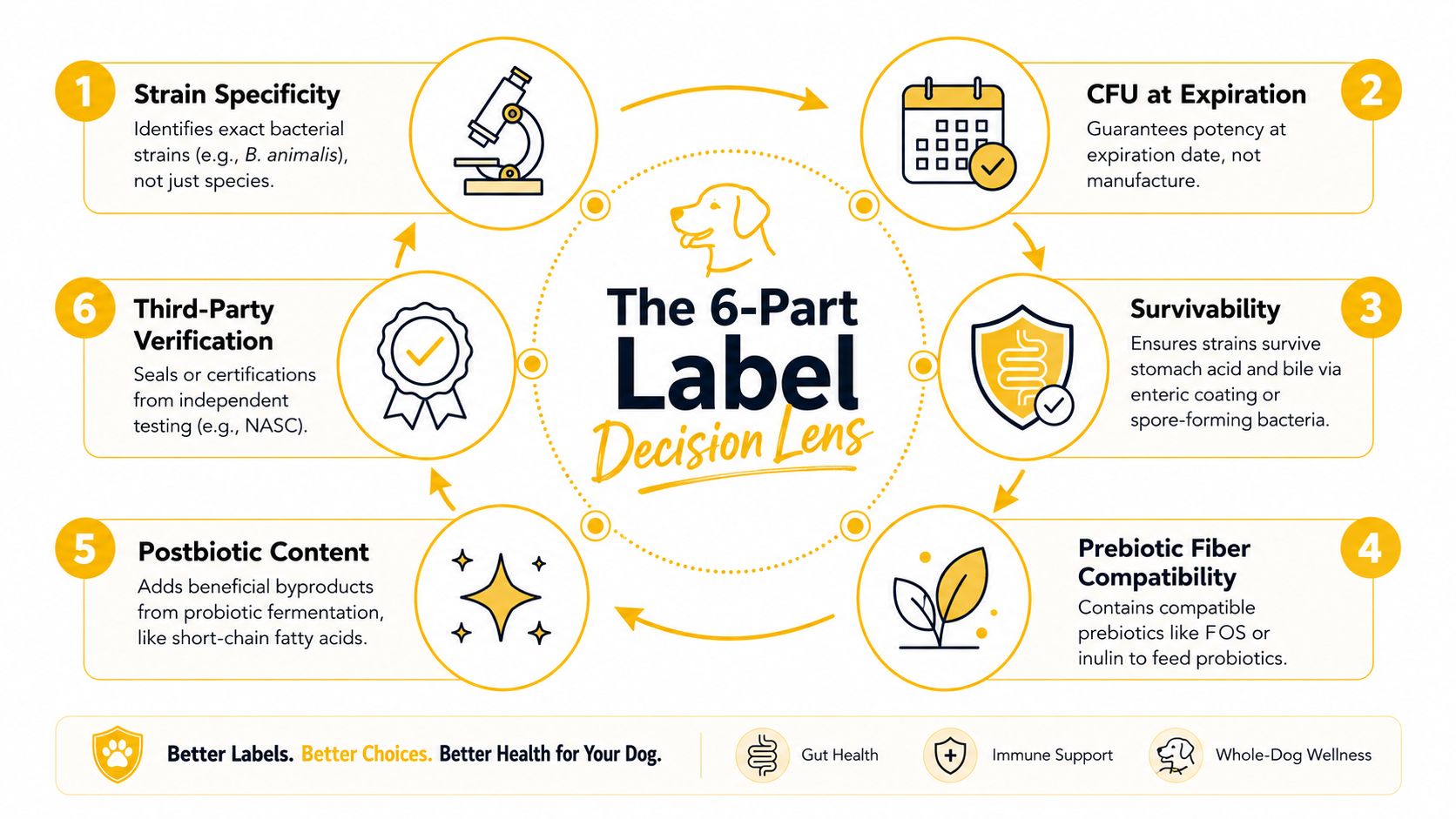
The six-part label decision lens
- Strain specificity. Look for the full genus, species, and strain, not just “Lactobacillus blend.”
- CFU at expiration. Potency should be guaranteed through the end of shelf life, not only when the product leaves the factory.
- Survivability. Ask how the strain gets past stomach acid and bile, especially if it isn't a spore-former.
- Prebiotic compatibility. Ingredients like fiber or prebiotics can help support the microbes, but they should fit the dog's stomach.
- Postbiotic content. Some formulas add the byproducts of fermentation, which can be part of the support strategy.
- Third-party verification. Independent testing gives you more confidence that the label matches the jar.
A product can boast a huge CFU number and still underperform if the strain dies before it reaches the gut.
Why multi-strain isn't always better
Multi-strain formulas can be helpful, but they also dilute the evidence story. If five organisms are listed and only one has meaningful canine data for your dog's problem, you're partly buying uncertainty. That doesn't make blends bad. It just means the label should be judged by the strongest strain in the mix, the purpose it was studied for, and whether the remaining ingredients support or cloud that goal.
Form matters too. Powders are easy to mix into food. Chews are easier for picky dogs. Capsules can be precise, but some dogs spit them out, and some formulas won't survive as well without a protective design. The right format is the one your dog will take consistently, because a perfect probiotic that sits in the cupboard helps no one.
The simplest scoring method is this. Rank the product high if it names the exact strain, explains the use case clearly, and proves viability through expiration. Rank it lower if it leans on CFU hype, vague blends, or glossy claims with no clear path from label to outcome.
Matching the Right Probiotic to Your Dog's Situation
A young Labrador with loose stool during a diet change is a good test case because the problem sounds simple but the buying decision isn't. The owner may want the highest cell count on the shelf, but the smarter move is to match the formula to the situation and confirm that the label names the strain all the way down to the strain code.
For diet transition, I'd look first for a product that explains how it supports stability during change, not just “digestive health.” For acute diarrhea, I'd want a strain with controlled canine evidence tied to stool recovery. For stress-related upset, I'd want a strain with a behavior or stress-linked canine trial behind it, not a generic mood claim. That's the difference between buying by label language and buying by biological fit.
Situation to label match
| Situation | Studied Strains | What to Look For on Label |
|---|---|---|
| Acute diarrhea | Canine-specific Lactobacillus blend, L. rhamnosus | Exact strain names, stool-support wording, viability through expiration |
| Sensitive stomach | Bifidobacterium and selected Lactobacillus strains | Clear GI indication, simple formula, no vague “gut blend” |
| Stress or separation changes | Enterococcus faecium SF68, novel Lactiplantibacillus plantarum strain | Stress-specific wording and a controlled canine study if available |
| Diet transition | Saccharomyces cerevisiae in recent canine work | Evidence for transition support, not just general digestive comfort |
| Puppy routines | Gentle, food-matrix delivery | Easy mixing, simple dosing, no unnecessary extras |
A useful outside reference for owners comparing stomach-sensitive options is this guide on probiotics for dogs with sensitive stomachs, because it reinforces the same principle, symptoms should drive the strain choice. That matters more than trying to make one bottle do everything.
The cleanest habit is to read the Supplement Facts panel like a diagnostic note. Look for the genus-species-strain triple, check the CFU guarantee through expiration, and decide whether the product is built for your dog's current problem or for a different one. Once you do that, the shelf gets much less confusing.
Dosing and Safety Across Life Stages and Conditions
Dosing gets messy when people try to force one rule onto every dog. Puppies, seniors, dogs on antibiotics, and dogs with immune problems don't all need the same approach, and some shouldn't start without a vet's input. The label may look simple, but the decision depends on timing, tolerance, and the dog's health status.
A practical safety rhythm
- Start low. Give half the intended amount for 3 to 5 days if your dog has a sensitive stomach.
- Separate from antibiotics. When possible, give probiotics 2 hours apart from antibiotics so the medication doesn't immediately neutralize the microbes.
- Watch the stool. If stool worsens or appetite drops, stop and reassess.
- Keep human products off the menu. Human probiotics with xylitol or chocolate flavorings are unsafe for dogs.
- Get vet clearance first for diabetic dogs, immunocompromised pets, and dogs on critical medications.
Puppies usually do better with a gentler start and a food-matrix delivery, like a powder mixed into a meal or a chew they'll eat. Seniors can be trickier because motility slows down and the gut may be less forgiving, so the formula needs to be easy on the stomach and consistent in use. For a broader look at age-related care, the senior dog guide from Global Pet Sitter is a useful companion read because it shows how gut support fits into a wider routine for older dogs.
If your dog is vomiting, refusing food, or getting worse instead of steadier, don't keep experimenting with supplements.
The biggest mistake is assuming “natural” equals automatically safe. Probiotics are still active ingredients, and active ingredients can help, irritate, or do nothing depending on the dog. That's why the right dose is the one that fits the life stage, the reason for use, and the dog's tolerance, not the one with the flashiest label.
For more age-specific guidance, see probiotics for senior dogs, especially if you're trying to decide whether daily use makes sense or whether a short course is the better fit.
When an All-in-One Supplement Simplifies the Routine
A lot of households don't need more bottles. They need fewer decisions before breakfast. If you're already managing gut support, joint support, and skin care, the question becomes whether a consolidated formula can replace a scattered routine without making the dog's daily plan harder to follow.
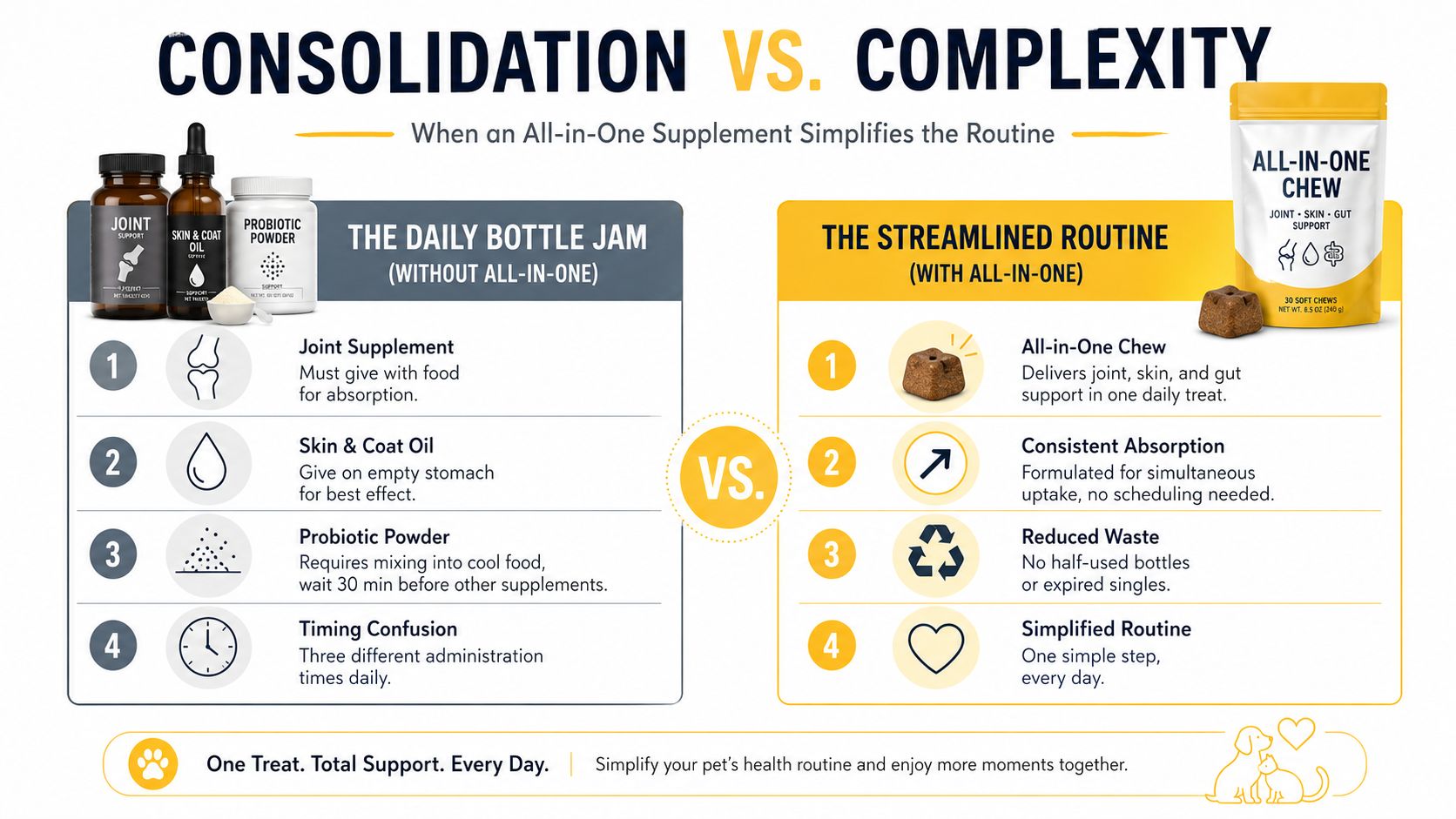
Where consolidation helps
- Fewer missed doses. One daily product is easier to remember than three bottles with different timing rules.
- Less storage clutter. A single powder or chew cuts down on half-used containers.
- Better compliance in multi-dog homes. When the routine is simple, it's easier to keep everyone on track.
- More practical maintenance. Dogs who don't need therapeutic-level dosing may do well with a broader daily formula.
The trade-off is real. A broad formula usually can't match the ingredient concentration of a targeted single-issue supplement, because it's spreading support across more jobs. That's fine if your goal is maintenance and convenience. It's not fine if your dog needs a narrow, clinically focused product for a specific digestive issue.
Convenience is valuable when it improves consistency, not when it hides a weaker formula.
If you're also sorting out calcium and other life-stage nutrients, a plain-language resource like calcium for dogs can help you avoid overstacking supplements that overlap. That overlap is where many owners get confused. They buy one product for the gut, another for joints, and a third for skin, then end up guessing which ingredient is doing what.
An all-in-one can make sense, especially for dogs who are stable, aging, or getting broad daily support rather than one-off treatment. The goal isn't to replace every specialized product. The goal is to decide whether the dog needs a precise tool or a simpler maintenance routine.
Red Flags, Vet Signals, and Smart Final Decisions
Some symptoms are not supplement problems. They're vet problems. If a dog has acute diarrhea lasting over 48 hours, blood in stool, vomiting with lethargy, sudden weight loss, or signs of dehydration in a puppy, stop label shopping and call the clinic. Probiotics can support recovery, but they're not a substitute for diagnosis when the picture turns urgent.
Label red flags to reject fast
- Proprietary blends. You can't judge the formula if the strain and dose are hidden.
- Vague strain names. “Lactobacillus blend” tells you almost nothing.
- No expiration guarantee. Potency through shelf life matters more than a big number at manufacture.
- Artificial colors or unnecessary additives. They don't help the gut decision.
- No independent testing. If the product won't show verification, be cautious.
A good final check is simple. Match the strain to the symptom, confirm that the label explains survivability, verify storage needs and expiration, and avoid products that claim to treat disease. If your dog has chronic illness, takes important medication, or is immunocompromised, get veterinary sign-off before starting anything new.
Final rule: buy the probiotic that fits the dog's evidence-based need, your routine, and your vet's guidance.
That's the answer to best dog probiotics. The best choice isn't the loudest label or the cheapest jar. It's the one that makes sense for your dog's exact problem and can be used consistently without guesswork.
If you want a simpler way to support gut health alongside broader daily care, explore the science-first approach at Pure Paw Labs. Their daily all-in-one formula is built for owners who want fewer bottles, a clearer routine, and a practical way to think about gut, joint, and skin support in one place.