


You're standing in the pet aisle, or scrolling late at night, looking at bottles and tubs that all promise better joints, shinier coats, calmer stomachs, and more energy. Meanwhile, your dog is snoozing nearby, and you're wondering a very simple question that somehow feels hard to answer: does my dog even need a multivitamin?
That's where a lot of caring owners get stuck. Maybe your dog seems a little slower getting up. Maybe the coat looks duller than usual. Maybe you've started cooking meals at home and want to be sure you're not missing something important. It's easy to feel like “more nutrition” must be better, but supplements don't work that way. The best dog multivitamin isn't the one with the longest ingredient list. It's the one that fits your dog's actual diet, age, and health situation.
Table of Contents
- Is a Multivitamin Right for Your Dog?
- Understanding the Foundational Need for a Supplement
- Decoding the Label Key Ingredients and Their Purpose
- How to Evaluate a Multivitamin's Quality and Safety
- Common Signs Your Dog Might Benefit from a Supplement
- When an All-in-One Powder is the Best Choice
- Making the Best Choice for Your Companion
Is a Multivitamin Right for Your Dog?
A dog owner comes into the clinic and says, “He's still eating, still wagging, still acting mostly normal. He just seems a little off.” That's a common moment. The changes are often subtle at first. A dog hesitates before jumping into the car. A once-soft coat feels dry. Stools get inconsistent. The owner starts wondering whether nutrition is the missing piece.
Sometimes it is. Sometimes it isn't.
That's why I always tell people to pause before buying the first supplement that sounds impressive. A multivitamin can help in the right situation, but it can also be unnecessary, or even unhelpful, if it doesn't match what your dog needs. Dogs aren't all starting from the same place. A young adult eating a well-made complete diet is very different from a senior dog with a sensitive stomach, and both are different from a dog eating homemade meals.
Practical rule: Ask “Why this supplement?” before asking “Which supplement?”
A good decision usually comes down to three questions:
- What does your dog eat every day? The base diet matters more than the supplement label.
- What changes have you noticed? Skin, joints, digestion, energy, and appetite all give clues.
- Does your veterinarian know about it? That matters most if your dog has a medical condition, takes medication, or eats a homemade diet.
If you keep that framework in mind, shopping gets much easier. You stop chasing marketing claims and start looking for a product type that fits your dog's real situation. That's how you choose the best dog multivitamin with confidence, not guesswork.
Understanding the Foundational Need for a Supplement
A multivitamin makes sense only if it fills a real gap.
That is the part many dog owners miss, especially after noticing a dull coat or inconsistent stool and wondering whether a supplement might help. The better first question is simpler. Is your dog lacking something in the daily diet, or are you adding nutrients to food that is already doing its job?
Start with the bowl, not the bottle
For many healthy adult dogs eating a commercial food labeled complete and balanced, the food is already designed to provide the vitamins and minerals needed day to day. In that setting, adding a multivitamin may do little, and in some cases it can stack extra nutrients on top of an already adequate diet.
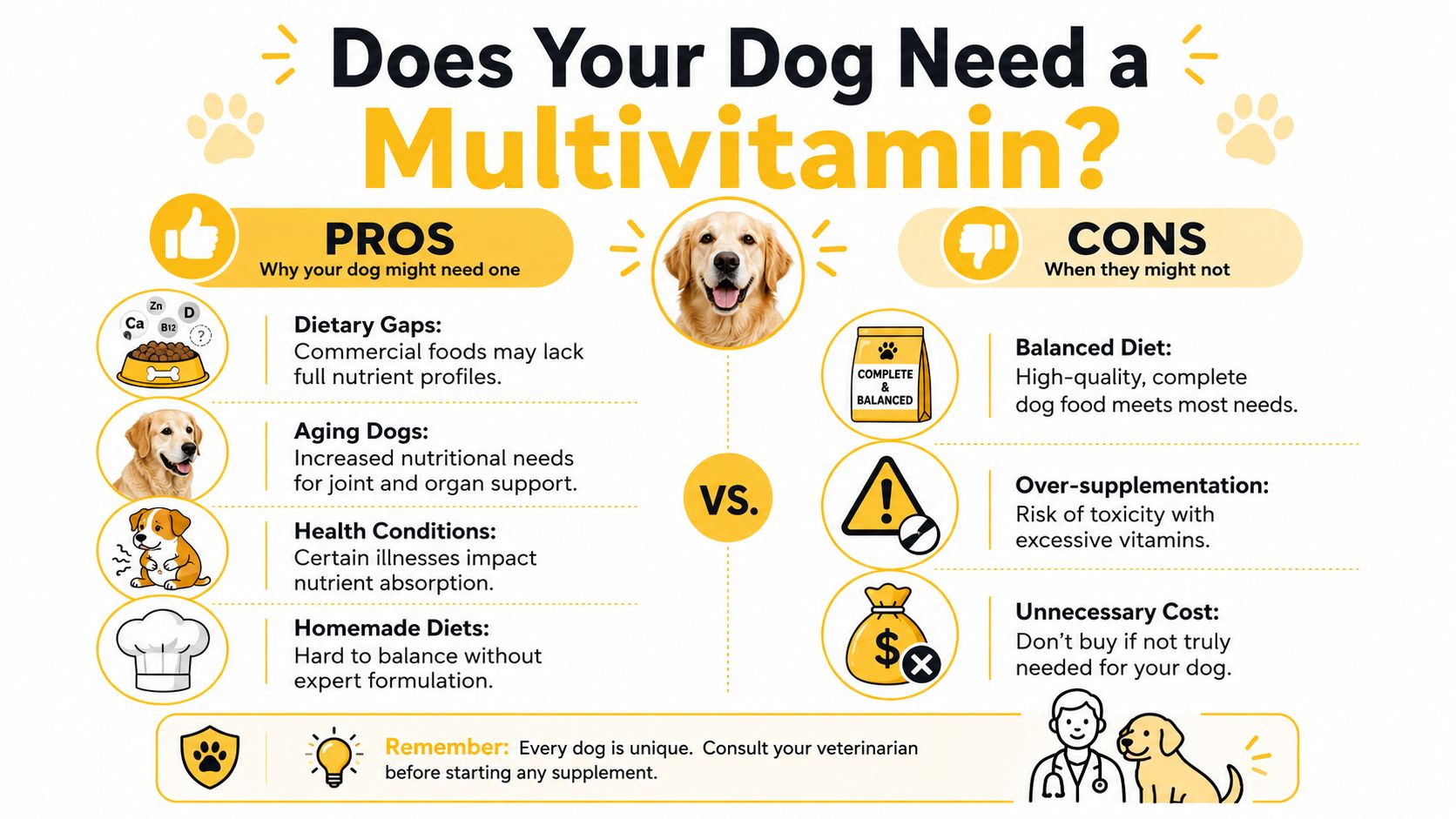
Homemade and raw diets are a different situation. A meal can look fresh, high-quality, and full of good ingredients while still falling short on trace minerals, certain vitamins, or fatty acids. The missing pieces are often the ones you cannot see. It works a bit like building a house with strong walls but leaving out wiring behind them. Everything may look fine on the surface, but the system is still incomplete.
That is why the base diet matters more than the supplement label.
Why homemade diets need closer attention
Homemade feeding can be done well, but it asks for precision. Protein is usually the easiest part to spot. Micronutrients are harder. Calcium balance, zinc, vitamin D, iodine, and other nutrients can be missed even in meals prepared with care.
Recipe differences matter too. A chicken-and-rice bowl, a raw blend, and a cooked beef-and-vegetable recipe do not create the same nutrient profile. One dog may need broad vitamin and mineral support. Another may need help in a narrower area, such as omega-3s for skin and coat. If that question is on your mind, this guide on whether dogs can have fish oil and when it helps gives useful context.
Human vitamins are not a safe shortcut. Dogs process nutrients differently, and some human products contain amounts or added ingredients that are not appropriate for them.
A simple framework helps:
| Feeding situation | Multivitamin need |
|---|---|
| Healthy adult dog on complete and balanced commercial food | Often unnecessary |
| Dog on homemade or raw meals | Usually needs targeted supplementation |
| Dog with a medical condition affecting absorption | Needs veterinary guidance before supplement use |
| Dog with vague wellness concerns but no diet review yet | Start by reviewing diet and history first |
If you prefer one product instead of managing several separate supplements, DA-1™ Daily All-in-One Complete Care is a once-daily food topper described by its maker as an all-in-one, human grade powder. That format may be useful for owners trying to support several areas at once, but the same rule still applies. The product should match the dog's diet and reason for use.
Decoding the Label Key Ingredients and Their Purpose
A multivitamin label can look impressive and still leave you wondering what any of it means. The easiest way to read one is to stop scanning for “more ingredients” and start matching ingredients to a purpose.
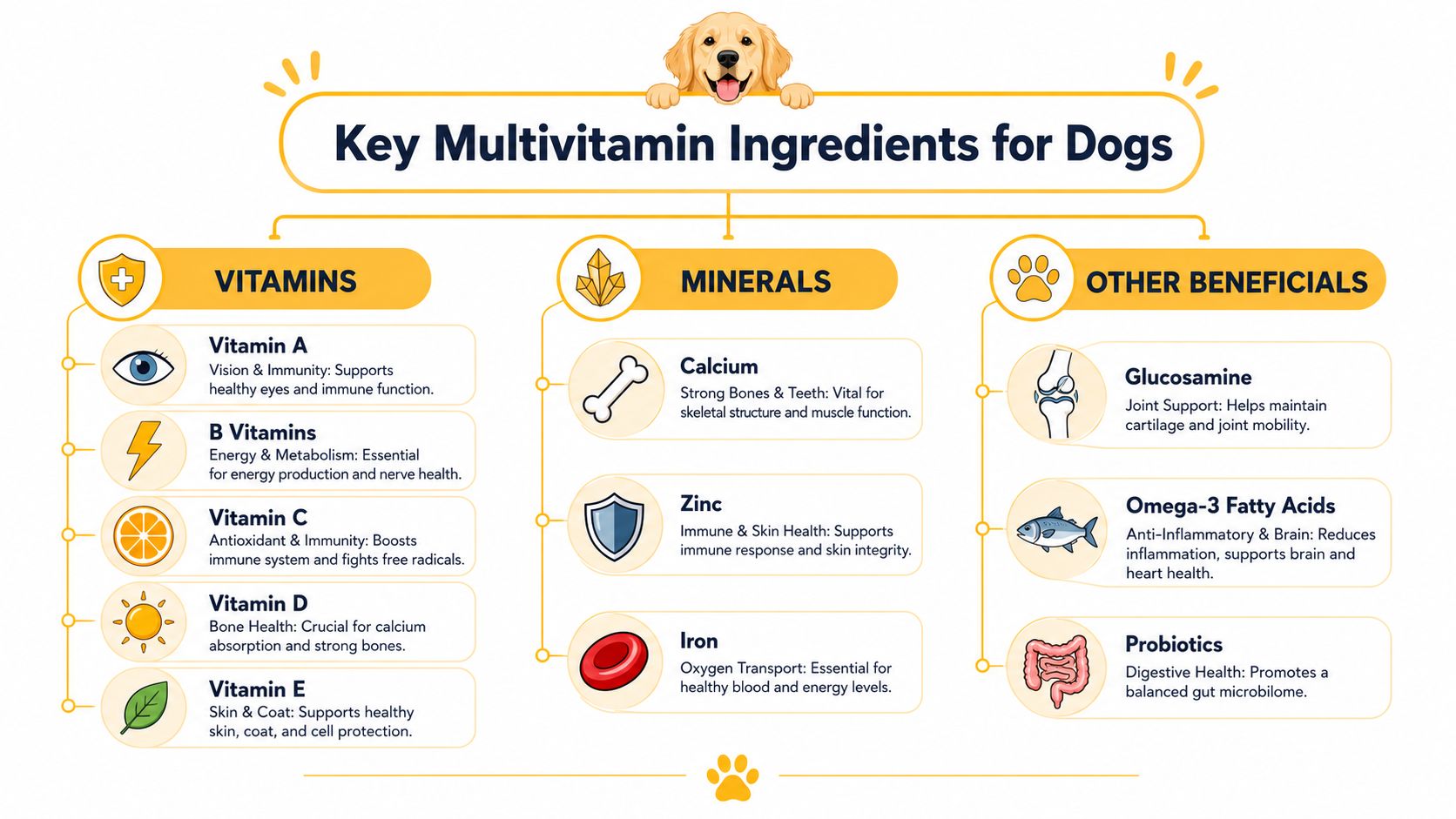
Vitamins and minerals
Think of vitamins and minerals as the background workers in the body. You usually don't “see” them, but they support the systems your dog relies on every day.
- Vitamin A helps support vision and immune function. It's important, but this is one reason more is not always better. Fat-soluble vitamins can build up if overused.
- B vitamins are commonly associated with energy metabolism and nerve support. If a label includes a B-complex, it's generally trying to support how the body uses food.
- Vitamin D supports calcium use and bone health.
- Vitamin E is often included for skin, coat, and cellular protection.
- Minerals like calcium, zinc, and iron support structure, skin integrity, and normal blood function.
A quick label-reading tip helps here. If your dog's concern is mainly skin and coat, you don't need to be dazzled by a huge mineral panel alone. You want ingredients that clearly line up with that concern.
Extras that support specific concerns
Many products go beyond basic vitamins and minerals. That's where labels become more useful for real-life problems.
- Omega-3 fatty acids are often chosen when a dog has dry skin, a rough coat, or needs broader support for inflammation, brain, or heart health. If you want a simple owner-friendly overview, this guide on whether dogs can have fish oil explains why this category gets so much attention.
- Glucosamine is usually included for dogs who are slower to rise, stiff after rest, or showing signs of age-related mobility changes.
- Probiotics are aimed at digestive wellness and gut balance. Owners often look for these when stools are inconsistent or the dog has a sensitive stomach.
What matters most: The ingredient should solve a problem you can name.
That means labels are easier to judge when you ask questions like these:
- Is my dog's issue mostly joints, skin, digestion, or a combination?
- Does this product contain ingredients that fit that issue?
- Is it trying to do one job well, or many jobs at once?
A useful label feels logical. If your dog is an older dog with stiffness and dull coat quality, a formula that combines joint support with skin-focused ingredients may make sense. If your dog is thriving but you cook meals at home, the priority may be basic nutrient completeness rather than a “wellness boost.”
Here's the part owners often miss. A “multivitamin” isn't always just vitamins. It may also function as a joint, skin, or gut support formula. That's not a problem, but it means you should read it as a tool with a purpose, not just a bottle of general goodness.
How to Evaluate a Multivitamin's Quality and Safety
Quality matters as much as ingredients. A long label doesn't help if the product isn't made carefully or if the dosing is sloppy.
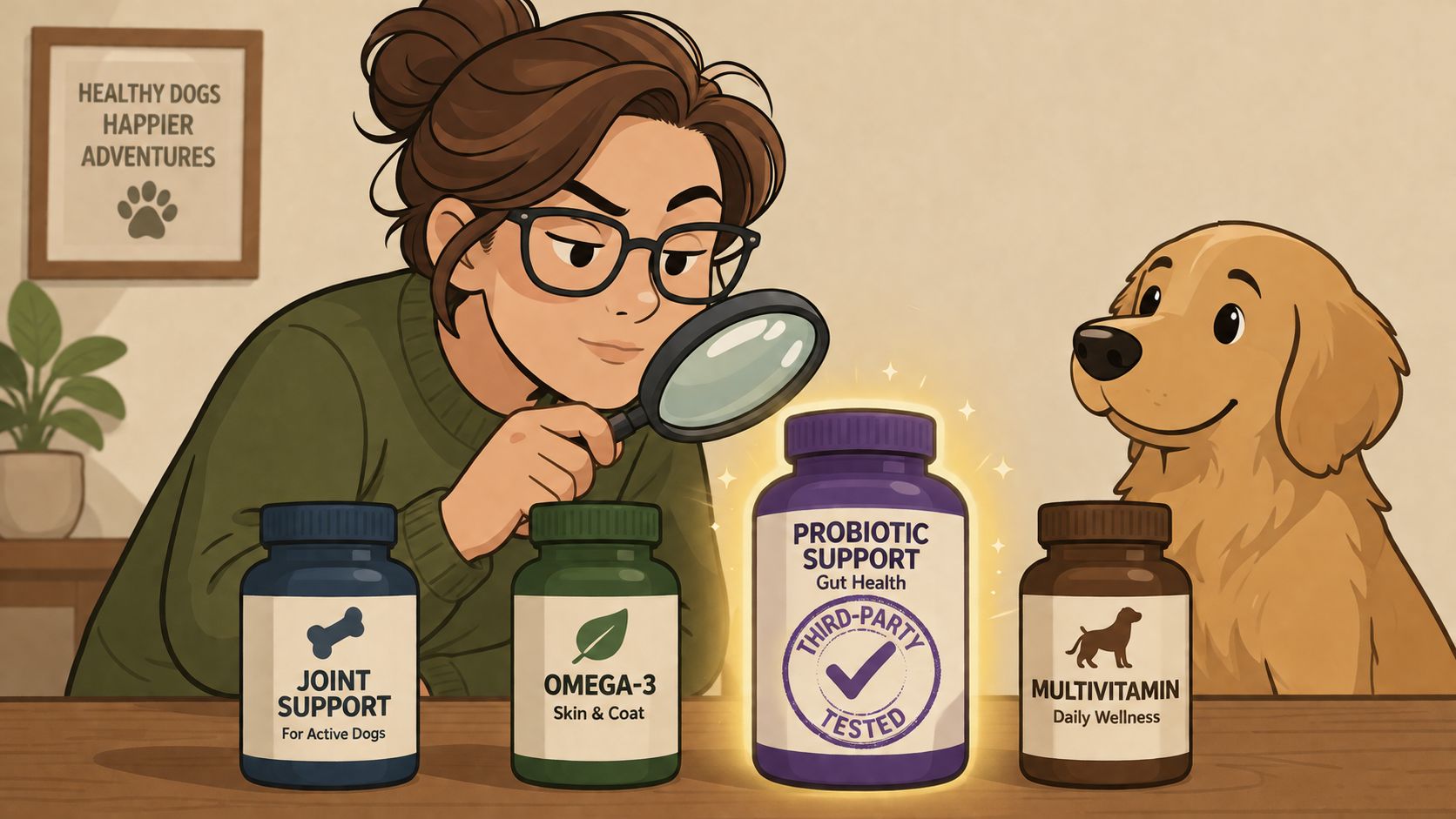
One of the clearest markers to look for is the NASC Quality Seal. The National Animal Supplement Council notes that this seal reflects rigorous quality control standards, which is especially important in situations where supplementation needs to be carefully matched and trusted.
A quick safety checklist
When I'm helping someone evaluate a product, I usually suggest a short checklist rather than a deep chemistry lesson.
- Look for the NASC Quality Seal. It's one of the easiest ways to identify a manufacturer that follows stronger quality control practices.
- Check whether the product is made for dogs. Human supplements are not interchangeable with canine supplements.
- Look for third-party testing language. This tells you the company is trying to verify what's in the product.
- Notice the form. Powders can be practical when owners need flexible mixing and easy daily use.
- Review the full ingredient panel. You're checking for purpose, not just quantity.
A good product should make dosing and intended use easy to understand. If the label feels vague, overstuffed, or confusing, that's a reason to slow down.
Here's a short walk-through on choosing pet supplements safely:
What to skip
Some products try to win you over with appearance instead of substance. Be careful with formulas that lean heavily on flashy language but don't clearly explain what the ingredients are doing.
If you can't tell why an ingredient is there, you can't tell whether it belongs in your dog's routine.
It also helps to avoid unnecessary extras such as artificial colors or filler-heavy formulas that don't add nutritional value. “Human-grade” can be a useful quality signal when it's backed by clear manufacturing information, but it still shouldn't replace veterinary guidance.
Safety becomes even more important if your dog has liver disease, kidney disease, digestive disease, or takes prescription medication. In those cases, even a thoughtful supplement choice should go through your veterinarian first.
Common Signs Your Dog Might Benefit from a Supplement
Dogs don't walk up and say, “My joints feel stiff,” or “I think my coat needs fatty acids.” They show you in quieter ways.
What you may notice at home
A few changes tend to send owners looking for the best dog multivitamin:
- Slower movement: Your dog gets up more carefully, pauses before stairs, or doesn't want to jump into the car.
- Skin and coat changes: More scratching, a rougher coat texture, flaky skin, or less shine than usual.
- Digestive ups and downs: Loose stool, gas, inconsistent poop, or a stomach that seems easily upset.
- General aging changes: Less enthusiasm on walks, more rest time, or a harder time bouncing back after activity.
None of those signs automatically mean “vitamin deficiency.” They can point to many things, including allergies, arthritis, dental pain, intestinal disease, or simple aging. But they do tell you where to focus your questions.
For example, a dog with flaky skin and a dull coat may need a closer look at skin-barrier support and dietary fat quality. If that's your concern, this guide on dog skin and coat support is a practical next read.
A dog with soft stool and noisy digestion may benefit from a gut-focused discussion with your vet. A dog who's stiff after naps may need a mobility workup, weight review, and maybe supportive ingredients, but first you need to rule out pain from injury or arthritis.
When to call your vet first
Some signs should push you toward a veterinary appointment before you add anything new:
| Sign | Better first step |
|---|---|
| Sudden lethargy | Veterinary exam |
| Ongoing vomiting or diarrhea | Veterinary exam |
| Noticeable weight loss | Veterinary exam |
| New limping or pain | Veterinary exam |
| Mild coat dullness with otherwise normal behavior | Diet and supplement review |
Mild wellness changes can justify a supplement conversation. Sudden or severe symptoms justify a medical visit.
Owners sometimes feel disappointed by that answer because they hoped the right powder or chew would fix everything. But the safest approach is also the most useful one. Identify whether you're looking at a nutrition gap, an age-related support need, or a health problem that needs diagnosis.
When an All-in-One Powder is the Best Choice
You open the cabinet at dinner and see three supplement tubs, each with its own scoop and directions. One says joints. One says skin. One says digestion. If that routine already feels hard to maintain, the problem may not be your intentions. It may be that your dog needs a simpler plan.
An all-in-one powder is often the better fit when the goal is broad daily support, not a highly targeted medical dose. It works a bit like organizing your dog's care into one daily checkpoint instead of several separate chores. For many owners, that makes the difference between a plan that sounds good and a plan that becomes a reality.
Who benefits most from a single scoop
A powder that covers several support areas can make sense in a few clear situations.
One is routine simplicity. If mornings are rushed or multiple caregivers feed the dog, one measured scoop on food is easier to use consistently than several separate products.
Another is overlapping age-related needs. Senior dogs often do not fit neatly into one category. You may notice mild stiffness, a duller coat, and a more sensitive stomach over the same few months. In that case, a broad-support formula can be more practical than building a stack of single-purpose supplements.
Homemade feeding is another common reason owners look at powders. Dogs eating homemade meals often need more than “general wellness” support. They may need help covering nutritional gaps created by the recipe itself. If that is your situation, this guide to homemade dog food supplement powder explains why powdered formats are often easier to use with home-prepared meals.
The trade-offs to think through
Convenience matters, but it is not the only question.
A broad formula may be the wrong tool if your dog needs one nutrient at a very specific dose, especially if your veterinarian is treating a medical condition or a veterinary nutrition professional has already built a precise diet plan. In that setting, a general multivitamin can be too broad and not specific enough.
The label still matters just as much with an all-in-one product. You want a formula that groups ingredients for a clear reason, such as joint support, skin barrier support, digestive support, or senior wellness support. A long ingredient list by itself does not mean the product is a better choice.
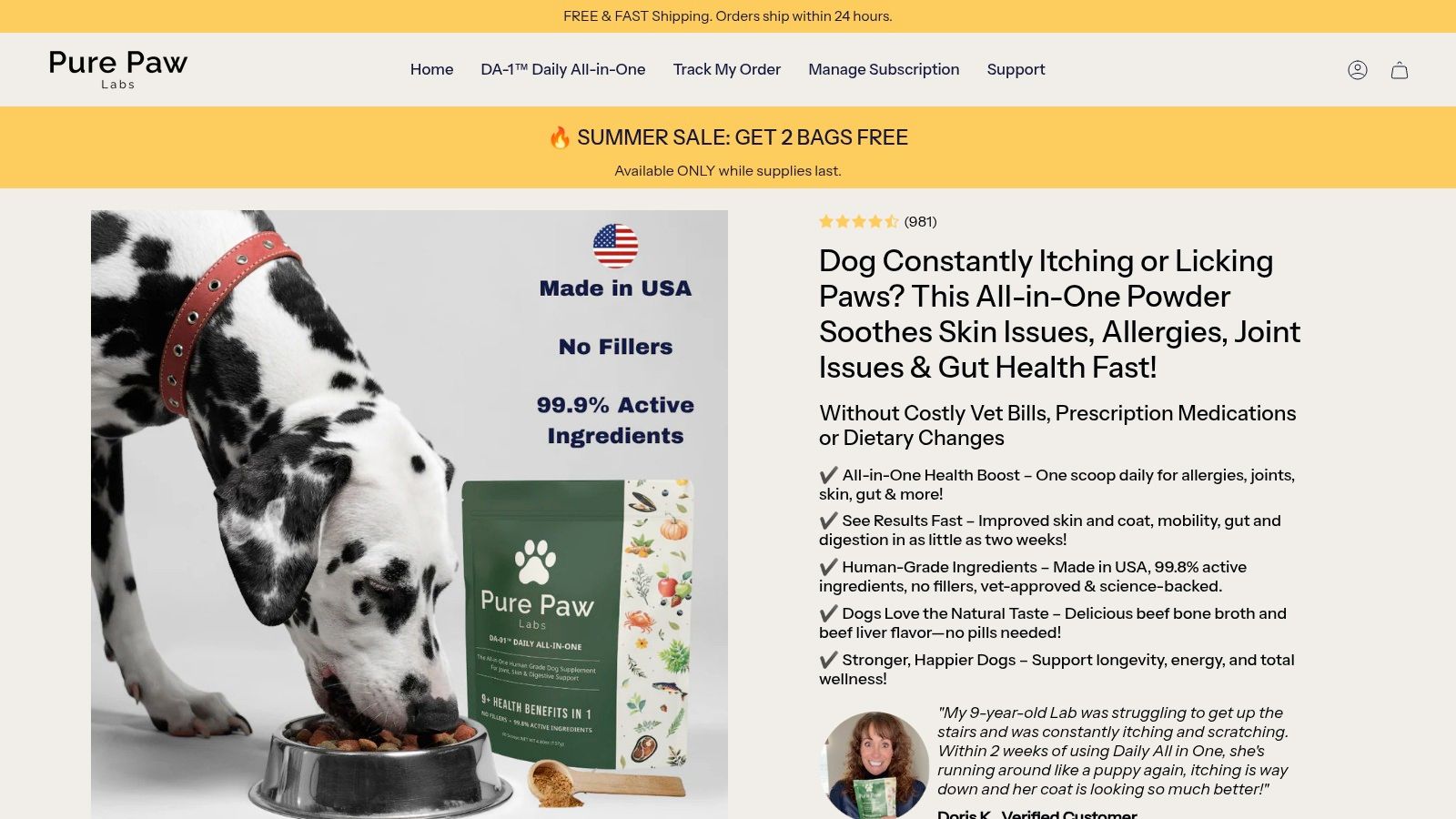
Pure Paw Labs offers DA-1™ Daily All-in-One - Senior Dog Support, Joints, Skin/Coat & More, described by the company as a single-scoop powder made with human-grade ingredients and designed to support joints, skin and coat, gut health, immune function, and stress-related wellness in older dogs.
That kind of formula is most helpful when your real challenge is not identifying one isolated issue. It is keeping up with several mild, everyday support needs in a way that stays realistic. If your dog needs broad support and you need a routine you can follow every day, an all-in-one powder can be a sensible option.
Making the Best Choice for Your Companion
By this point, the decision usually feels less confusing. The best dog multivitamin isn't about chasing the most popular product. It's about matching the supplement to the dog in front of you.
That usually means working through a short decision path:
- Look at the daily diet first. Commercial complete-and-balanced feeding and homemade feeding are not the same situation.
- Match the concern to the ingredient type. Joints, skin, digestion, and general aging support each point you in a different direction.
- Check quality markers. A dog-specific formula, clear labeling, and recognized quality standards matter.
- Choose a format you can use consistently. If multiple bottles are making life harder, a single broad-support powder may be easier to maintain.
The right supplement should make your dog's care plan clearer, not more complicated.
The most important next step is still a conversation with your veterinarian. That's especially true if your dog is on a homemade diet, has chronic health issues, takes medication, or has symptoms that are getting worse. Good supplements can be helpful tools. They work best when they're part of a thoughtful plan, not a guess.
If you want a simpler way to support multiple wellness areas with one daily routine, take a look at Pure Paw Labs. Their approach centers on human-grade dog supplements designed to make daily support easier for pet owners who don't want to juggle a complicated stack of products.