


You may be looking at your dog and noticing two problems that seem unrelated. Maybe the stools are inconsistent, gas comes and goes, and every small stressor seems to throw digestion off. At the same time, your dog just never seems as resilient as you'd expect. Minor upsets linger, recovery feels slow, and “immune support” products all start to sound the same.
That's where a lot of confusion starts.
For Align probiotic gut health & immunity support, people often assume one probiotic works much like any other probiotic. In practice, that's not how this biology works. The gut and immune system are connected, but probiotic effects are usually strain-specific, sometimes modest, and often much stronger for digestive goals than for broad immune promises.
For dogs, that distinction matters even more. A product designed around a human strain, a vague “blend,” or a trendy claim may not match what your dog's gut needs. The useful question isn't “Are probiotics good?” It's “Which microbial approach, for which goal, in which dog?”
Table of Contents
- The Hidden Connection Between Your Dog's Gut and Immune System
- How Probiotics Actually Work Inside Your Dog's Body
- Why Strain Specificity Matters More Than Brand Names
- Live Probiotics Versus Postbiotics What the Science Shows
- What the Evidence Says About Probiotics and Dog Immunity
- How to Choose a Dog-Safe Probiotic Product Wisely
- Building a Simple Daily Wellness Routine for Your Dog
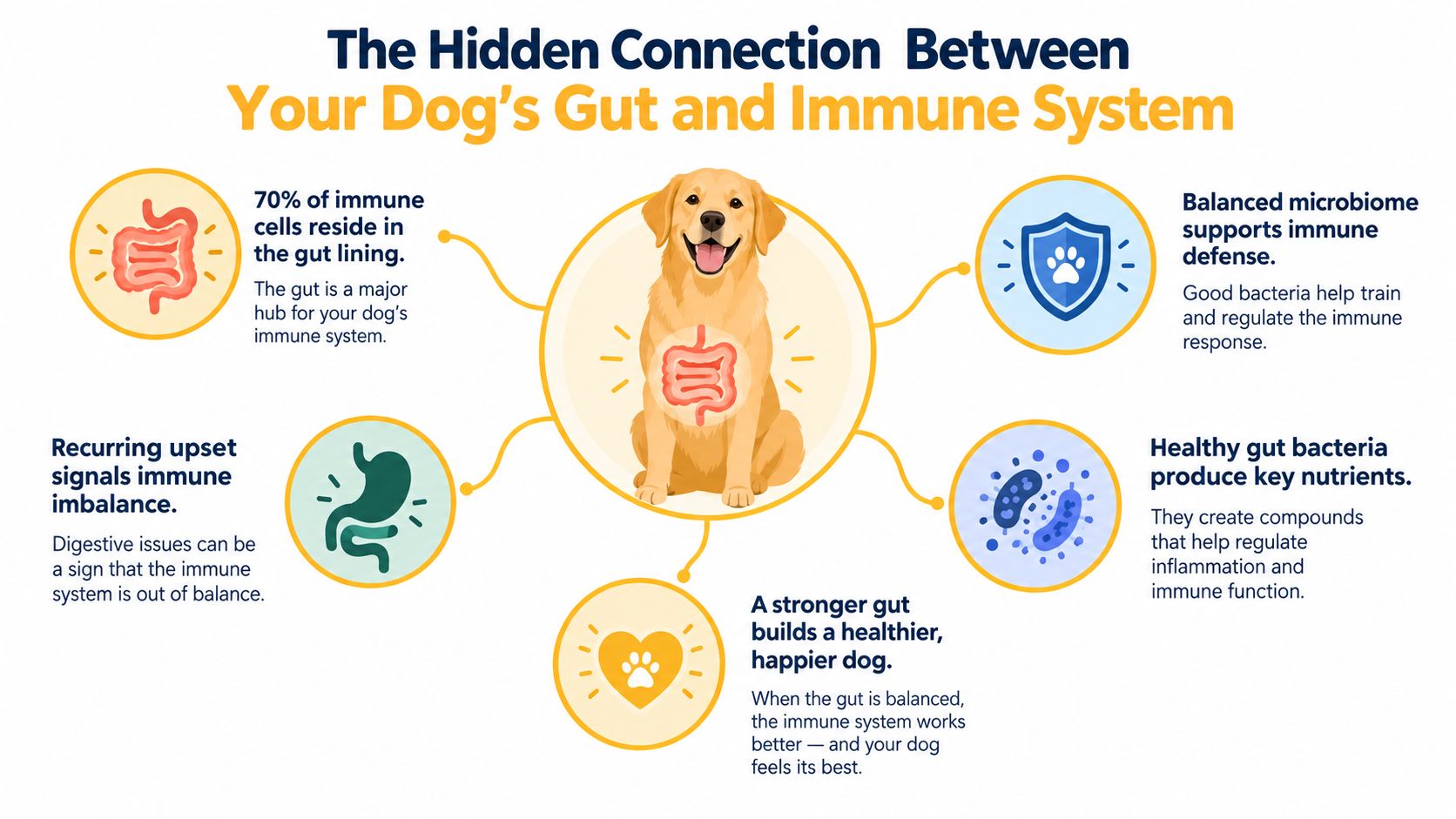
The Hidden Connection Between Your Dog's Gut and Immune System
A common story in practice goes like this. A dog has soft stools on and off for months. Nothing dramatic, just enough that the owner keeps changing treats, adding toppers, and wondering whether stress is part of it. Then they also mention that the dog seems to get run down easily or never quite bounces back after routine digestive trouble.
Those details often belong in the same conversation.
The gut isn't just a food-processing tube. It's more like a busy border checkpoint. Food particles, water, helpful microbes, and waste all move through the same system, and the body has to decide what gets allowed through the gut lining and what gets stopped. When that barrier is working well, it helps the immune system stay calm and selective. When it's irritated or imbalanced, the immune system gets more “noise” to react to.
Why the gut matters beyond digestion
Inside the intestines, the lining acts as both a filter and a communication surface. Gut microbes interact with that lining all day. Some help maintain order. Others create more irritation when the ecosystem shifts out of balance.
That's why digestive signs can spill into whole-body effects. A dog with an unsettled gut may not only show stool changes. You may also see a lower tolerance for diet changes, stress, or routine disruptions.
For a more complete overview of canine digestive balance, Pure Paw Labs has a useful guide on dog gut health.
What owners often miss
Many owners separate “digestion support” from “immune support” because the labels do. Biology doesn't draw that line so neatly. The intestinal lining is one of the main places where the body learns what is safe, what is irritating, and how strongly to respond.
A calmer gut can mean more than better stools. It can mean less immune overreaction to everyday gut traffic.
That doesn't mean every digestive supplement will improve immunity in a meaningful way. It does mean the gut is a reasonable place to focus when a dog seems broadly sensitive.
How Probiotics Actually Work Inside Your Dog's Body
Probiotics don't work like antibiotics. They don't go in and “wipe out the bad guys.” A better way to think about them is as coaches for the gut environment. If the strain is appropriate, it can influence the lining, the local microbes, and the immune signals passing through that tissue.
They help reinforce the gut barrier
One of the clearest biological pathways involves the intestinal barrier itself. A 2023 systematic review and meta-analysis of 26 randomized controlled trials involving 1,891 participants found that probiotics improved intestinal barrier function, including a mean increase in transepithelial resistance of 5.27 and reductions in serum zonulin, endotoxin, and lipopolysaccharide markers compared with controls, according to this Frontiers in Immunology review.
In plain language, that means some probiotics appear to help the gut lining become less leaky and less inflammatory. That matters because the more unnecessary material crosses from the gut into circulation, the more work the immune system has to do.
They shape immune signaling
The second job is communication. Gut microbes and gut-associated immune cells are in constant contact. Certain probiotics seem to nudge that conversation away from excessive inflammatory signaling and toward better immune balance.
That's why strain choice matters so much. Different strains produce different metabolites, interact with the gut lining differently, and may affect inflammation in different ways. Two labels may both say “probiotic,” yet behave very differently in the body.
Practical rule: Don't expect a probiotic to “boost immunity” in a generic way. A better expectation is that the right strain may support gut barrier integrity and help regulate local immune responses.
For owners trying to keep routines simple, products that combine gut support with other aging-dog needs can make adherence easier. For example, DA-1™ Daily All-in-One - Senior Dog Support, Joints, Skin/Coat & More is described as a complete multi-system formula with 18 human-grade ingredients targeting cells, gut, and joints in a single daily scoop. That kind of format doesn't prove probiotic efficacy by itself, but it does address a real problem many owners face, which is inconsistent use of multiple separate products.
What this means in real life
If your dog's gut is irritated, the target isn't just comfort. The target is a more stable environment where the intestinal wall, resident microbes, and immune cells can communicate with less friction.
That's a more useful framework than vague wellness language. It also sets up the next key point. Not all probiotics can do the same job.
Why Strain Specificity Matters More Than Brand Names
The word “probiotic” is broad. Too broad. It groups together organisms that may share a category but not a clinical effect.
A good example comes from the human strain most associated with Align, Bifidobacterium longum subsp. infantis 35624. An eight-week randomized, double-blind, placebo-controlled trial found that daily encapsulated 35624 in IBS subjects was associated with measurable fecal recovery of the organism and was designed around symptom and host-response endpoints, as discussed in this review of 35624.
The label needs more than a species name
That finding matters because it wasn't evidence for “all bifidobacteria.” It was evidence tied to one specific strain under a specific use case. A label that says only Bifidobacterium or only Lactobacillus leaves out the detail that often matters most.
Here's the practical difference:
- Species is the family name. It tells you the general group.
- Strain is the individual identity. It tells you which exact microbe was studied.
- Indication is the target problem. It tells you what outcome the evidence applies to.
A strain can be useful for IBS-related symptoms in people and still not be the right choice for broad immune claims. It can also be poorly matched to dogs if the data come from human digestive conditions rather than canine use.
Human strains are not automatically dog strains
Owners get tripped up by marketing. If a human probiotic has a recognizable brand and some digestive research behind it, people often assume it transfers neatly to pets. That leap isn't justified.
Dogs have their own gut ecology. A human-derived strain may pass through, interact briefly, or have limited relevance in the canine intestine. Sometimes that still may be useful. Sometimes it won't be.
A separate summary of the 35624 literature notes that the strain has been linked to shifts in inflammatory signaling, including normalization of the IL-10/IL-12 cytokine ratio in IBS patients, which supports a gut-level immune modulation story, but also emphasizes that broader immune claims remain limited and inconsistent in healthy adults, according to this strain summary.
So when you see Align probiotic gut health & immunity support, the most responsible interpretation is this: a probiotic's value depends less on the brand umbrella and more on the exact strain, the target outcome, and whether that evidence fits dogs at all.
Live Probiotics Versus Postbiotics What the Science Shows
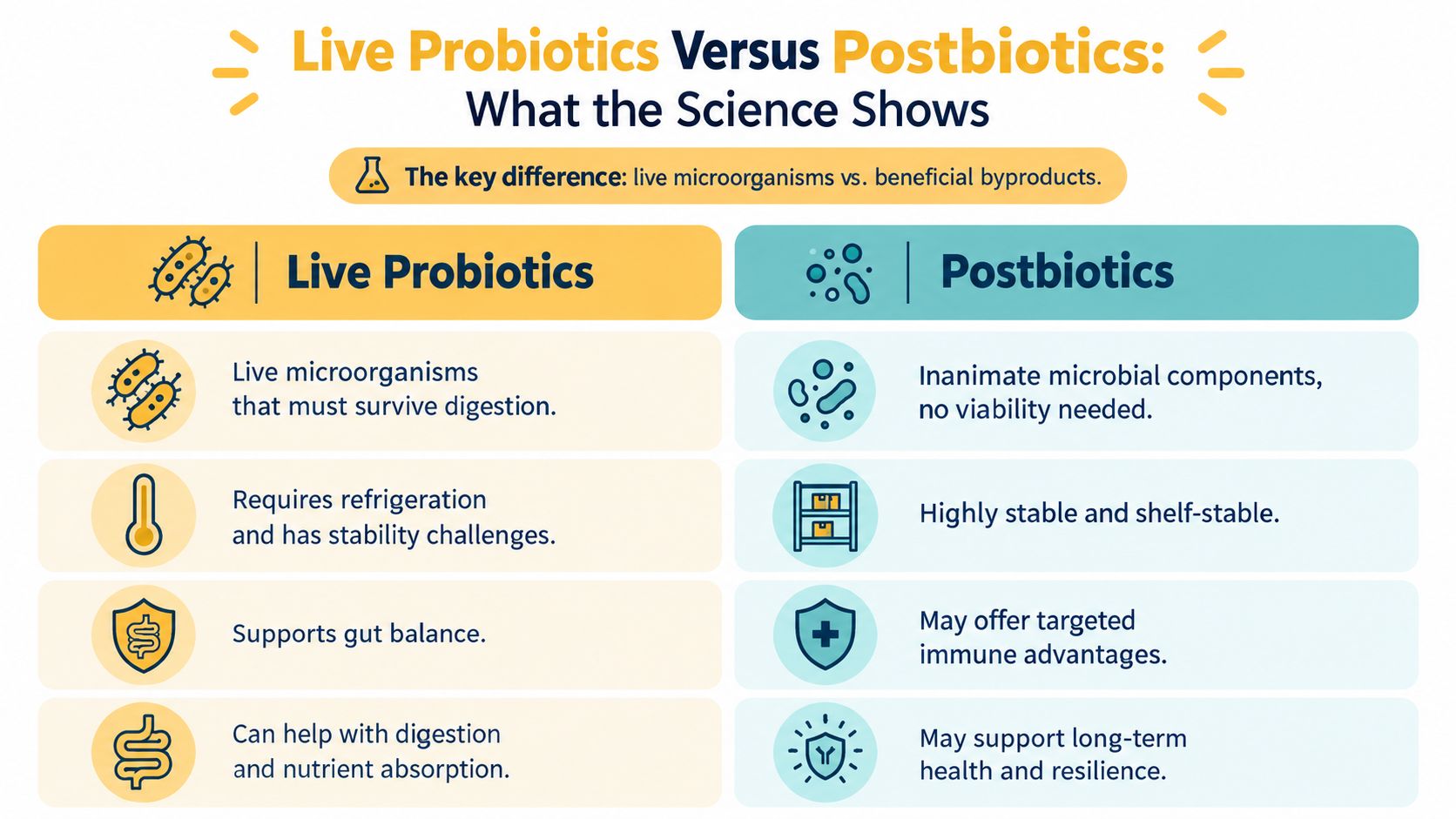
Live probiotics get most of the attention, but they're not the only microbial tool worth understanding. Postbiotics are non-living microbial preparations or components. Instead of relying on a live organism to survive storage, digestion, and competition in the gut, postbiotics deliver microbial parts or byproducts directly.
How the two approaches differ
| Approach | Main idea | Potential advantage | Main limitation |
|---|---|---|---|
| Live probiotics | Deliver living microorganisms | May help shape the gut ecosystem directly | Effects depend heavily on strain survival and fit |
| Postbiotics | Deliver inanimate microbial components or metabolites | Greater stability and a cleaner mechanistic target | Real-world canine outcomes are still being clarified |
A 2024 Veterinary Record review described postbiotics as inanimate microbial preparations or components that may enhance epithelial barrier function and modulate local and systemic immune responses. The same source also notes that a 2025 canine systematic review found no statistically significant differences versus controls in pooled postbiotic outcomes, while a 2026 puppy study reported higher vaccine-specific antibody titers, lower GI infections, and improved inflammatory markers with specific probiotic strains. That summary appears in this review on biotics in dogs and cats.
That's a nuanced picture, which is the honest one.
Here's a helpful visual explanation before the practical takeaway:
When each may make sense
Some owners want the traditional live-probiotic route. Others care more about stability, storage simplicity, or a formulation aimed at barrier and immune signaling rather than colonization.
If you want a deeper primer on this category, Pure Paw Labs has a useful article on postbiotics for dogs.
The newer question isn't whether live microbes are “better.” It's whether the format matches the health goal.
For a puppy with a specific immune-development question, one strategy may fit. For an adult dog with chronic loose stool, another may fit better. Product format should follow the problem, not the trend.
What the Evidence Says About Probiotics and Dog Immunity
The fairest summary is simple. Digestive benefits have the stronger track record. Immune claims are more mixed.
That doesn't mean immune effects are imaginary. It means you should read them with a narrower lens.
What broader probiotic evidence suggests
In humans, a large systematic review and meta-analysis summarized 42 randomized placebo-controlled trials in adults ages 18 to 65, with about 9,000 participants total, and found that orally ingested probiotics taken for at least one week were associated with a modestly lower risk of at least one respiratory tract infection versus placebo. The same review also reported small reductions in infection duration and severity, while noting that effect sizes were small and the optimal strain, dose, and duration remain unsettled, according to this review on probiotics and immune health.
That's encouraging, but it's not a blank check to treat every probiotic as a proven immune supplement for dogs.
How to read dog immunity claims more carefully
A useful rule is to separate measurable biological activity from proven real-world benefit. A product may influence inflammation or barrier markers without yet having strong evidence for fewer illnesses, better resilience, or consistent outcomes across dogs.
An independent guide focused on canine use notes that evidence is most consistent for digestive uses, while immune, skin, and behavioral effects remain promising but mixed. It also points out that strain-specific effects and real-world benefits in dogs are still not well evaluated across conditions, as summarized in this guide on probiotics for dogs.
Use that distinction when reading labels:
- More grounded claims usually focus on stool quality, digestive balance, or support for gut health.
- More speculative claims use broad language about immunity without saying which strain was studied, in what species, and for which endpoint.
- Best-case products tell you the exact organism, the intended use, and how quality is verified.
If a product says it supports immunity, ask one more question: Support how, exactly? Through barrier function? Through inflammatory signaling? In dogs, or only in people?
How to Choose a Dog-Safe Probiotic Product Wisely
The safest way to shop is to ignore the front-label hype at first. Turn the container around and look for evidence that someone built the formula for a real canine use case, not just for a trending keyword.
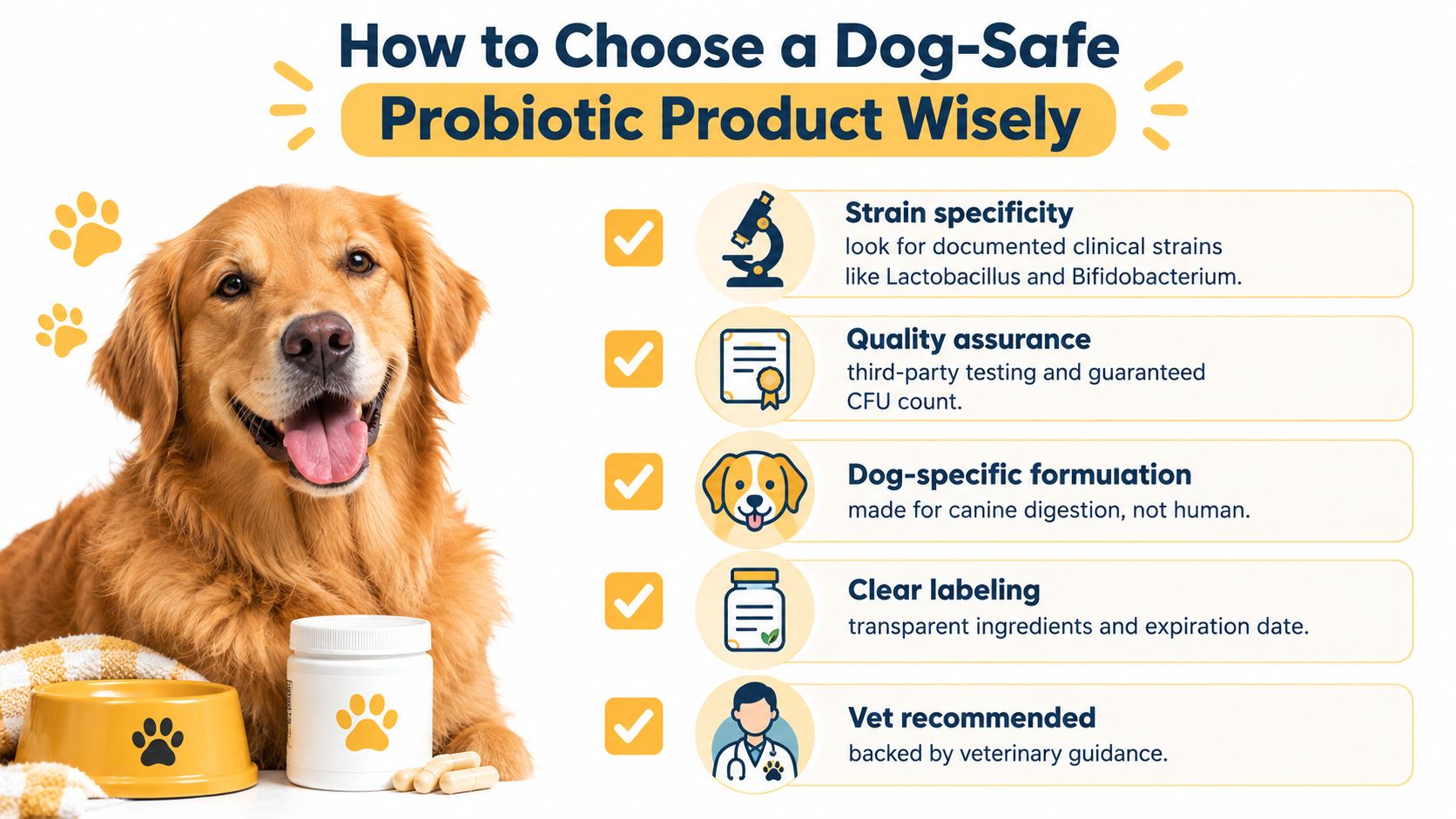
What to look for on the label
- Exact strain naming: Look for more than a genus or species. A clinically meaningful probiotic should identify the strain when possible.
- Dog-appropriate design: A canine product should be formulated with dogs in mind, rather than assuming a human digestive product translates directly.
- Quality verification: Third-party testing, clear manufacturing standards, and transparent ingredient lists matter because microbes are sensitive ingredients.
- Simple daily use: The best supplement is the one owners can give consistently.
For owners comparing options, Pure Paw Labs also has a practical overview of what to look for in a probiotic supplement for dogs.
Red flags that deserve skepticism
Some products sound impressive but tell you very little. Be cautious when you see:
- Vague blend language: If the label lists only “proprietary probiotic blend,” you can't judge strain relevance.
- Category claims without context: “Supports immunity” means very little without a mechanism or target outcome.
- Overcomplicated routines: If your dog needs separate powders, chews, capsules, and toppers, consistency usually falls apart.
Choose the product your household will use every day, not the one with the flashiest promise.
Why routine simplicity matters
Many dogs don't need a giant supplement stack. They need a reasonable daily plan that owners can maintain for weeks without forgetting doses or mixing too many products into meals.
That's one reason all-in-one routines appeal to busy households. If a formula combines gut support with other wellness priorities in a way that fits your dog, it may reduce missed doses and make monitoring easier. Simpler routines also make it easier to notice whether the dog is improving.
Building a Simple Daily Wellness Routine for Your Dog
A good wellness routine doesn't need to be elaborate. In most dogs, consistency beats complexity.
Start with the basics. Feed a stable, appropriate diet. Keep treats predictable. Give any gut-support product long enough to judge fairly, and avoid changing five things at once. If you're adding fiber-rich foods during recovery from loose stool, a guide on safe sweet potato portions for dogs can help you avoid turning a helpful idea into too much of a good thing.
A practical daily pattern
A simple plan often looks like this:
- Use one main daily support product rather than rotating multiple gut products with overlapping roles.
- Track stool, appetite, and energy in plain notes for several weeks.
- Hold the diet steady while you evaluate the supplement.
- Call your veterinarian if your dog has persistent vomiting, weight loss, blood in stool, or a big drop in appetite.
Some dogs show changes fairly quickly. Others need a longer runway, especially if the issue is chronic or tied to stress, diet inconsistency, or age-related changes.
What to remember most
The biggest takeaway from the Align probiotic gut health and immunity support conversation is that microbial products are not interchangeable. Live probiotics, postbiotics, and specific strains all have different strengths. The evidence is usually clearest for digestive support, while immune support deserves a more careful reading.
That's good news. It means you can make calmer, smarter decisions. Look for fit, not hype.
Pure Paw Labs offers science-backed, human-grade dog supplements built to simplify daily care, including routines that support gut health alongside other common needs like joints, skin, coat, and stress. If you want a more straightforward way to build a consistent daily wellness plan for your dog, visit Pure Paw Labs.